


The eternal promise:
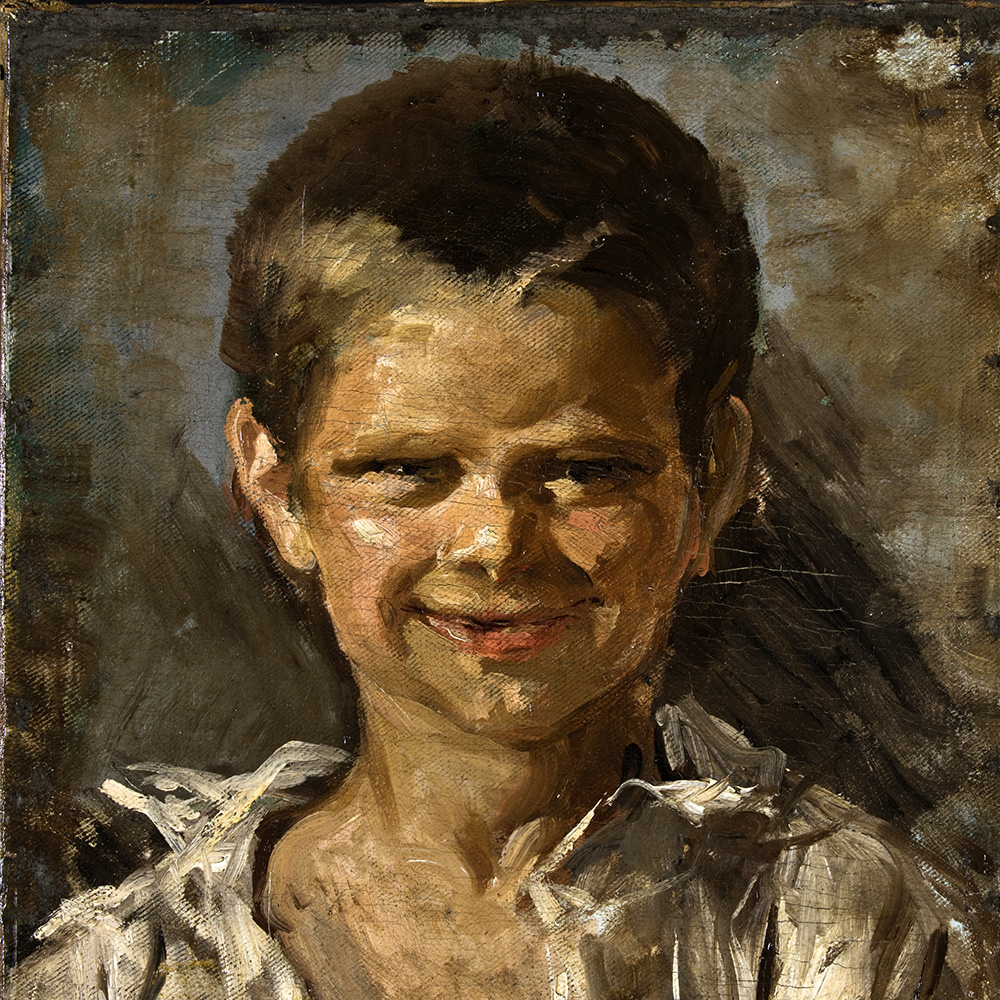
Boy of Portici. Marià Fortuny. Museu de Reus
Boy of Portici. Marià Fortuny. Museu de Reus
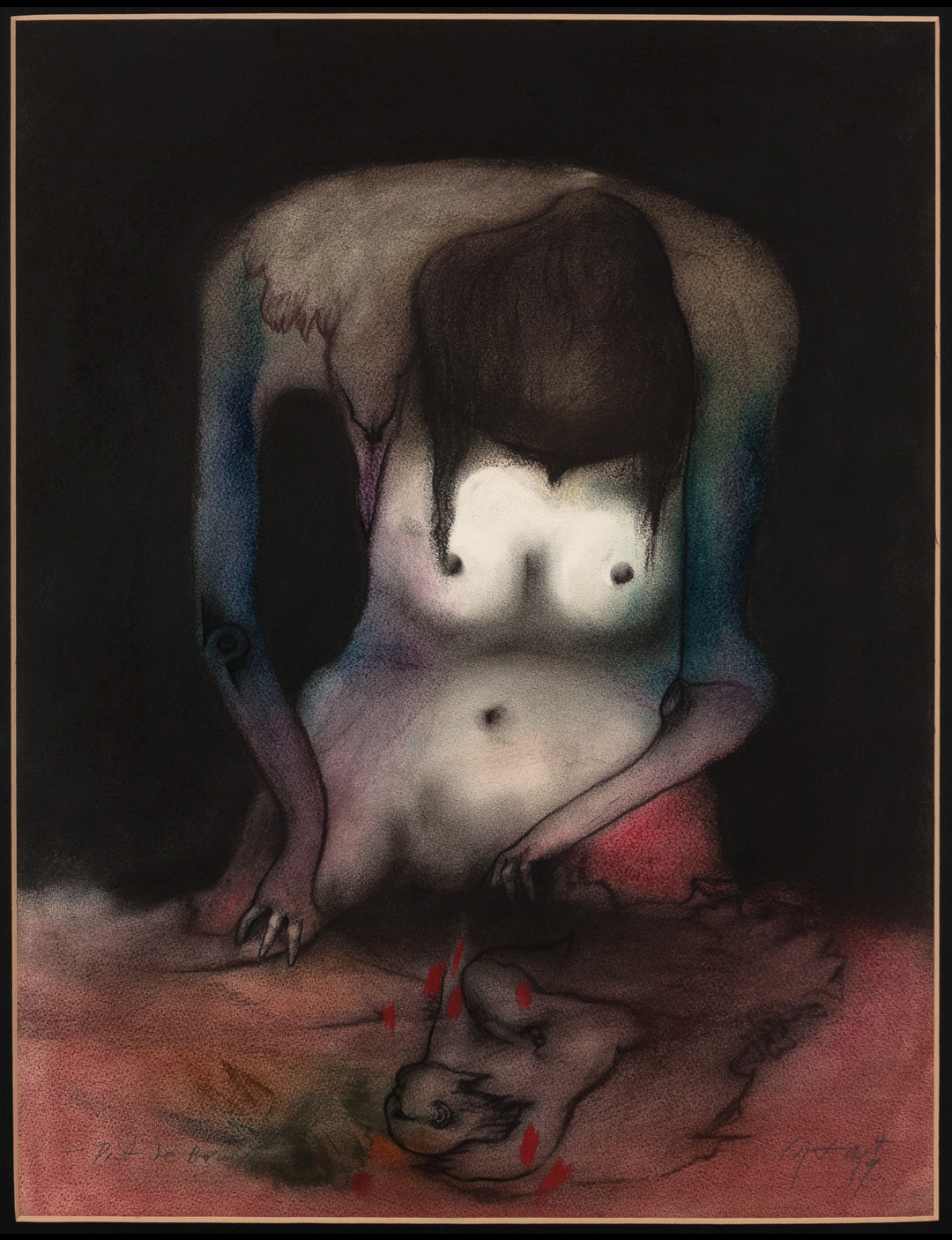
Modest Cuixart, Brunilda’s Labour, 1979, Pastel on canvas. MACBA Collection. Long-term loan from the Generalitat de Catalunya. National Collection of Art. Formerly the Salvador Riera Collection. Image courtesy of the Museu d’Art de Girona. Photo: Rafel Bosch
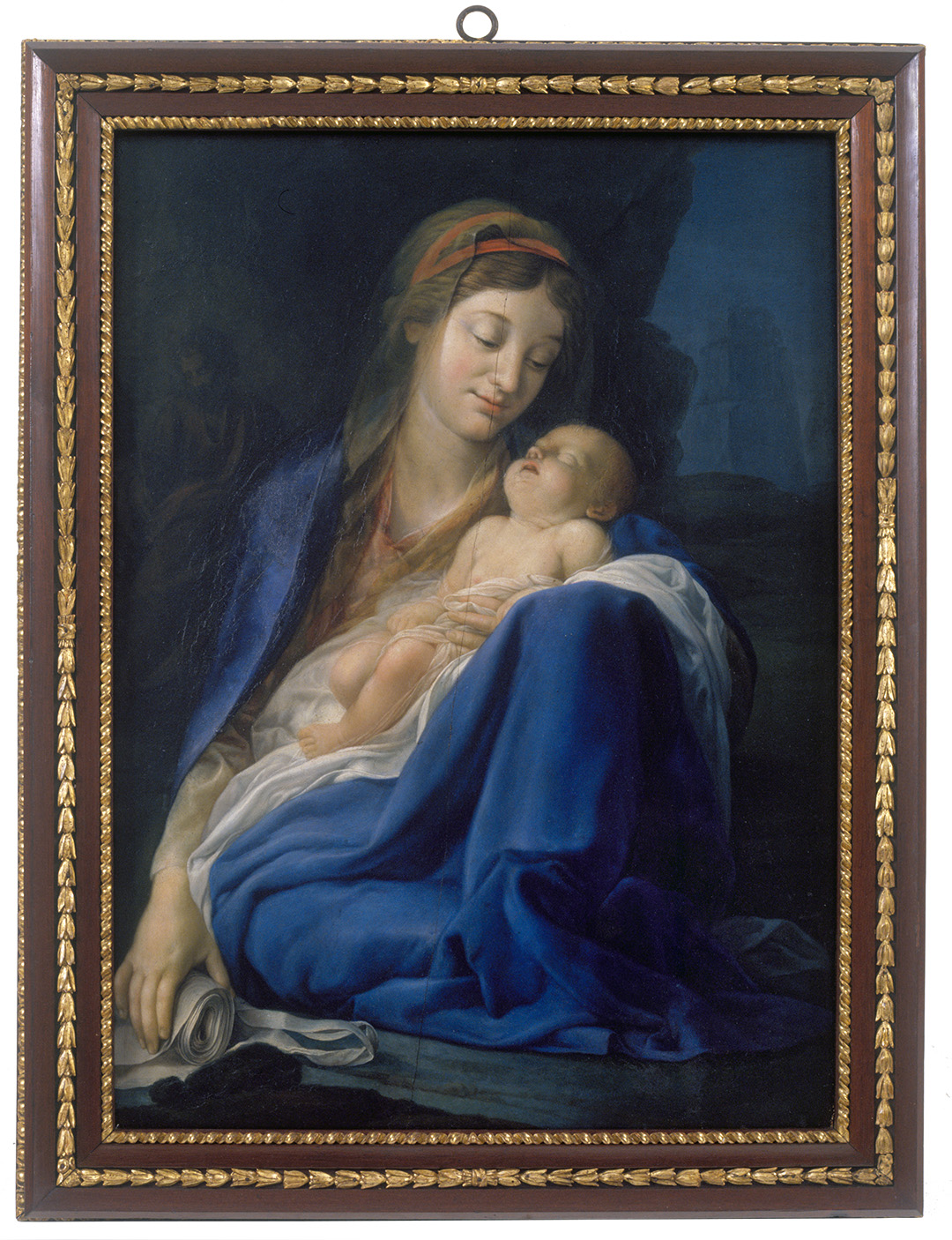
Attributed to Bernardo Martínez del Barranco, Our Lady of the Holy Girdle, c. 1775 . Museu de Lleida
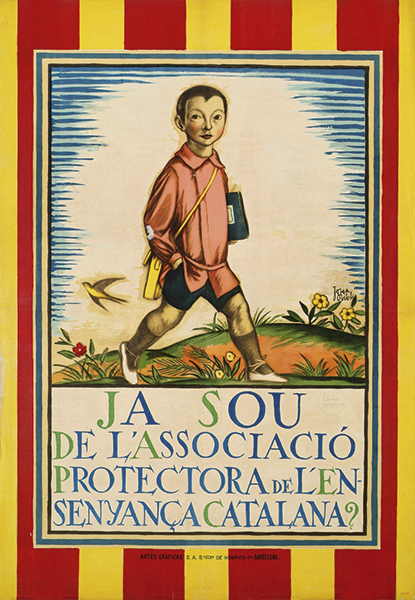
Josep Obiols, Are you a member of the Catalan Education Protection Association?, 1921<br>Lithography in colour. Museu de Reus (IMRC, MR13305)
Copy of Children playing dice by Bartolomé E. Murillo, 19th century, Oil on canvas Museu Nacional d’Art de Catalunya, no. 113809 113809
Keisai Eisen, The courtesan Sakie, of the Sanotsuchiya house, with the kamuro Tayori and Ayano <br>c. 1830, Publisher Yorozuya Kichibei, Colour woodcut. Museu Nacional d’Art de Catalunya, Gabinet de Dibuixos i Gravats
Joaquim Martí-Bas, Contribute to the work of the Children's Aid Committee, 1936-1937, Print by J. Horta & Cia, Colour lithography. Museu del Disseny, GAGB 15/08, Photography: Xavi Padrós
The eternal promise: Childhood in art

Ricard Bru Turull
Professor in the Department of Art and Musicology at the Autonomous University of Barcelona
Children and art
From the iconographies crafted in Ancient Egypt, the images made in the Graeco-Roman world and depictions from Christian society to the representations of childhood amongst the bourgeoisie, working class and peasants, from the nameless child, happily running out on the street, to wartime corpses, throughout history children have represented a powerful symbol of life, innocence and tenderness, but also a possible source of concern. Hence, although artistic representations of children do not necessarily have to be faithful to their world, they have served both to celebrate life and love as well as to denounce injustices. To do so, art has adopted the image of children, especially starting in the 18th century, and has made use of these depictions, making them shine as a reflection of life itself with all its ambivalence and complexity, yet mostly seeing in them a perennial symbol of hope, happiness and the freedom we all yearn for.
The appearance of the representations of Harpocrates, the god Horus as a young child, the son of Isis and Osiris, vulnerable yet indestructible, reflects the use of domestic practices in Pharaonic Egypt linked to protecting children. The iconography of this divinity is one of the oldest iconographic representations associated with childhood. We can easily identify Harpocrates as he appears nude, with a knotted braid behind his ears and especially because he has put his index finger in his mouth, like many infants.
![[2] MFM_4383-1](https://xarxa.museunacional.cat/wp-content/uploads/2025/11/2-MFM_4383-1-289x570.png "[2] MFM_4383-1")
Head of Harpocrates (fragment of an Egyptian figure) 2nd-1st century BC, Terracotta, Museu Frederic Marès, MFM no. 4383 4383. Photography: © Pep Herrero
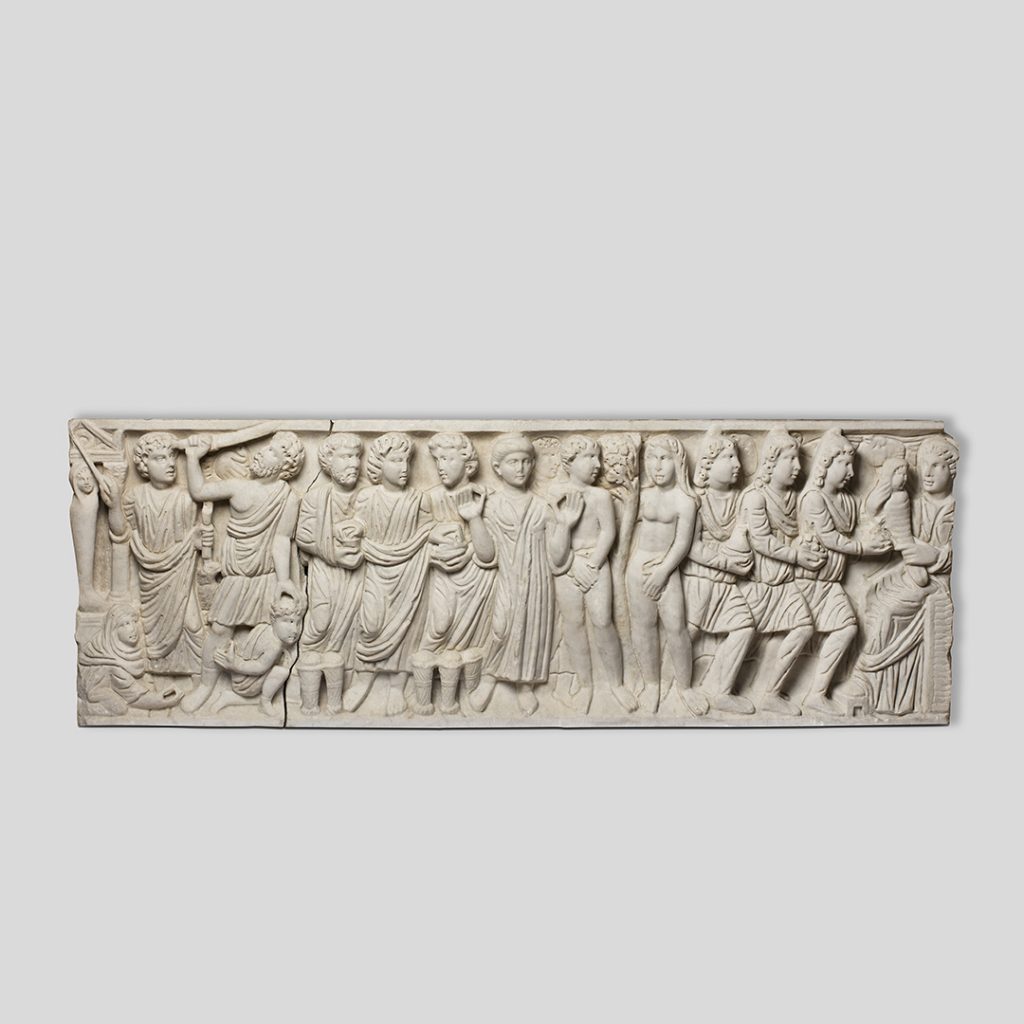
The adoration of the magi, Front of a Roman sarcophagus, Roman workshop. Second decade of the 4th century AD, Layos (Toledo), Marble, Museu Frederic Marès, MFM no. 157. Photography: © ArtWorkPhoto.eu
Although we can find images that feature children in Graeco-Roman art, the fact that they were not part of public life normally either relegated children to a secondary role or they were connected to symbolic scenes, beliefs or myths, like the story of Eros. However, as soon as the first Early Christian images emerged, images of the Infant Jesus started to appear. This front of a late Roman sarcophagus, created by a sculpture workshop in Rome in the early 4th century AD, offers an excellent example. From left to right, the piece represents the resurrection of Lazarus, Isaac being sacrificed at the hands of his father Abraham, the multiplication of the loaves and fish, the orant, the original sin of Adam and Eve and, finally, the adoration of the magi of the Infant Jesus, wrapped in swaddling clothes and held tightly in the Virgin’s embrace.
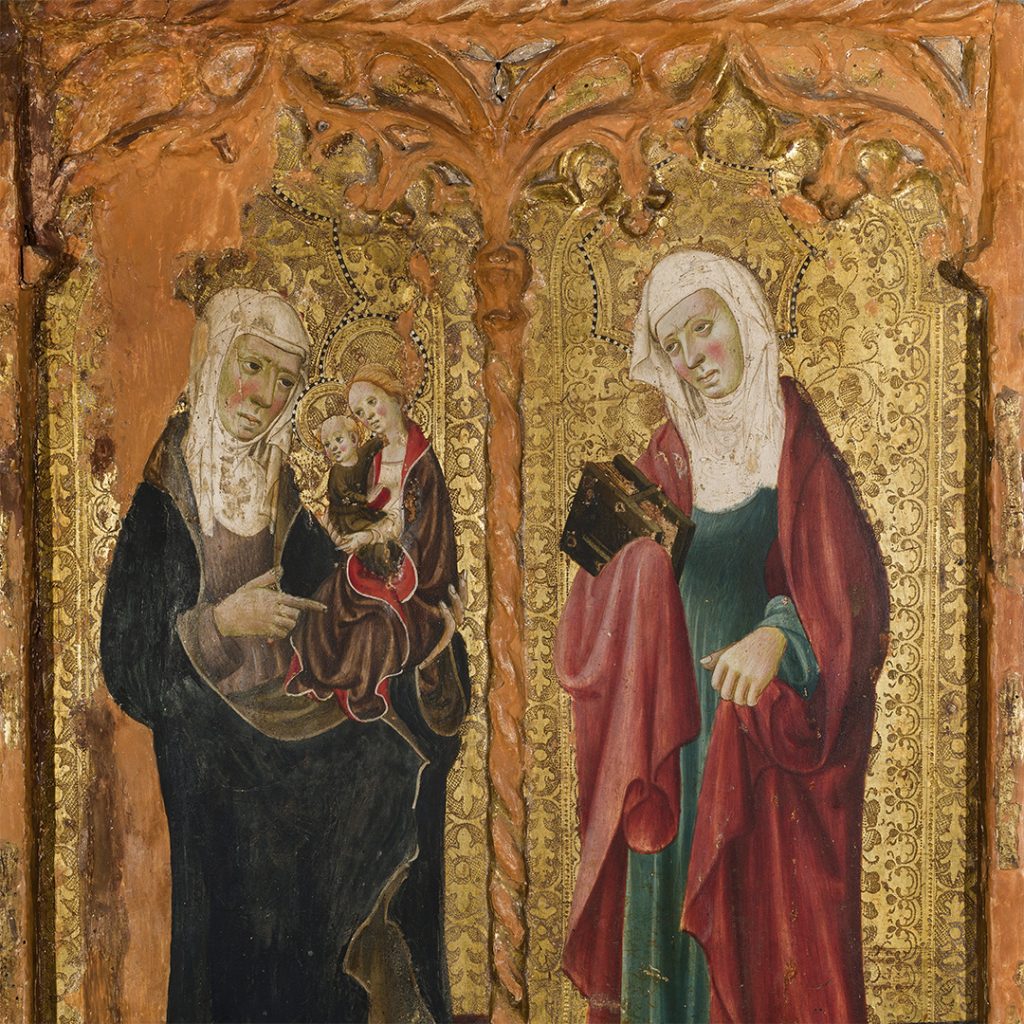
Master of Saint Basilissa, Compartment of an altarpiece representing Saint Anne, the Virgin Mary and the Child, Catalonia, second quarter of the 15th century, Tempera and gold leaf on wood. Unknown origin, Museu Episcopal de Vic, MEV no. 1031. Photography: © Museu Episcopal de Vic, file: The Mad Pixel Factory
As soon as the religious images of the Gothic period abandoned the rigid nature of previous eras, stories that spoke directly about the more human side of Jesus, the stories about his childhood and his family, started to spread. The same happened with his mother, the Infant Virgin Mary, as well as Saint Anne. After this period, coinciding with the spread of the devotion to Saint Anne, the first representations of the Virgin and Child with Saint Anne started to appear as a clear precursor of family portraits. In this case, the representation of the Virgin and Child with Saint Anne forms part of a fragment of a Catalan altarpiece of unknown origin, of which two compartments are preserved in the Museu Episcopal de Vic.
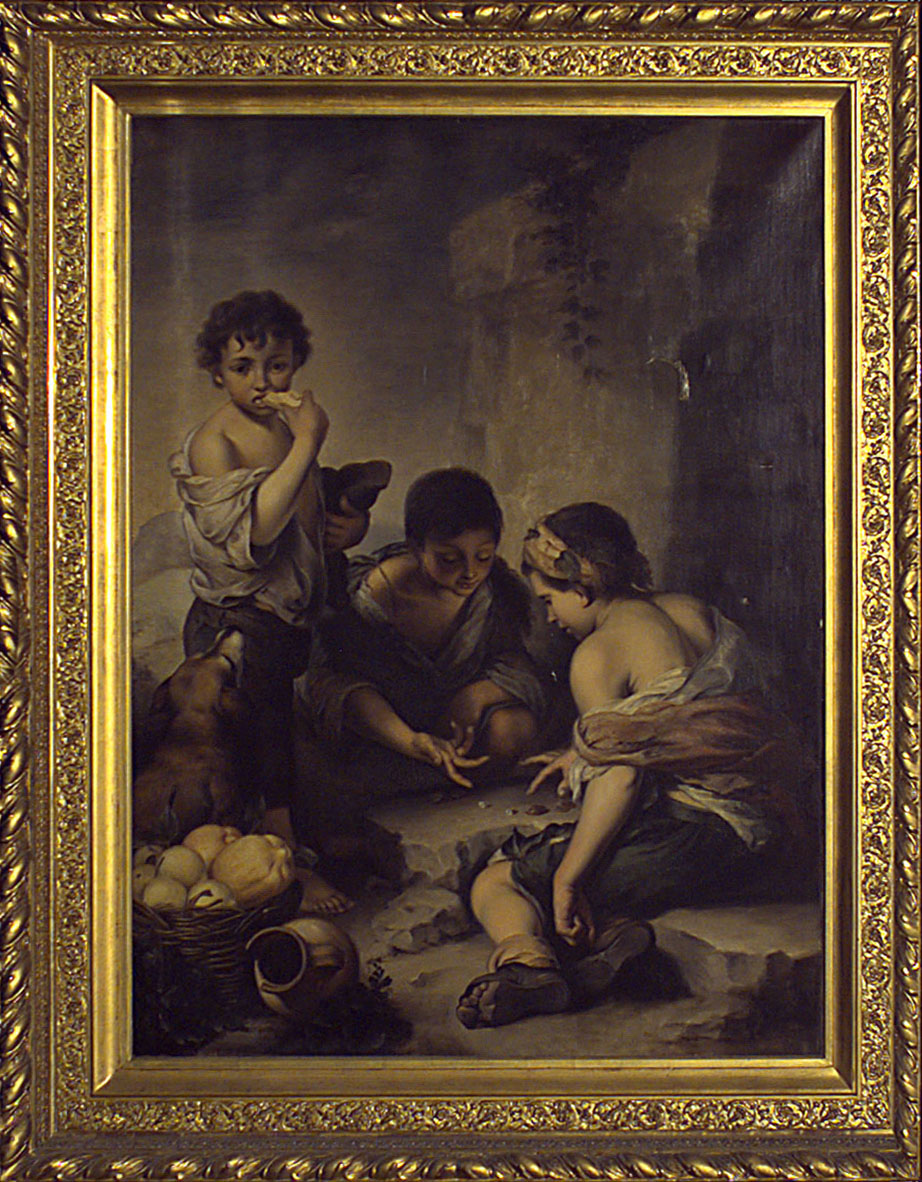
Murillo’s oil painting Children playing dice (1665-1675), preserved today in Munich with the Museu Nacional d’Art de Catalunya owning a 19th-century copy, bears testimony to how pictorial naturalism enabled the appearance of new subject matters and the presence of children in art even as far back as the 17th century. Although Velázquez, the iconic Spanish painter from the Golden Age, paid special attention to children, Murillo singularly stood out as one of the great painters of childhood. Murillo made children the central characters; he gave them a role in painting that they had rarely held before, both in religious works and particularly in secular pieces. He managed to depict them with all kinds of nuances which made his works a unique testimony of the joyful and spontaneous, albeit poor and humble, childhood of the kids who lived in the street in 17th-century Spain.
Copy of Children playing dice by Bartolomé E. Murillo, 19th century, Oil on canvas. Museu Nacional d’Art de Catalunya, no. 113809 113809
Vigée Le Brun was one of the most renowned female artists from pre-revolutionary France and early 19th-century Europe. Chosen as a member of the Académie Royale at a precocious age in 1783, she became a trusted painter of Queen Marie Antoinette and one of the most revered portrait artists among European courts. Despite her initial intimacy with the French monarchy and rococo aesthetics, the portraits by Vigée Le Brun soon started to evoke the influence of the Enlightenment mentality evinced by Rousseau and his essay Emile (1762), where childhood was recognized as a vital stage with its own character. The natural appearance and direct gaze of this elegantly dressed young girl recalls the Rousseauean conception of a loving childhood and the changing conceptions of the era.
Until the mid-19th century, commissioning a painter to create a portrait was quite expensive. Normally, only the wealthiest classes could afford to do so, given the difficulty in finding talented portrait painters and the time required to create the piece. Thus, as soon as photography started to democratize the possibility to immortalize people’s faces and appearances, the demand for family portraits, as well as portraits of the children at home, increased substantially. It goes without saying that over the years photography put an end to the old profession of miniaturists and a large part of portrait painters who had previously monopolized that demand.
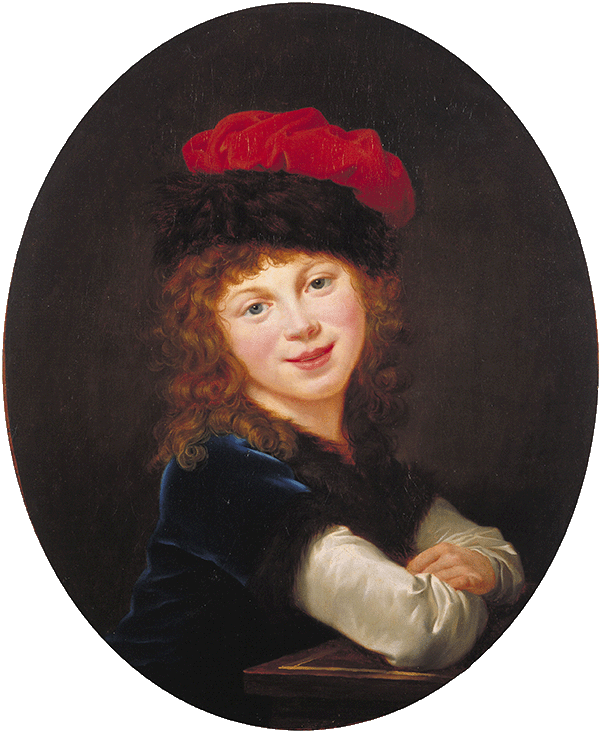
Élisabeth Vigée Le Brun, Portrait of a Girl, 1788-1790, Oil on canvas. Museu Nacional d’Art de Catalunya, no. 65011 65011
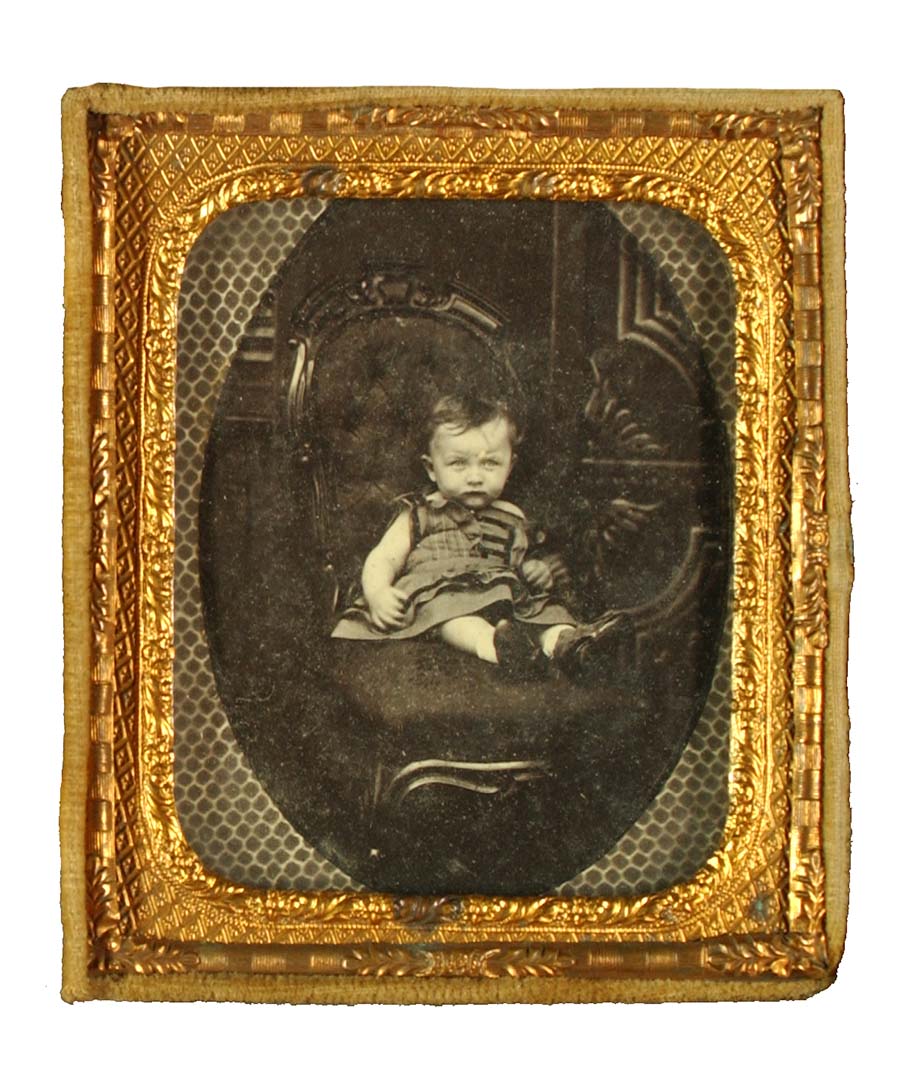
Portrait of a child, c. 1855 1855. Albumen photograph in a Daguerreotype case. Museu Frederic Marès, MFM no. S-6359
Photography: © Mariano R. Blanco
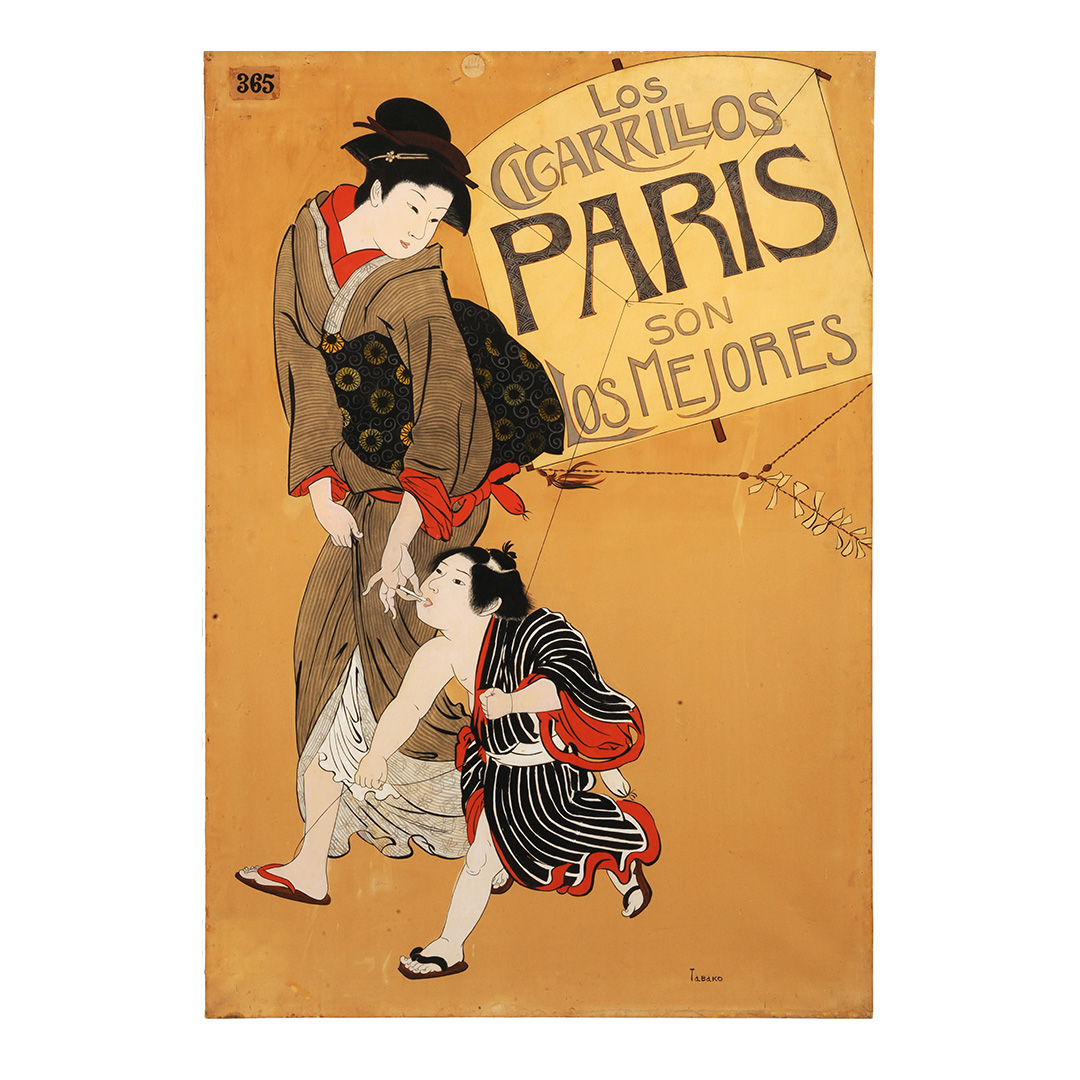
P. Tera, Cigarrillos París, 1901, Gouache on paper. Museu de la Garrotxa, Olot
Like women, children were a common subject in advertising. With the spread of chromolithography and modern posters, children started to appear in advertisements on a large number of posters, showcasing everything from chocolates and soap to an endless array of commercial products, including some as unlikely as tobacco. P. Tera (humorously signed Tabako) presented this project to the international Cigarrillos París contest promoted in Buenos Aires by the Olot-born entrepreneur Manuel Malagrida. Like many other artists, Tera chose an image of a woman and child, but he did so by creating a literal copy of an 1889 cover of the magazine Le Japon Artistique that featured a late 18th-century engraving by Torii Kiyonaga. By changing the girl’s umbrella that appeared in Kiyonaga’s work for a Cigarrillos París brand cigarette, the artist found the way to draw people’s attention and make this poster, as was popularly said at the time, “a call stuck to the wall”.
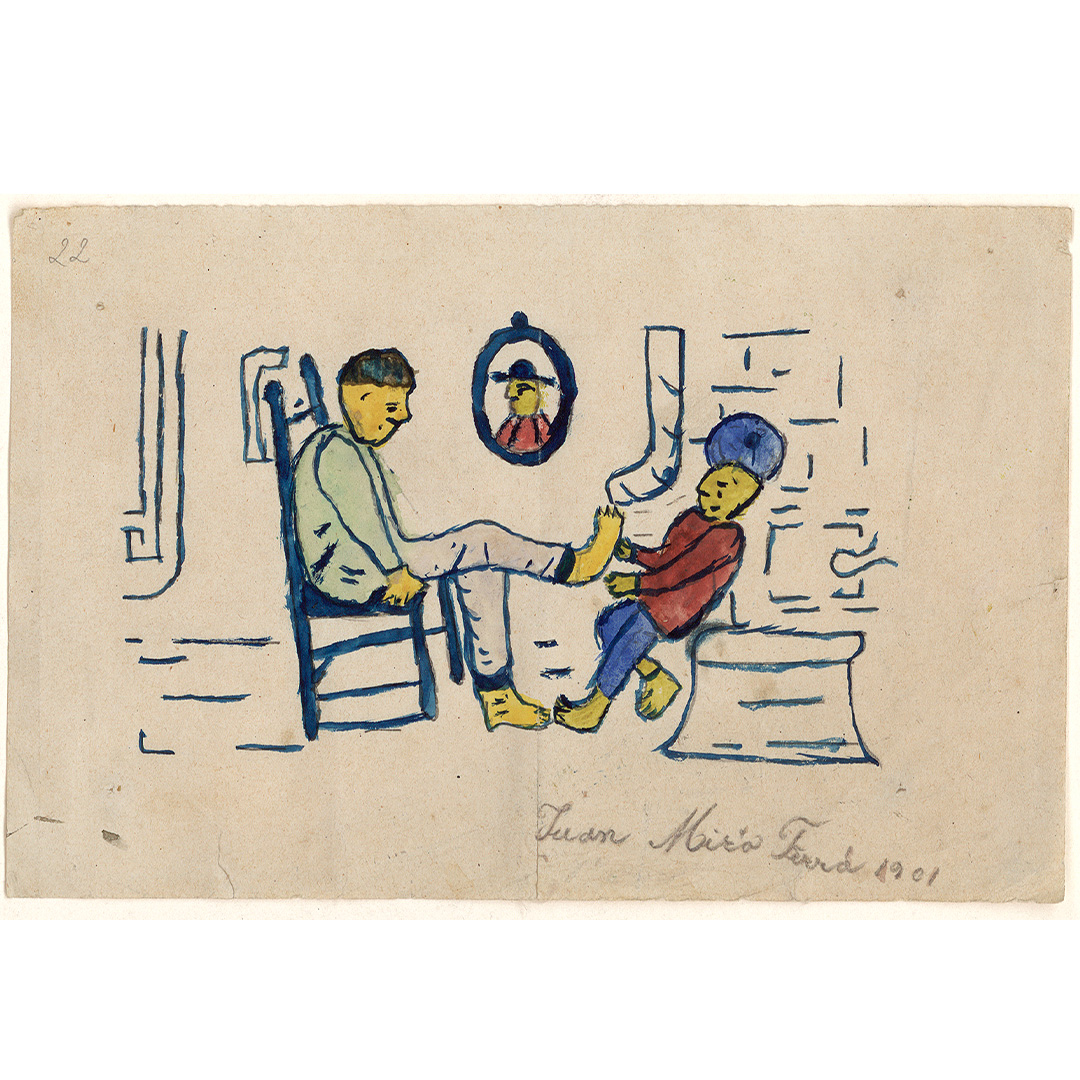
Joan Miró, Untitled (The podiatrist), 1901, Pencil, watercolour and ink on paper. Fundació Joan Miró. FJM No. 22 22
The podiatrist is one of the earliest preserved drawings by Joan Miró. At the age of eight, he started to create detailed drawings that faithfully depicted his surroundings, drawings in colour which were signed and dated, that testify to the young Miró’s interest in becoming an artist. These pieces are still childlike drawings, even if they show a stubborn desire to represent reality in a meticulous and objective manner. They feature a vastly different perspective from the poetic language he discovered later on and from the freedom of children’s drawings that he later admired as an adult. In a precocious and veiled fashion, The podiatrist highlights the artist’s ever-present obsessive interest in feet, and for feet rooted in the ground. Miró saved these childhood drawings, along with those made by his daughter, at a time in which, during the height of the avant-garde movement, both Miró and his companions from ADLAN found in children’s drawings the fantasy, sensibility and spirit of creative freedom that modern art yearned for. Unsurprisingly, Sebastià Gasch explained how when Joan Miró visited the Escola del Mar in the Barceloneta neighbourhood in 1930, the painter admired the rough and unpolished drawings made by the 4- to 6-year-old children. “Now that is art, exclaimed Joan Miró excitedly standing by my side”.
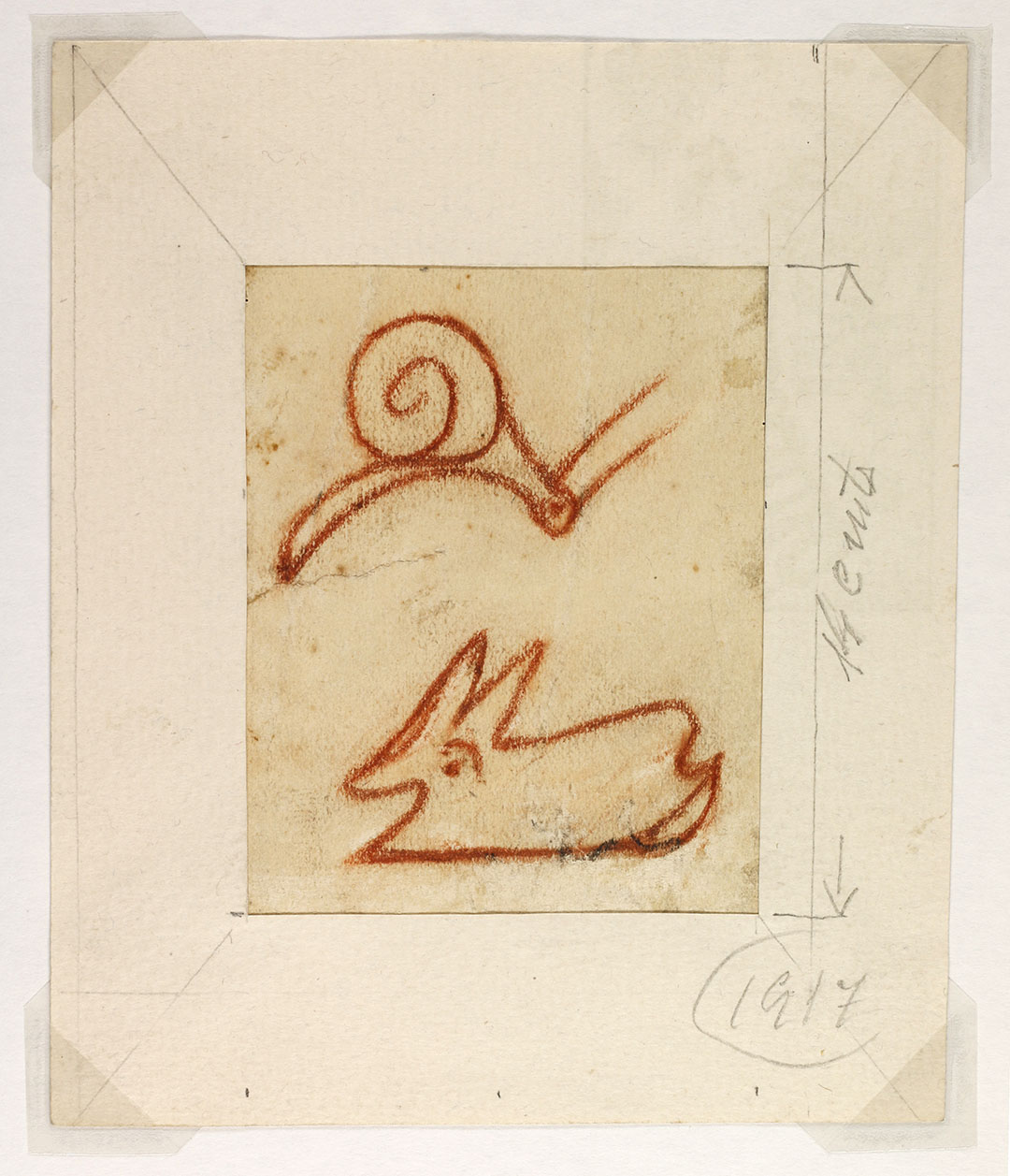
Leandre Cristòfol Peralba, Representative drawing, 1915, Graphite pencil on paper. Museu Morera, Lleida, no. 1758 1758
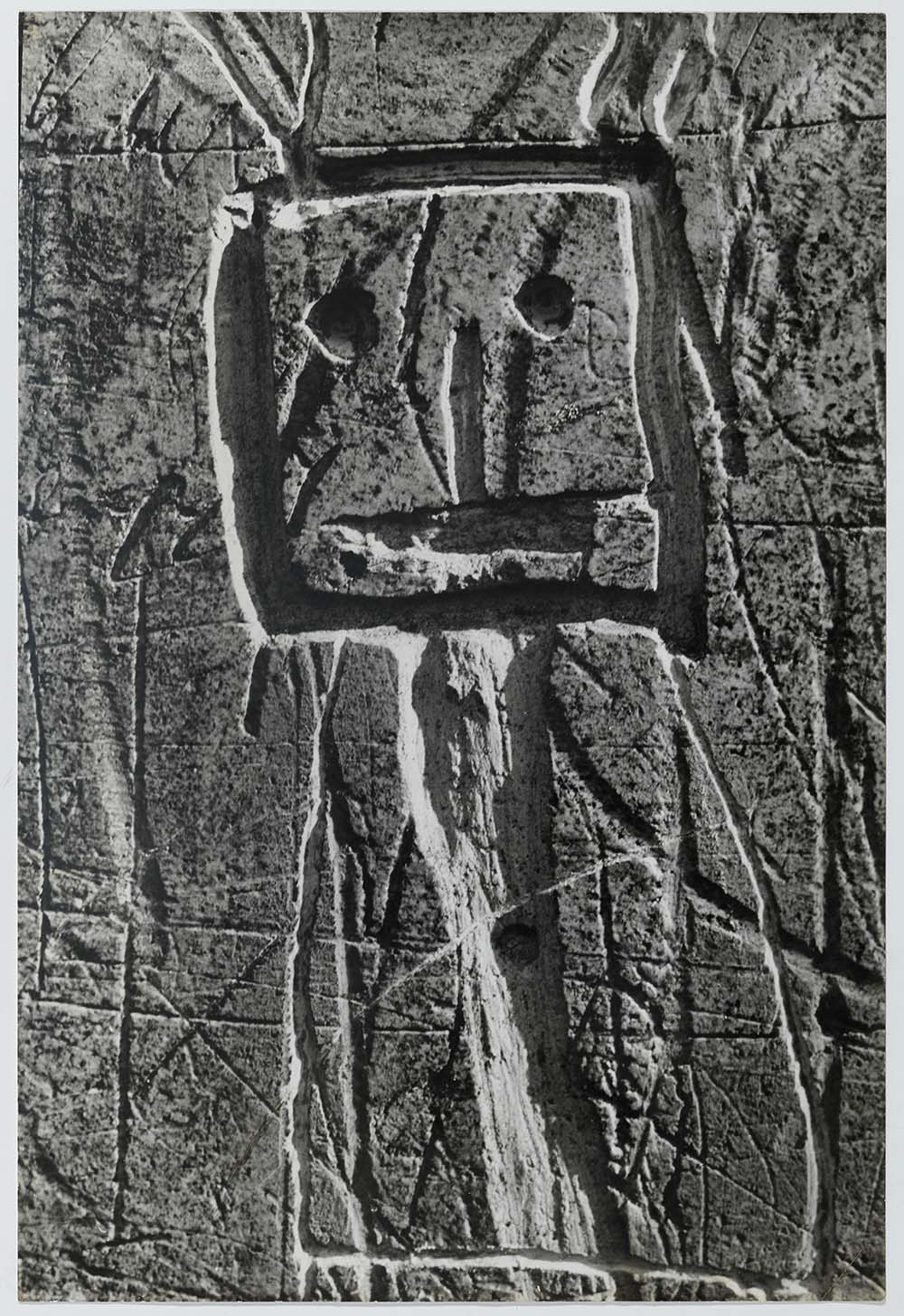
Brassaï, Picasso & Co. Graffiti. Series XI: “Primitive images”, c. 1930 (print from 1950), Gelatin silver print. MACBA Collection. MACBA Foundation. Photography: FotoGasull
Leandre Cristòfol was one of the most fascinating 20th-century Catalan sculptors and, starting from when he began coming closer to the ADLAN group, one of the pioneers in surrealist sculpture. Cristòfol was born in Os de Balaguer in 1908. Years before starting his artistic training and beginning to learn the carpentry trade in Lleida, his interest in art started to appear in drawings made at age 7 or 8 that his parents decided to keep. In this case, the child’s innocent gaze was fixed on the forms of nature and small animals in motion. This aspect, i.e., movement, years later became one of the hallmarks of his sculpture.
The avant-garde movement of the 1920s and 1930s saw in children’s drawing the free art which, unentangled from debased rules and the academy, expressed itself in a pure, virgin manner as prehistoric art had done. Collected and praised by critics and artists alike, contests and exhibitions were held, and they were seen as a source of original expression as intense as the work of Michelangelo. Children’s graffiti etched in rock was a similar example, such as the ones found in the church of Sant Joan de Boí which were on display at the Museu d’Art de Catalunya in the 1930s and which became a point of departure for artists including Miró and Picasso. Around the same time, Brassaï started taking photos of the walls along the streets of Paris with graffiti etched into them, starting a series which was first printed in the magazine Minotaure (1933-34) and later shown in 1956 at the Language of the Wall exhibition at New York’s MoMA before being published in the book Graffiti (1961) accompanied by two conversations with Picasso.
From pregnancy to childbirth
A vast chasm spans between the numerous depictions of Our Lady of Hope from the Middle Ages and the contemporary artistic images of pregnancy and childbirth. Yet they all resort to a series of constants, whether the uncertainty or hope of new life, to waiting for the unborn child’s arrival. Conception and pregnancy are represented throughout art history in different manners, based on every culture’s traditional iconography, whether pre-Colombian, Graeco-Roman, Christian, Buddhist, or Hindu, among others. Likewise, childbirth has not always been represented in the same way. Childbirth, which essentially until the 20th century could result in a clear risk for the woman, has rarely been shown realistically. On the contrary, artists have generally depicted it symbolically or have focused on the time after childbirth. This private act in previous times took place at home, though in recent years has moved into the hospitals.
Sculpted with polychrome alabaster from Beuda, this statue probably comes from the former convent of Saint Francis of Assisi in Girona. The priestly nature of the figure, represented from the front, with an immovable look and rigid symmetry, recalls the Romanesque tradition, although it contrasts with the naturalism of the folds in the clothing, which emphasize the Virgin’s pregnancy. The carving also stands out due to the position of her hands, resting on her knees, her open legs and the folds of her clothing that insinuate the birth canal through which the baby, still in his mother’s womb, must come.
![[12] 001830_1](https://xarxa.museunacional.cat/wp-content/uploads/2025/11/12-001830_1-292x604.png "[12] 001830_1")
Our Lady of Hope, 1401-1425, Polychrome alabaster. Museu d’Art de Girona, no. 001830. 001.830. Diputació de Girona Art Fund. Photography: Rafel Bosch
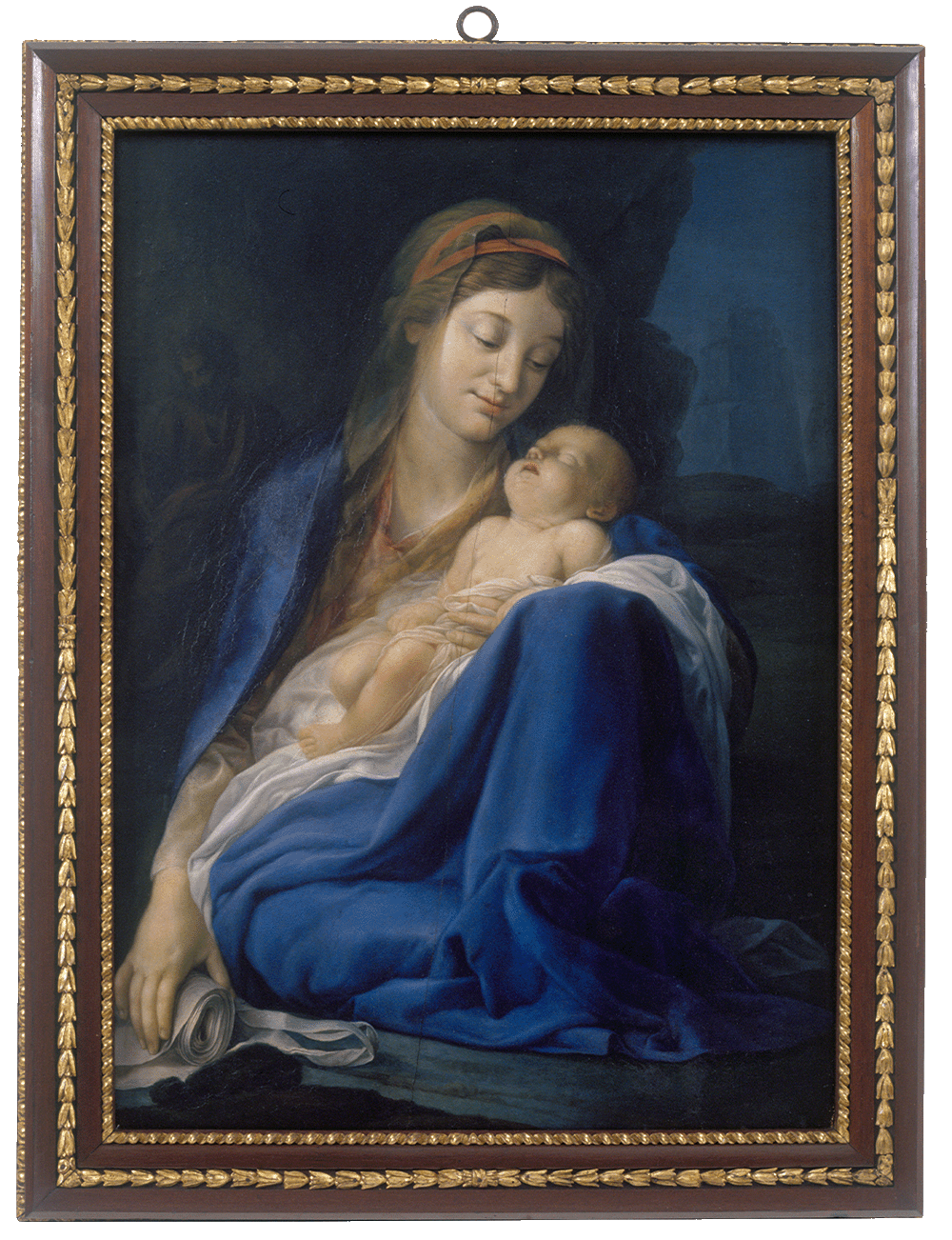
Attributed to Bernardo Martínez del Barranco, Our Lady of the Holy Girdle, c. 1775. Museu de Lleida
Our Lady of the Holy Girdle, or of the Belt, is one of the numerous Marian names that spread throughout the 17th and 18th centuries in Catalonia thanks to the tradition that tells the story of the miraculous apparition of the Virgin in the Cathedral of Tortosa in 1178 to give a girdle from her pregnancy. The worship of the relic of the Holy Belt turned the Virgin of the Holy Girdle into the patron saint of Tortosa in 1863, while the girdle spread as a symbol of heavenly aid in the months of pregnancy. The practice of wrapping the woman’s belly with a belt during the last stage of pregnancy until childbirth spread in Tortosa, and to part of the Terres de l’Ebre, a practice that still remains to this day. This belt, or girdle, which has previously been in contact with the relic, is a symbol of the desires and the hope that pregnancy and awaiting a newborn’s arrival entails.
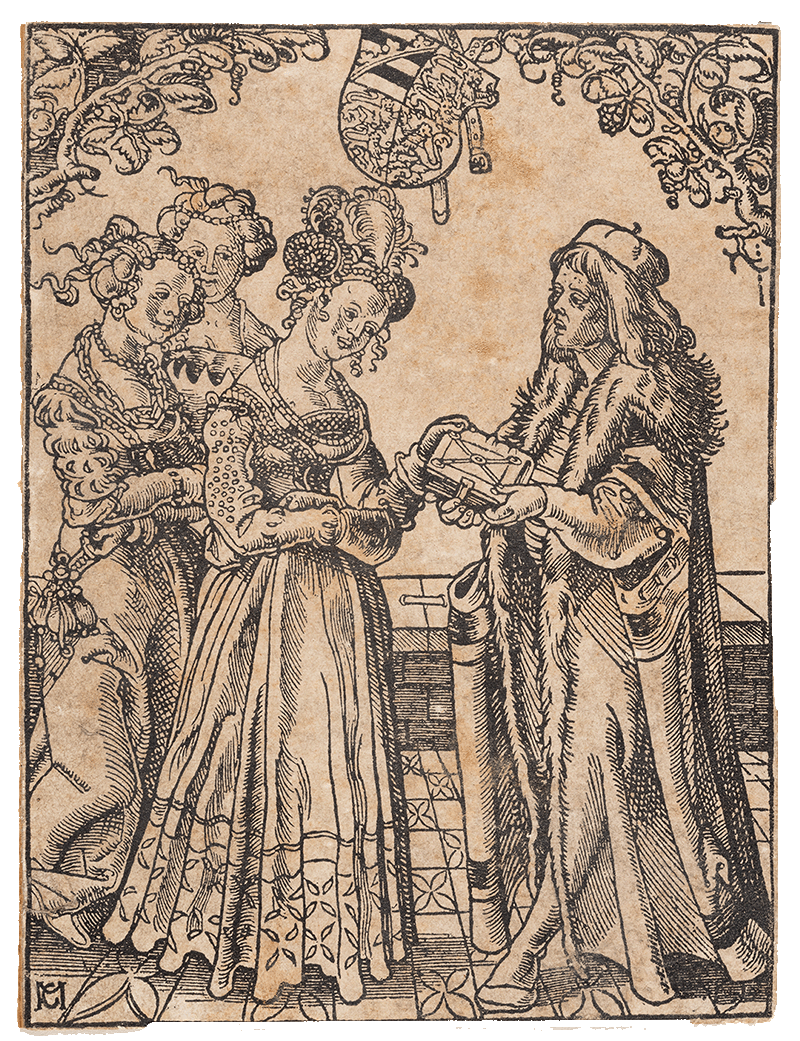
Martin Kaldenbach, Rosegarden for pregnant women and midwives (Der Swangern Frauwen und Hebammen Rosengarten), 1513. Woodcut. Museu de Lleida. Gelonch Viladegut Collection.
The emergence of printing in the late 15th century transformed the way in which knowledge was circulated. During the era of humanism and the Renaissance, books, often featuring illustrations, were distributed on a mass scale and allowed knowledge to be shared more quickly and effectively. Within this context, accompanying the appearance of texts printed with moving type, woodcutting became a new complementary means for conveying ideas and a wide range of medical and healthcare practices. This is the case of this engraving by Martin Kaldenbach, one of Dürer’s disciples, which comes from an important book on obstetrics by Eucharius Rösslin published in Strasbourg in 1513. Although the image shows the book’s author giving a copy to Katharina von Braunschweig-Lüneburg, to whom the work is dedicated, the book includes a series of 20 woodcuts that showed the positions of the foetus, the uterus and childbirth for the first time.
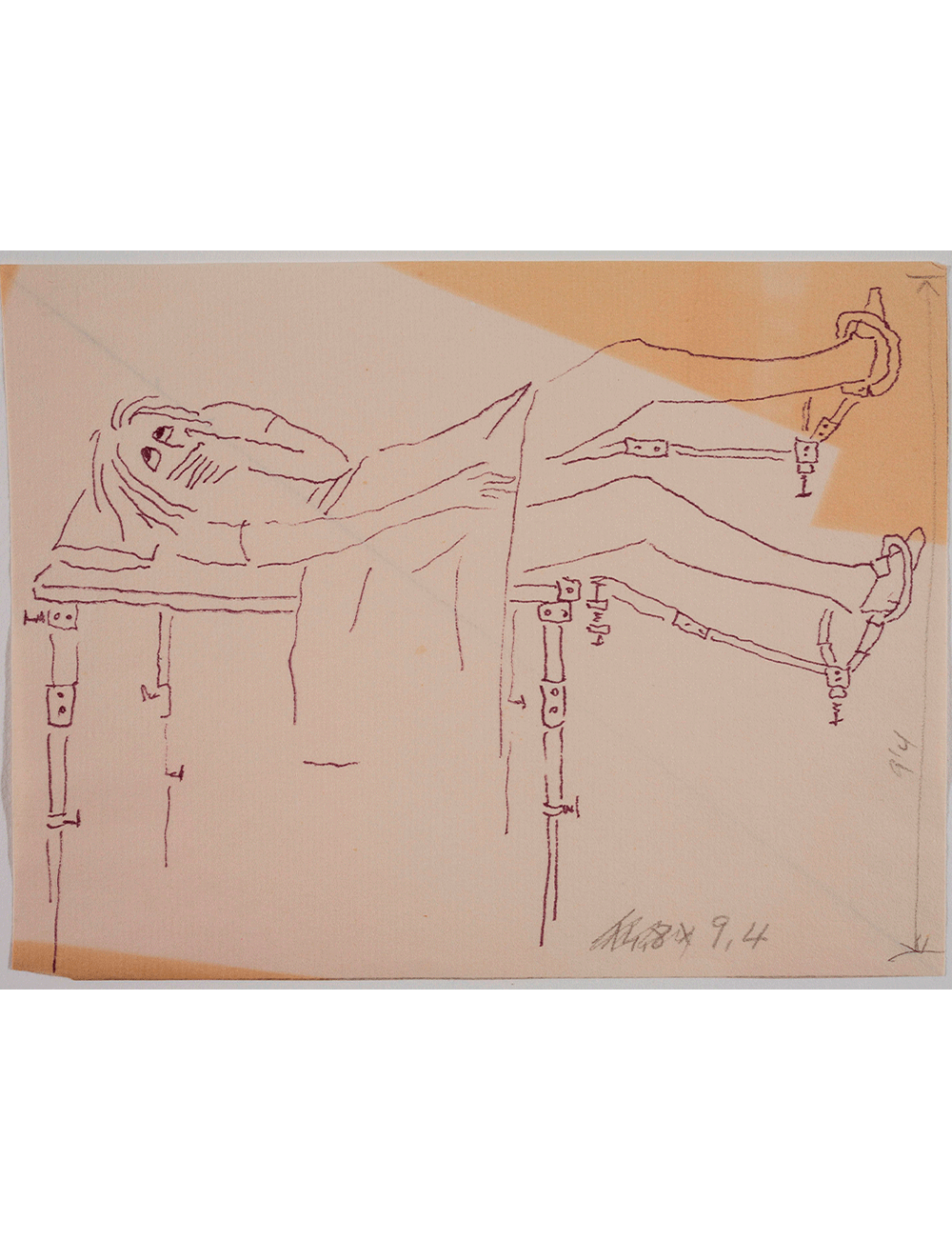
Núria Pompeia, Original piece for the book Maternasis, 1967, Ink on paper. Museu Nacional d’Art de Catalunya, no. 254647-013 254647-013
In 1967, the artist Núria Pompeia, a writer, cartoonist and pioneer of feminist drawing, published the book Maternasis, a work celebrated for its groundbreaking, intimate and poignant approach to the uncertainties that go hand-in-hand with pregnancy. The taboos, the loneliness, the pain and the fears about pregnancy were laid bare and demystified across seventy-some paintings that portrayed what pregnancy and childbirth meant first-hand from a woman’s perspective, with irony and sincerity.
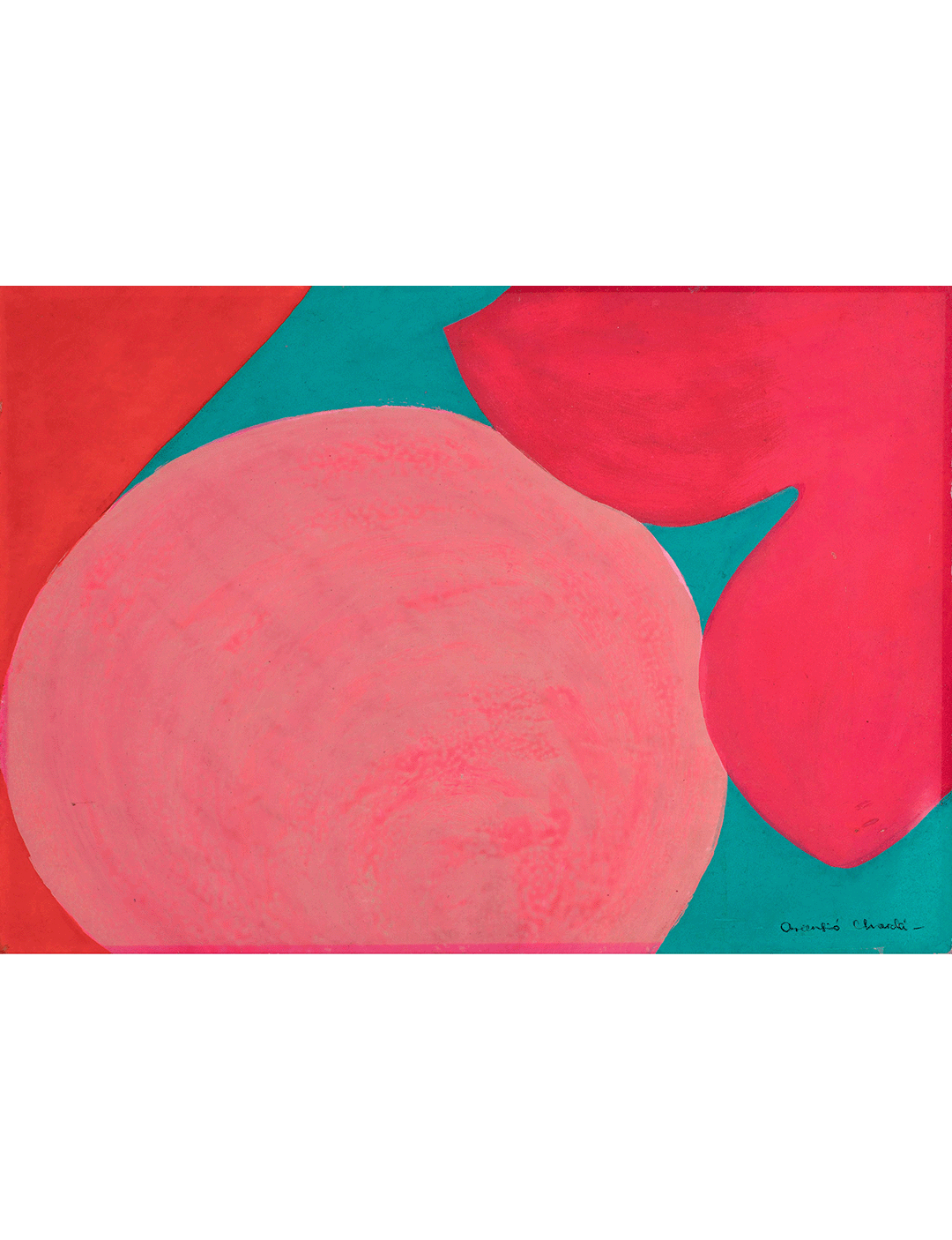
Mari Chordà, Pregnant self-portrait, 1966-1967, Varnished gouache on cardboard. Museu Nacional d’Art de Catalunya, no. 254216 254216
Within the growing feminist wave in the West, Mari Chordà painted a series of self-portraits while pregnant. She addressed motherhood from a liberated feminist perspective. However, unlike the contemporary approach in Maternasis based on natural or everyday concerns, Chordà chose to represent pregnancy from a symbolic and transcendent dimension. Following the psychedelic aesthetic of 1960s pop art, the artist crafted a series of different paintings corresponding to the different months of pregnancy.
Modest Cuixart, Brunilda’s Labour, 1979, Pastel on canvas. MACBA Collection. Long-term loan from the Generalitat de Catalunya. National Collection of Art. Formerly the Salvador Riera Collection.
In the past, art rarely represented childbirth based on pain and suffering, almost never associating it with death. After having grown past his informalist stage, Modest Cuixart returned to figuration and did so through an interest in the human body and in women that was awakened when the artist was still young, especially after studying for two years at Medical School. The myth of Brunilda, a Valkyrie and shieldmaiden from Nordic mythology, appears throughout a series of works by the artist. Brunhilda’s Labour testifies to the artist’s recurring tendency to evoke bodily amputations, deformations, monstrosity and metamorphosis, here representing the main figure after an infant’s death, in the style of a mater dolorosa.
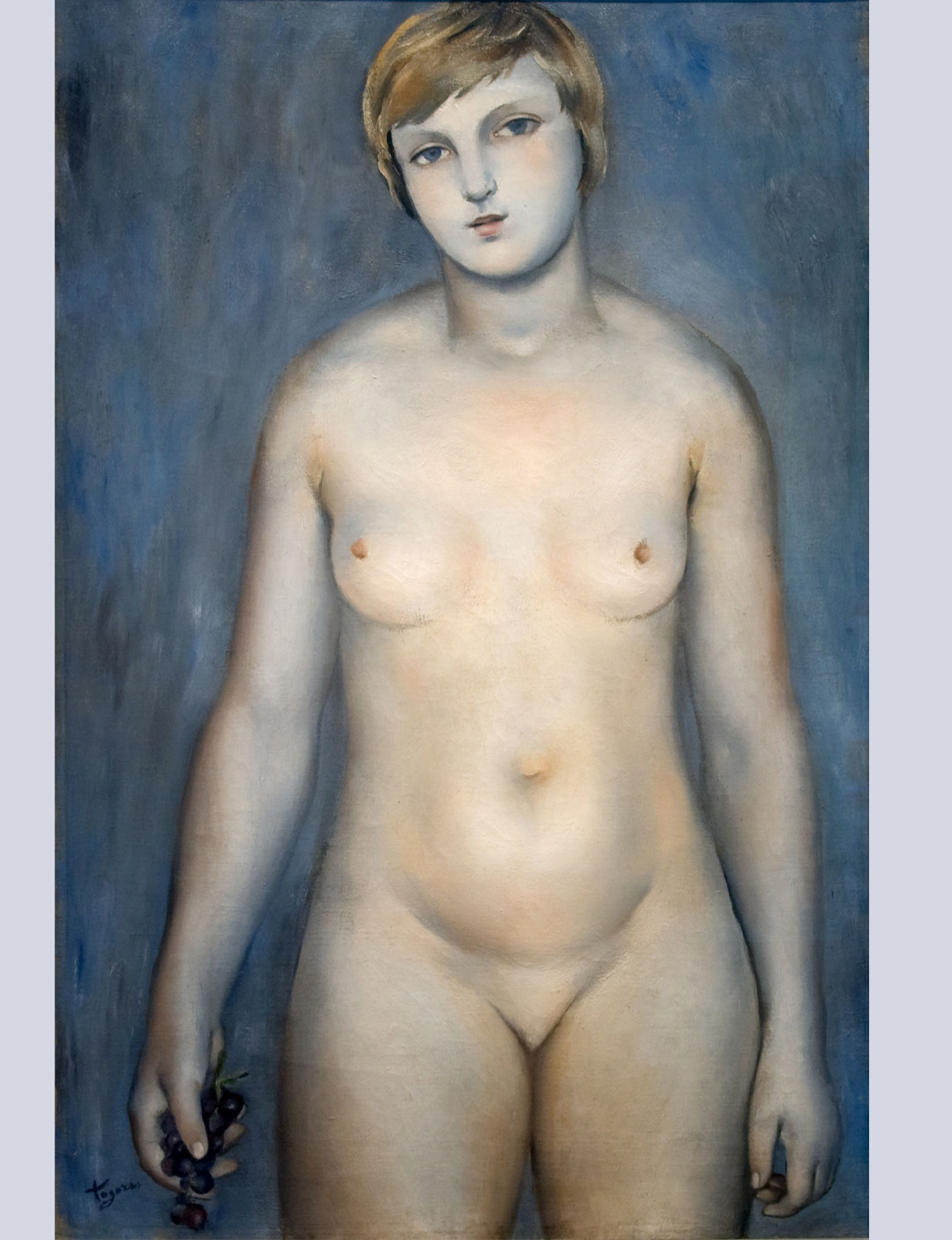
Josep de Togores, Femme avec raisin (Woman with Grape), Paris, 1926, Oil on canvas. Museu d’Art de Cerdanyola, MAC
Femme avec raisin (Woman with Grape) is the portrait that the painter Josep de Togores made in Saint-Tropez shortly after his wife, the Austrian Antonia Bechtold, had their first daughter Maria del Roser (Tití). This piece is a natural and sensual depiction of a woman’s nude body that becomes an allegory of fertility through the presence of the grapes in her hand. The young Tití had a portrait made of her the following year by Manolo Hugué in Prats de Molló; a childhood portrait made with baked clay that is preserved in the Museu d’Art de Cerdanyola, just like this painting.
The first days
When a child is born, both during the labour itself and in the first weeks of recovery, the newborn lived in a woman’s universe where the mother was often accompanied by midwives who took charge of providing the initial care. Biblical scenes, in particular depictions of Christian events (the birth of the Virgin, Saint John the Baptist and Jesus), are the ones that have most prolifically described and represented these moments and allow us to discover both the practices and the mentality of the era.
Both Romanesque as well as early Gothic art, especially after the founding of the Franciscan Order, expanded the images of the Nativity with the Virgin lying down, resting after having given birth, accompanied by Joseph who nonetheless remains practically absent. This is the case of the famous murals like the ones in the church of Sant Andreu de Pedrinyà, in the Museu d’Art de Girona, as well as in altarpieces and altar tables like this one from Sagàs, in Berguedà. In the image, the Virgin appears resting with her eyes closed, stretched out on a wooden bed and wrapped up in a blue sheet. Mary is recovering from the painful childbirth while the infant rests in a separate space in the background, in the feeding room in the manger, with the ox and the mule keeping him warm with their breath.
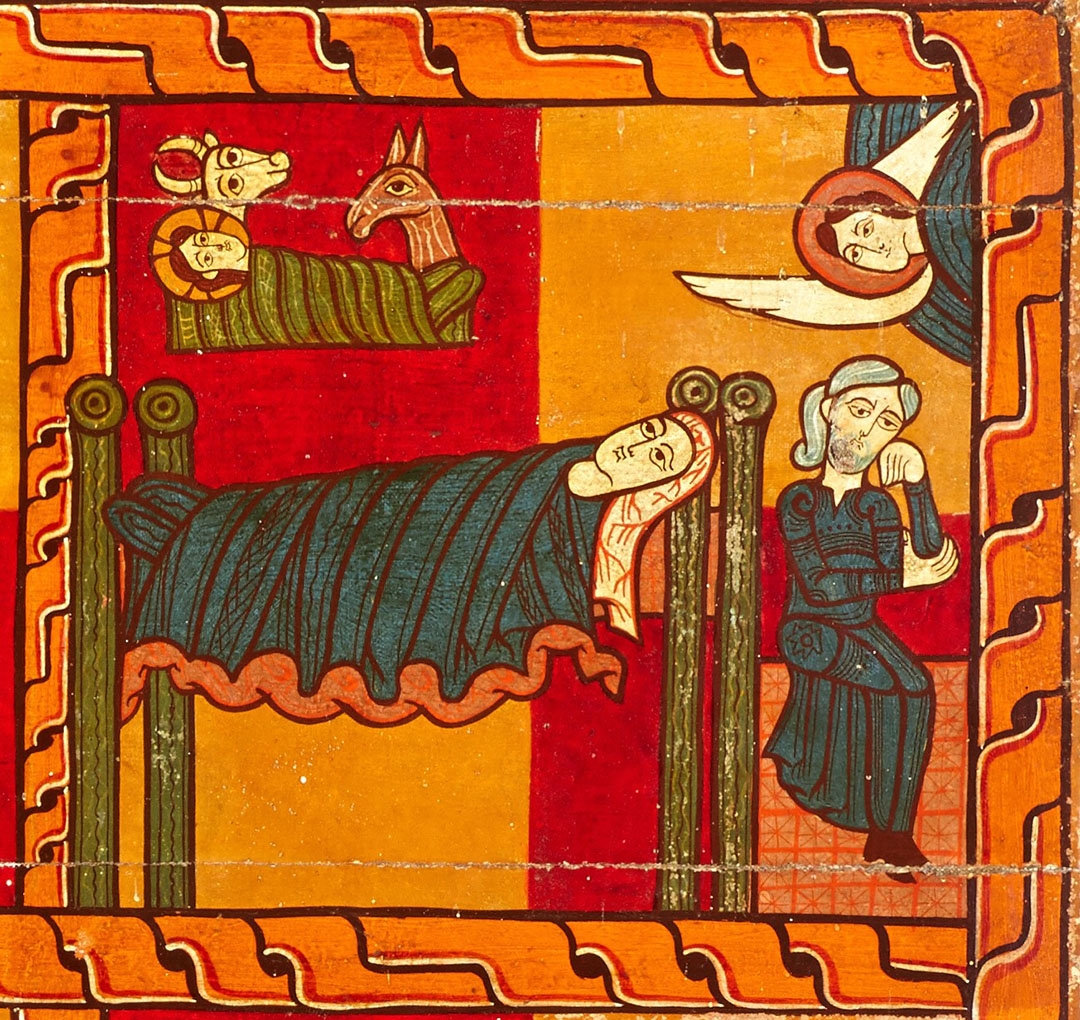
The Nativity, Altar table of the church of Sant Andreu de Sagàs, Late 12th century, Tempera painting on wood. Museu Diocesà i Comarcal de Solsona, MDCS no. 11.2 11.2
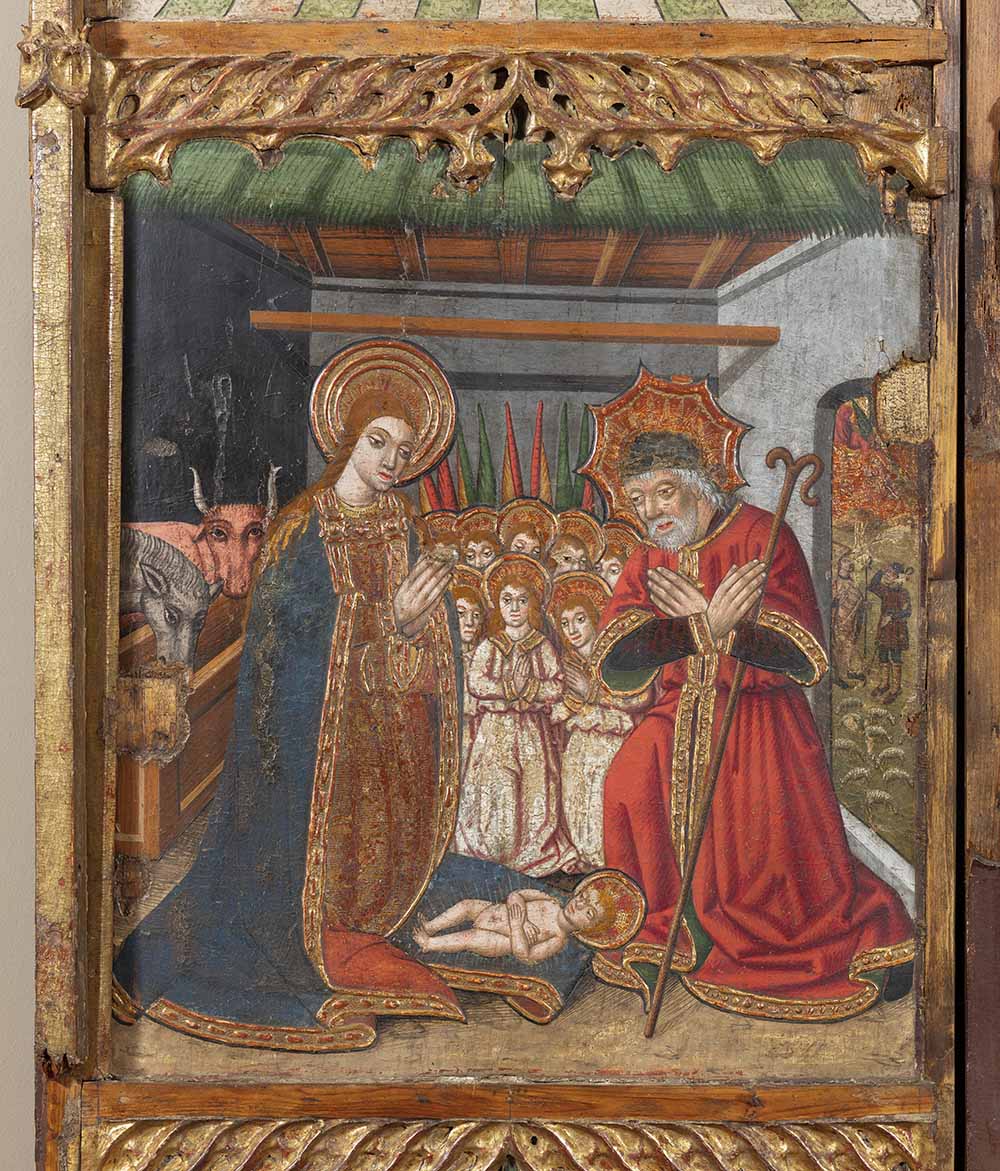
Francesc Solives, Compartment of the altarpiece dedicated to the Virgin, 1481, Tempera and gold leaf on wood, Museu Episcopal de Vic, MEV no. 887 887. Altarpiece from the sanctuary of Mare de Déu de la Bovera, in Guimerà (Urgell).
Photography: © Museu Episcopal de Vic, photographer: Enric Gracia
Starting in the 14th century, and especially in the 15th century, following the mystic visions of Saint Bridget of Sweden, the Nativity of Jesus was no longer represented as a natural birth. Instead, it became a painless miracle with the Immaculate Virgin kneeling while adoring her unclothed and solitary infant on the earth, who appears as if from nowhere. This is how the Nativity scene is depicted on the altarpiece in the sanctuary of La Mare de Déu de Bovera, painted by Francesc Solives with a style notably influenced by Jaume Huguet.
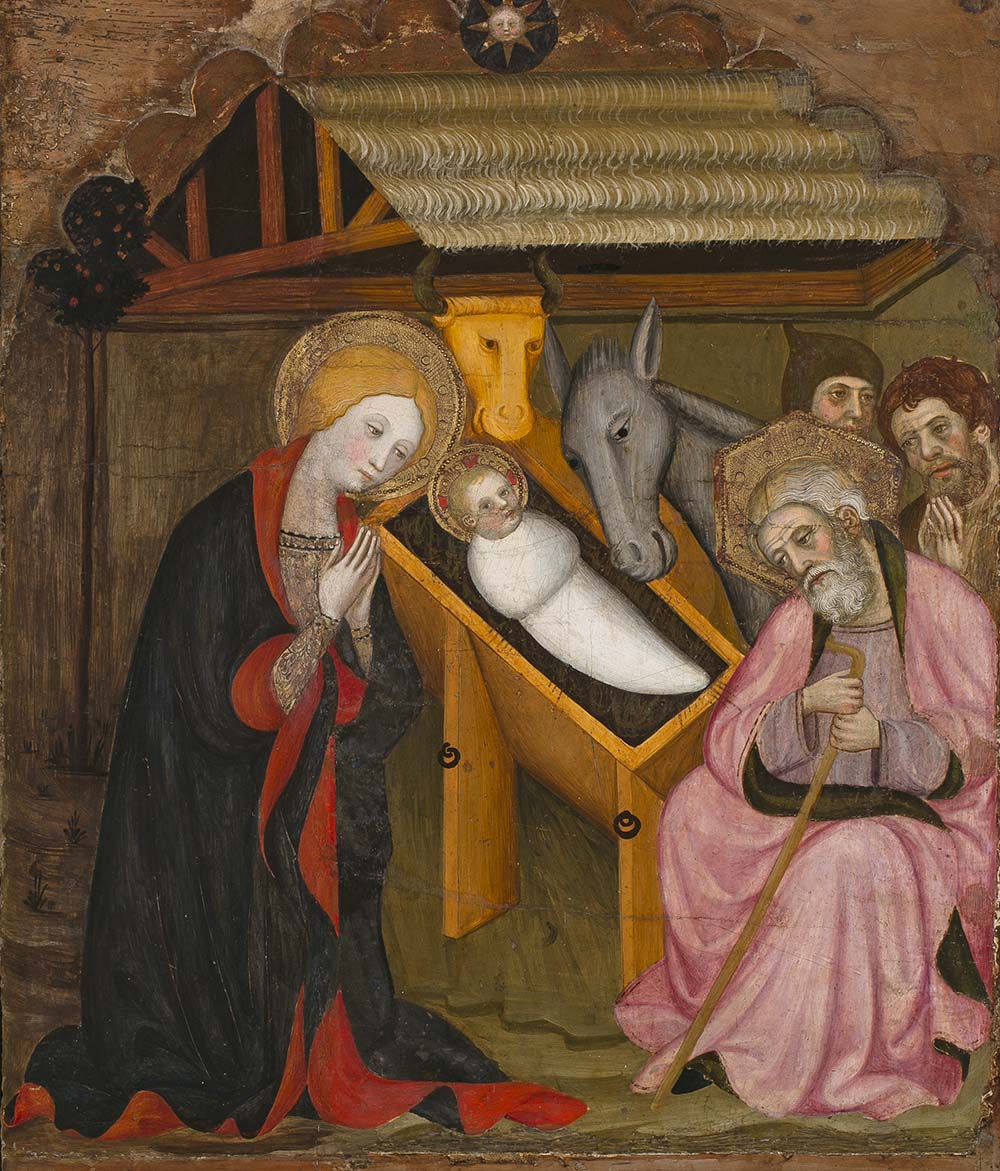
Pere Serra, Nativity, c. 1400, Fragment of the altarpiece of the church of Sant Pere de Cubells (La Noguera). Tempera on panel, Museu Maricel, Sitges
Beyond the cold of an unclothed newborn alone on the ground, adored by Joseph and Mary according to Saint Bridget’s visions in her dreams, starting in the 14th century, as a result of a progressive process of humanizing Jesus, the image of the Holy Family often started to become warmer, more approachable, vivid and tender than in previous representations. We can find a highly representative example in this scene painted by Pere Serra around 1400, with Saint Joseph, the Virgin, the ox and the mule accompanying the infant wrapped up in swaddling clothes in the manger.
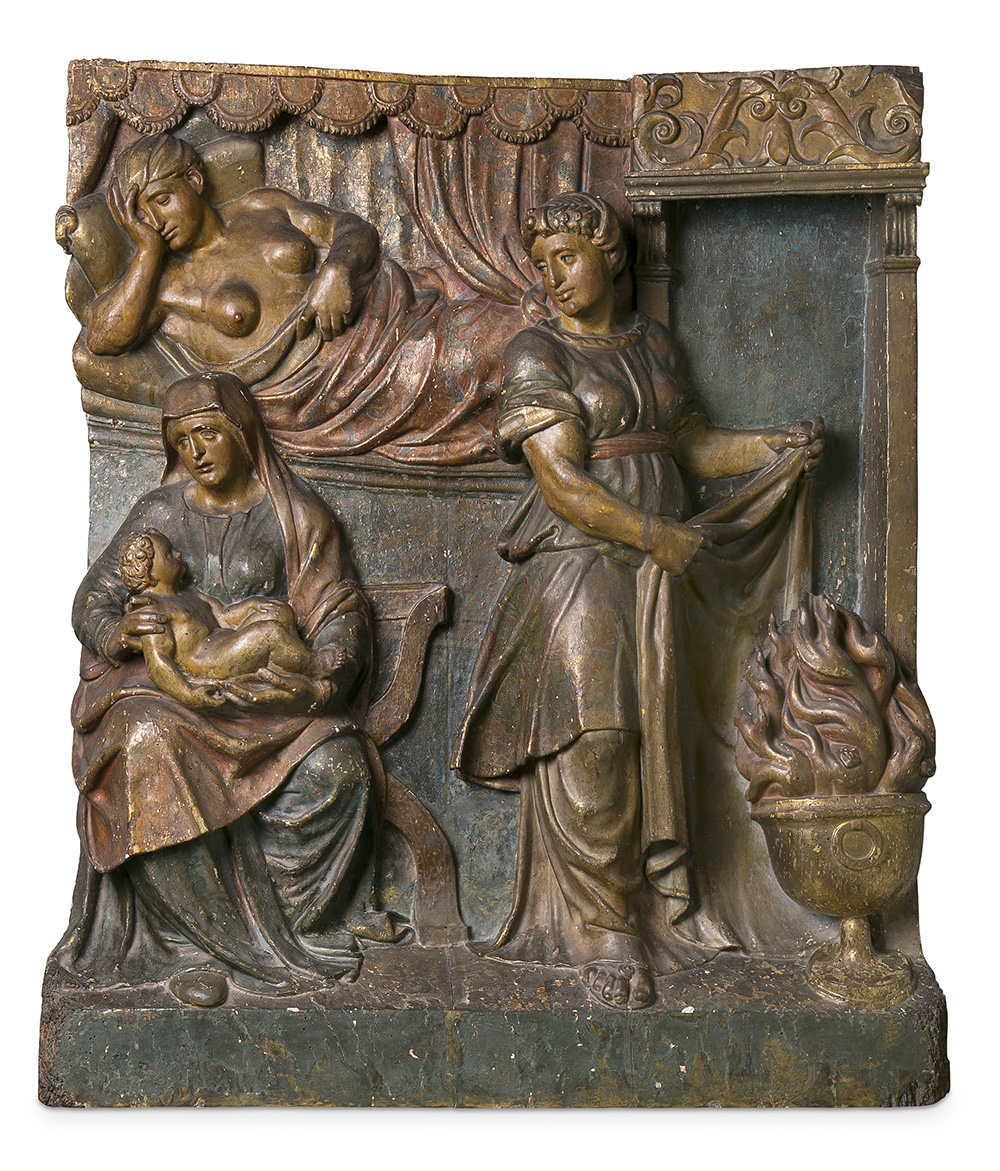
Juan Sáez de Torrecilla, Nativity of the Virgin Mary, Palencia, 1570-1582, Polychrome carving
In 1633, Bernini sculpted different faces representing each of the different stages of childbirth on the coats of arms on Saint Peter’s Baldachin in the Vatican. However, we do not typically find images from the past that realistically depict childbirth. Yet, thanks to the non-canonical narrations in the apocryphal gospels on the nativity (Proto-gospel of James, Pseudo-Matthew, De nativitate Mariae…), the Christian tradition features numerous works that celebrate the first moments after childbirth. This is the case of the birth of the Virgin Mary, often represented with greater verisimilitude than the typical miraculous images of the Infant Jesus. In this relief, Saint Anne is shown lying on the bed, resting after giving birth, with a wet-nurse breastfeeding the child and another woman drying the swaddling clothes.
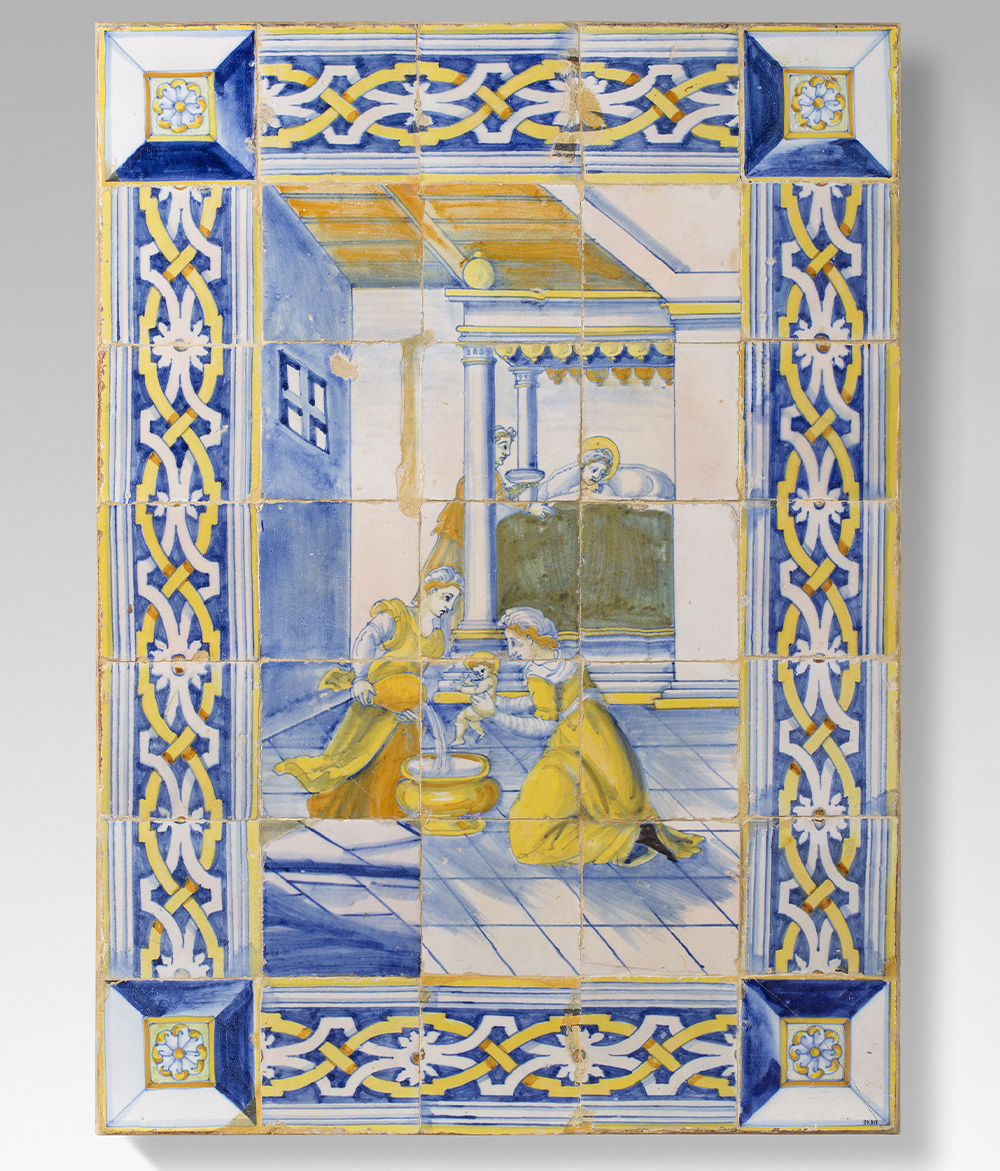
The Nativity of the Virgin Mary, Last quarter of the 16th century. Talavera de la Reina (Toledo).
When representing childbirth, many works of art often resort to memorializing a baby’s first bath in a washbasin or bathtub. This task was typically carried out by the midwives and assistants while the mother rested in bed. The women ran a warm bath, sometimes with a drop of wine, to remove the biological waste, and anointed the baby’s body with oil before covering them in swaddling clothes and wrappings. The apocryphal gospels do not provide as many details about the Nativity of Mary. However, these stories served as the starting point so that the tradition was able to develop its own iconography over the centuries which made it possible to humanize the image of the Virgin Mary and the Baby Jesus, thus making them more relatable.
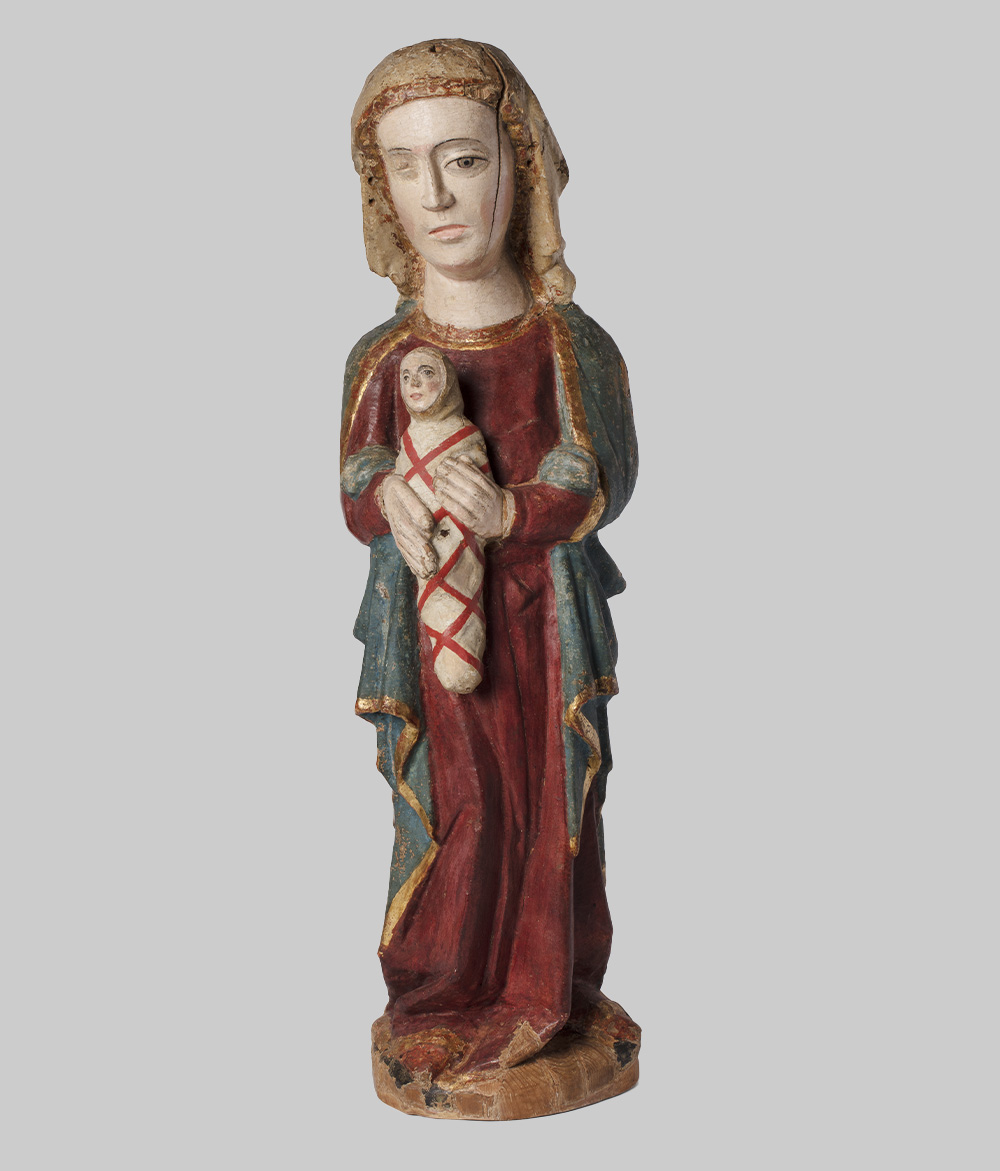
Virgin with Child, Catalonia, 14th century, Polychrome carving, Museu Frederic Marès, MFM no. 847 847. Photography: © ArtWorkPhoto.eu
Newborns were represented with their entire body tightly wrapped, often with white swaddling clothes and all kinds of coverings, leaving only their heads bare. This common practice in both the Roman and Mediaeval eras lasted throughout the ancien régime, serving to protect the newborn’s body until the fourth month. This practice ensured that the child was completely immobilized to avoid risks out of fear that the body would become deformed due to the baby’s erratic movements, while it helped keep their body warm and, according to tradition, relaxed the infant. As this carving shows, the widespread presence of this iconography of the newborn Jesus is significant. We can understand how a representation of the child made it possible to empathize with him and make the gospel more approachable for the faithful, although it is interesting to note how, starting in the 15th century, precisely when Christ became humanized, he also started to be depicted nude. In any case, completely swaddling newborns was a practice which, although discouraged by the most recent medical studies, lasted until the mid-18th century, in the era of the Enlightenment and the discovery of the importance of childhood.
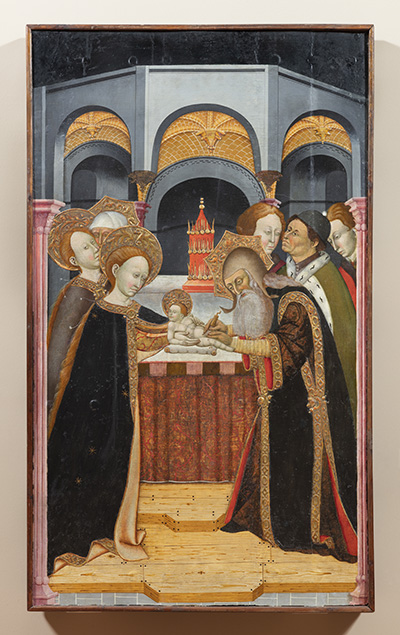
Coming from the main altarpiece of the parish church of Santa Maria de Verdú, together with the altarpiece of the chapel of the Paeria in Lleida, this piece represents one of the greatest works by the painter from Lleida Jaume Ferrer II. Among the scenes on the altarpiece, we can find the circumcision of Jesus. The Gospel of Luke (2:21) explains how the child was circumcised on the eighth day after he was born, in accordance with the Hebrew tradition. Normally, this was a ritual that was practised at home, although the mediaeval artistic tradition typically placed the scene in a temple, with a bit of added poetic licence, imagining that the event took place in the presence of the Virgin, who should have been on bed rest after childbirth. The naturalism of the International Gothic is shown in this scene in all its splendour, with the accurate portrayal of the priest’s face and Mary’s tears.
Jaume Ferrer II, Circumcision, Altarpiece from Verdú, c. 1432-1434, Tempera and gold leaf on wood 1777. Photography: © Museu Episcopal de Vic, photographer Enric Gracia.
Concepts of motherhood
The concept of motherhood, just like that of fatherhood, has changed over time. We find it abundantly present in Ancient Greece, through the Greek figurines known as kourotrophoi, images of mothers breastfeeding children, likely often used as an amulet with protective purposes, or as votive images expressing appreciation. Until the modern age, European representations of breastfeeding focused on the figure of the Virgin Mary, although it occasionally included Saint Anne. It wasn’t until the 17th and 18th centuries that the more secular representations of motherhood became commonplace, whether as mothers or wet-nurses. The Enlightenment above all witnessed the appearance of novel voices when trying to understand the value of motherhood and the first stage of childhood growth under a mother’s gaze. In art, as a reflection of society in past centuries, women’s role in caring for children has always been predominantly from a tender and close perspective.
This scene was painted in oil on wood on the central panel of the altarpiece of the church of Canapost, in the Baix Empordà, portrays long-standing iconography in Christian art that is known as the Virgo lactans, that is, the representation of breastfeeding as a manifestation of Mary’s motherhood and, also, as a symbol of the Virgin’s role as an intercessor. In this case, following a realist style with Hispano-Flemish influence, the master from Canapost crafted a delicate, serene and emotional representation of the Madonna, surrounded by angelic musicians, with eyes nearly shut, veiled by chastity, yet still attentive to the nursing babe whom she presses close to her left breast.
Master from Canapost, Nursing Madonna, from the altarpiece of Sant Esteve de Canapost
Second half of the 15th century, Oil and gold leaf on wood. Museu d’Art de Girona, MDG no. 293. 293. Bishopric of Girona Fund. Photography: Rafel Bosch.
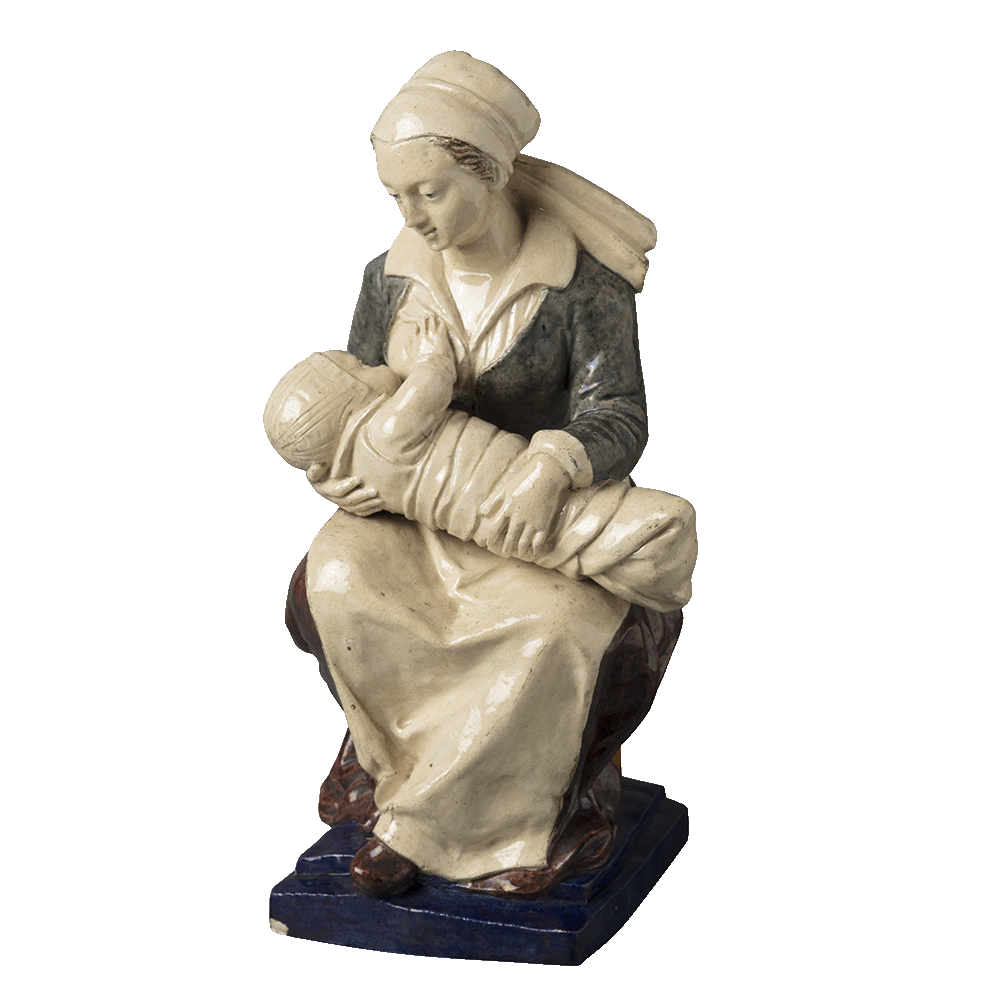
Georges Pull, Wet-nurse, c. 1860-1880, Polychrome pottery. Museus de Sitges
The bond between mothers and their babies became closer in the modern era, especially as of the late 18th century with the rise of the bourgeois family model. Motherly affection made many women decide to breastfeed their own children instead of delegating this responsibility to a wet-nurse. Wet-nurses were women who breastfed other women’s babies professionally, whether due to the biological mother lacking natural milk or due to social reasons. They were often in charge of taking care of orphaned children. The polychrome pottery figure of this wet-nurse was copied in the 19th century from the original 17th-century piece by the French sculptor Guillaume Dupré, preserved at the Musée national de céramique in Sèvres, and was acquired by the Museu de Reproduccions Artístiques de Barcelona.
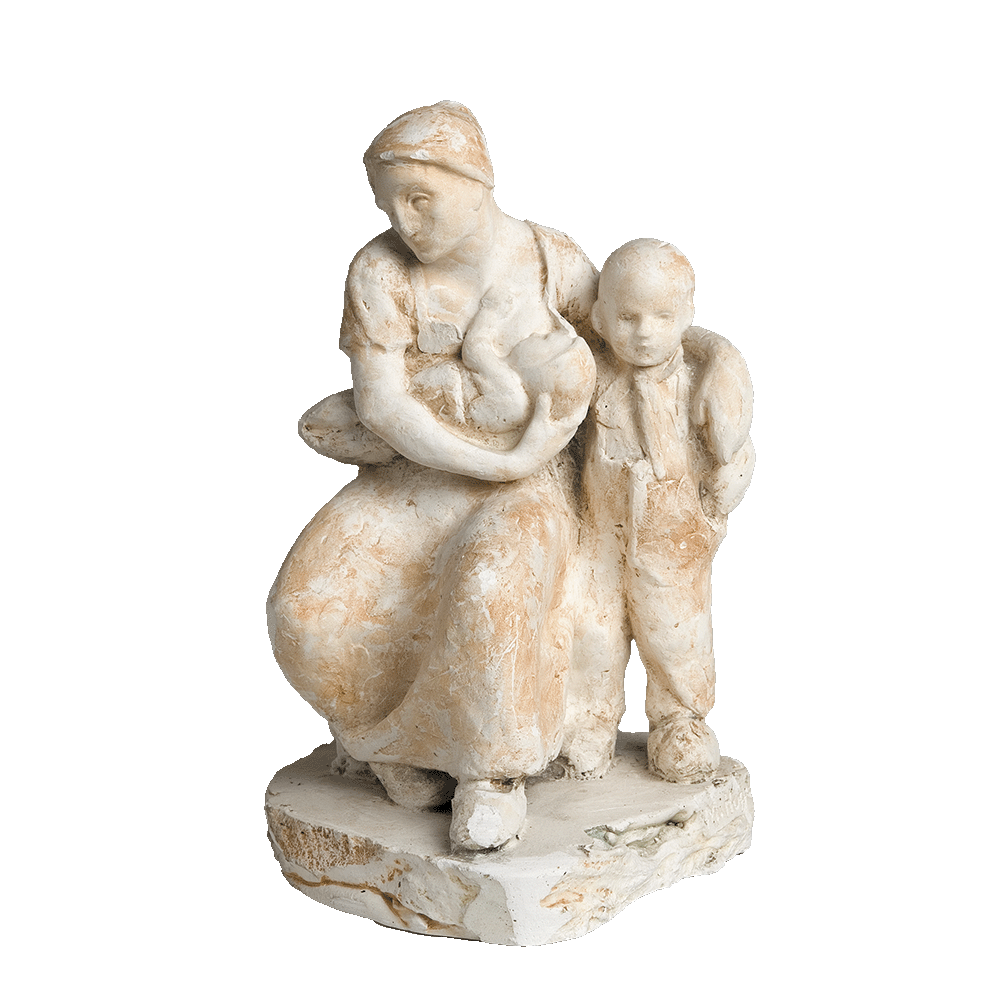
Manolo Hugué, Motherhood, c. 1897-1900, Painted plaster, Cau Ferrat, Sitges
This representation of motherhood, modelled using plaster possibly during one of the many times Manolo Hugué stayed in Cadaqués in the late 19th century, is the only piece preserved from the early part of the sculptor’s career, prior to his trip to Paris in 1900. This was a time during which he nonetheless achieved initial recognition in Barcelona’s arts scene. Hugué, one of the most brilliant Catalan sculptors from the first half of the 20th century and the creator of many other depictions of motherhood, and even some of fatherhood, in this case modelled a set of sculptures full of compassion following the turn-of-the-century aesthetic. By placing an emphasis on the social outlook that he shared with many postmodern friends, such as Gargallo, Fontbona and Picasso, he created the modern image of a mother of modest means breastfeeding a newborn as she hugs her other child.
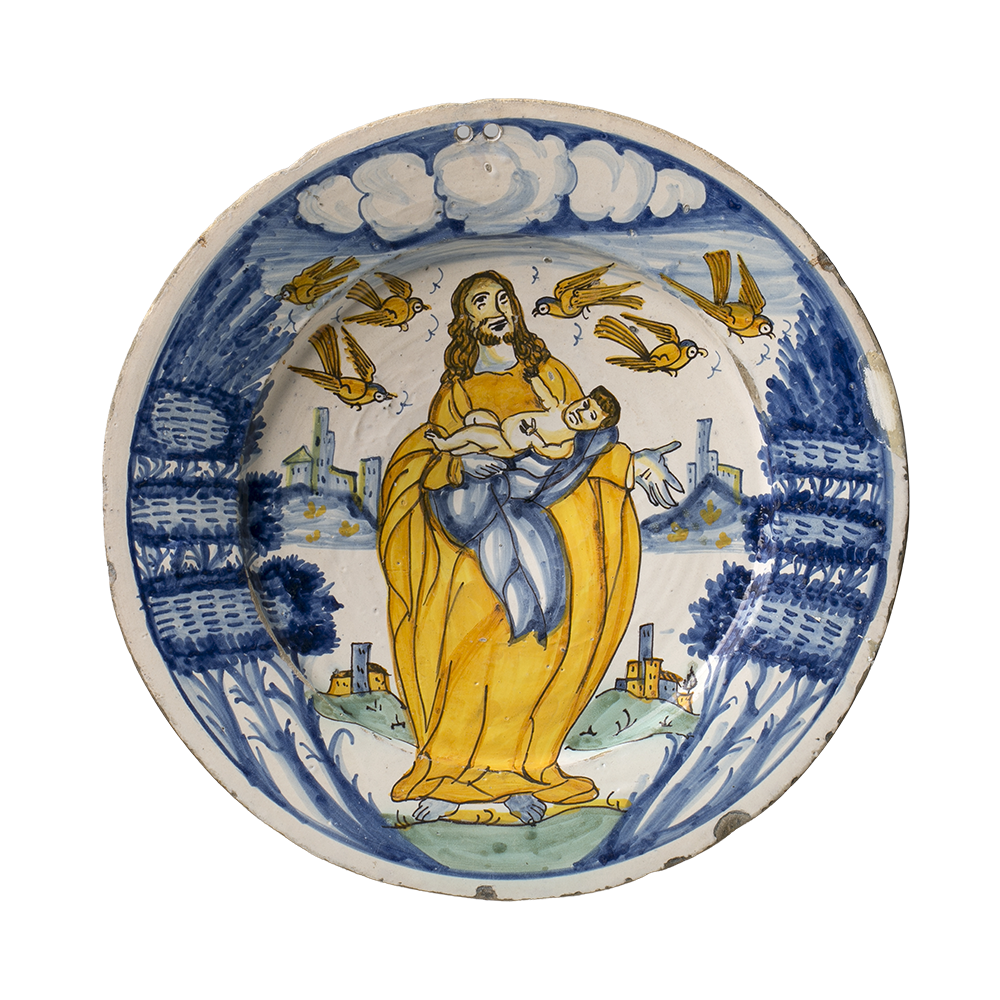
Plate decorated with Saint Joseph and the Child, Barcelona, late 17th century – early 18th century
Polychrome pottery. 37 cm, Cau Ferrat Consorci del Patrimoni de Sitges, MCFS 30.069
The Xarxa de Museus d’Art de Catalunya boasts a large number of depictions of motherhood from numerous eras, from Gothic carvings and altarpieces to modern sculptures from artists including Llimona and Gargallo that portray women breastfeeding their children. On the contrary, we do not frequently find portrayals of fatherhood, a fact that should not surprise us if we consider that society’s role for fathers never included childcare: “this first education undeniably belongs to women: if the Author of nature had wanted it to be a matter of men, he would have given man milk to nourish the children”, Rousseau argued. However, we can find scenes like this Catalan Baroque plate, from the series of girdles and belts, where Joseph, who according to numerous apocryphal gospels had been the father of four sons and two daughters from a marriage before his time with Mary, appears with a baby boy in his arms. Saint Joseph always took on a secondary role in the iconography of the baby Jesus, although his status as an adoptive, rather than biological father, allowed him at times to be represented taking care of the baby.
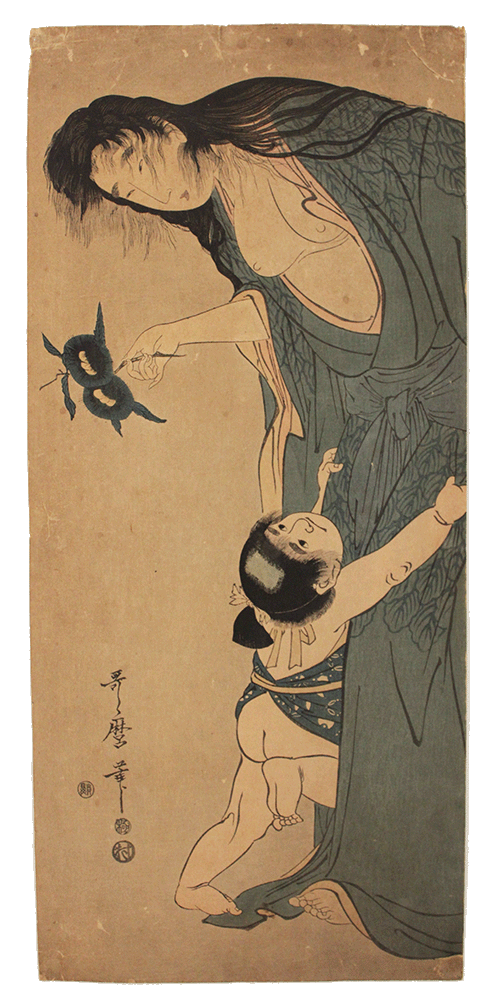
Kitagawa Utamaro, Yamauba and Kintarō, c. 1804-1805, Original edition by Murataya Jirobei (reprint from 1912), Colour woodcut. Museu Abelló
One of the most popular depictions of motherhood in Japanese art is the representation of Yamauba with Kintarō. According to legend, Yamauba, a mythical, wild mountain woman, half human, half demon, raised the orphan boy Kintarō after he was abandoned on mount Ashigara by his father. Nurtured and nursed by Yamauba, Kintarō became one of the most beloved heroes of Japanese folklore due to his bravery and superhuman strength. Among the many representations created by the ukiyo-e school of artists, and by Utamaro in particular, the scene from this stamp portrays Yamauba holding a stick with chestnuts and with her kimono open, showing her nude breasts, perhaps just about to breastfeed the still young Kintarō.
![[30] TogoresDiapo copia_2](https://xarxa.museunacional.cat/wp-content/uploads/2025/12/30-TogoresDiapo-copia_2-716x1099.jpg "[30] TogoresDiapo copia_2")
Togores painted Un borratxo (A Drunk) at the beginning of his career, between late 1910 and early 1911. Around 1910 Togores created the oil painting The madman of Cerdanyola, which was acquired by the Belgian government after being unveiled at the Sala Parés and displayed at the Brussels International Exposition. The praise he received from critics such as Joaquim Folch i Torres encouraged him to paint Un borratxo (A Drunk), which won an award at the 6th International Art Exhibition of Barcelona (1911). The work shows a family’s masover (male sharecropper) dancing while drunk. Seated by his side as a counterpoint to the man’s irresponsible attitude is his wife, a masovera, who as with many other women from the lower class, also worked as a wet-nurse, caring for a young child under the blazing sun. In contrast with the foreground that features this humble family, in the background Togores added several fair-haired children from bourgeois families on summer break all dressed in well-ironed white clothing, laughing at the peasants. The work was painted by Togores when he was only 18 years old, shortly after being introduced by Folch i Torres as an emerging talent: “a young man; more than a young man he’s a child. And despite that and his young age, he has started his career as a painter, as if he were a revolutionary master”.
Josep de Togores, Un borratxo (A Drunk), 1911, Oil on canvas. Museu d’Art de Cerdanyola, MAC
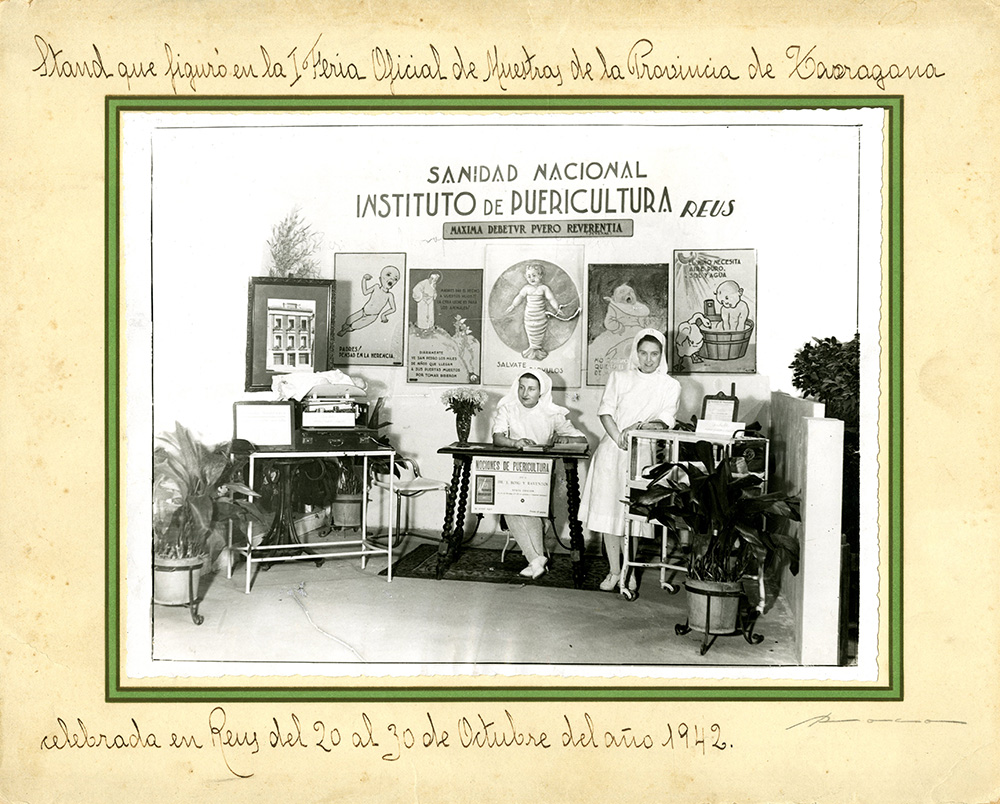
Throughout the 19th century and during the first half of the 20th century, paediatric clinics, medical offices for new mothers, spread to promote breastfeeding and help out the most vulnerable families. This photograph shows a stand advertising one of these centres, the Institut de Puericultura de Reus, created in 1917 and popularly known as “La Gota de Llet” (the Milk Drop). Like most, this was a free clinic dedicated to breastfeeding infants. It dispensed sterilized milk, breastmilk and other nutritional foods in order to reduce infant mortality. The centre also organized community outreach activities and taught parents to care for their children in a healthy manner. The background of the image includes five illustrated posters that show the concerns for caring children and ensuring their health in the midst of the postwar period.
Stand of Institut de Puericultura de Reus a la Primera Fira Oficial de Mostres de la Província de Tarragona, 1942, Photograph. Museu de Reus (IMRC. MRF Frias Fund)
The age of play and innocence
Erasmus of Rotterdam wrote in his Joy of Folly (1509): “Everyone knows that by far the happiest and universally enjoyable age of man is the first.” Although many children have been forced to work from a young age, the first stage of life has always been identified with boundless and limitless joyful times of play, as Pieter Bruegel the Elder immortalized in the oil painting Children’s games (1560, Kunsthistorisches Museum, Vienna). Many of the images of children between two and ten years old that we find in works of art recall those times of innocence and happiness, an age often dedicated to play and learning.
Distancing itself from the priestly nature of Romanesque art, which majestically enthroned the depictions of the Virgin Mary, Gothic art frequently includes the representation of figures that stand out for their humanism without rejecting religious symbolism, with a relatable and familiar Infant Jesus taken from episodes of apocryphal gospels. This is the case of the Virgin with Child by Berenguer Ferrer from Manresa (Museu Frederic Marès) or the majestic Virgin Mary from the monastery of Santa Maria de Bellpuig de les Avellanes. In images like these, the infant Jesus is being held in the arms of the Virgin Mary, playing with a goldfinch depicting one of the miracles narrated by the apocryphal Infancy Gospel of Thomas, which explains Christ’s early years. According to this apocryphal tale, when Jesus was only five years old, he used to play by making models of birds using the mud from a stream bed, into which he breathed life by clapping his hands so that they could fly.
![[33] 3772_1](https://xarxa.museunacional.cat/wp-content/uploads/2025/12/33-3772_1-scaled-274x671.png "[33] 3772_1")
Attributed to Bartomeu de Robió, Our Lady of Bellpuig de les Avellanes, Lleida school, 14th century
Polychrome stone. Museu de Lleida
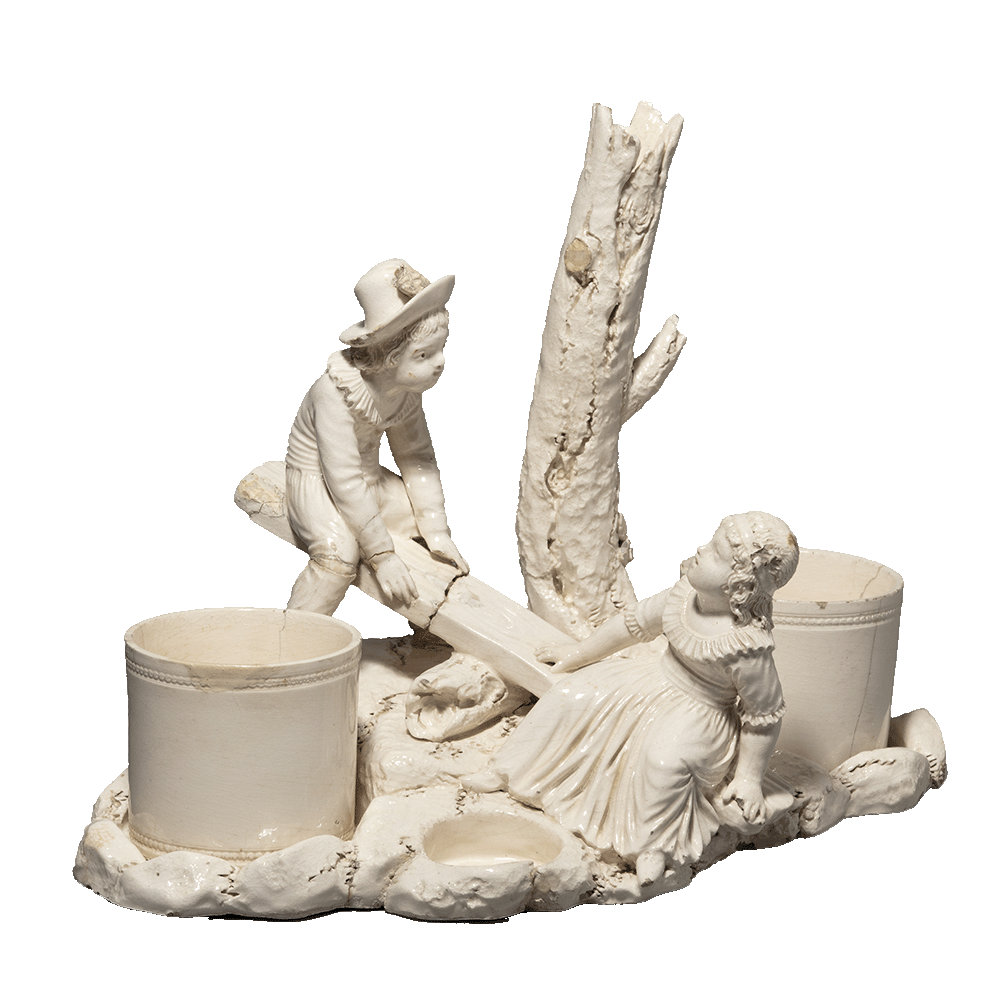
Plate from Alcora, Late 18th-Early 19th century, Pottery. Museu del Disseny de Barcelona, no. 18796 18.796
This playful scene, where a boy and a girl have fun atop an improvised seesaw made out of a log and a wooden board, tells us of the new charming and bucolic aesthetic, albeit with a popular taste and sober style, which was commonplace in the neo-Classical era. The creamy colour of the ceramic earthenware pottery evokes the success of the English creamware or white pipe clay products that were imported in the late 18th century by the Count d’Aranda to the Valencian manufacturers in Alcora. As production was exorbitantly expensive, a decision was often made to manufacture these types of decorative ceramic objects coated with a creamy-white enamel to imitate the luxurious original creamware.
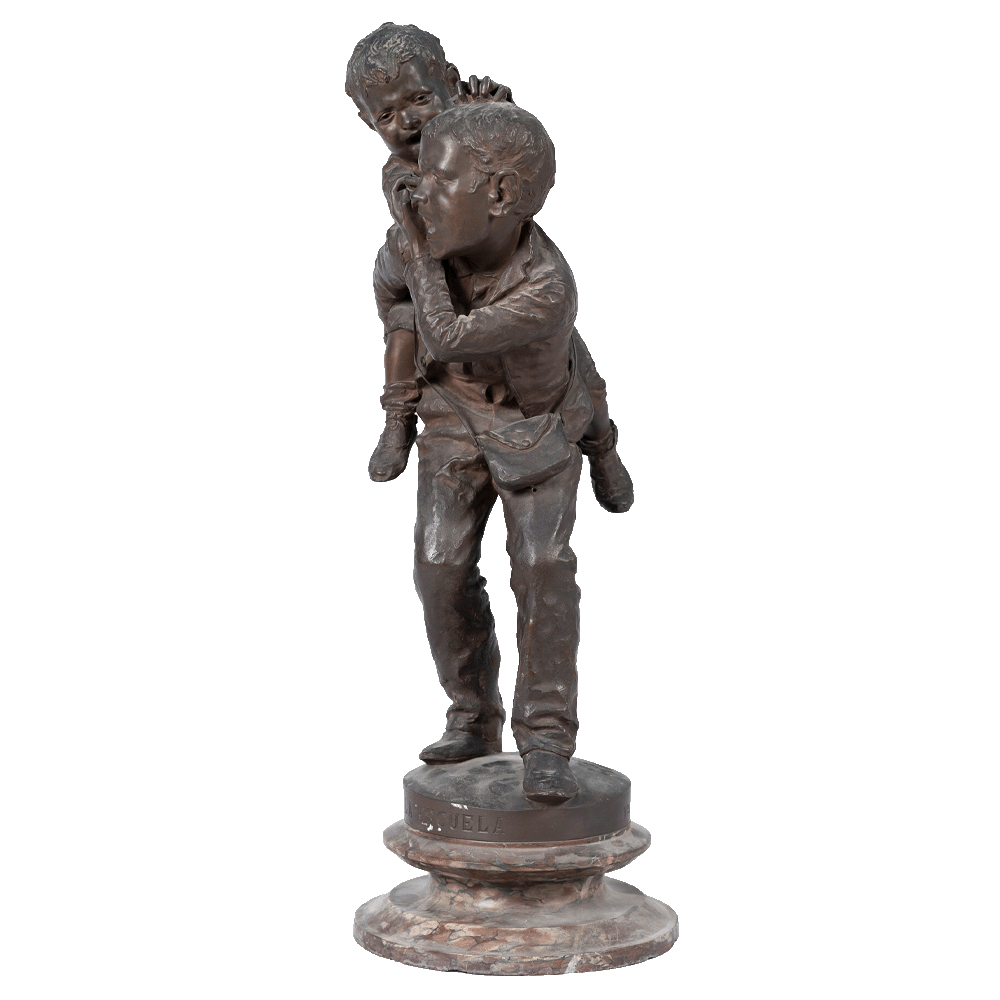
Emili Benlliure Morales, To the school, 1888, Bronze. Museu Nacional d’Art de Catalunya, no. 10567 10567
With the bronze piece entitled To the school, Emili Benlliure revisited a theme as old as art history itself: representing laughter and joy through one of the most popular games of Ancient Greece, riding piggyback (ephedrismos). Benlliure, who in March 1886 had exhibited the sculpture of a young boy named Swindler at Sala Parés, presented a series of terracotta sculptures named A girl at school at the Barcelona Universal Exposition. In parallel with the reproduction of the cover of La Ilustració Catalana in February 1888 of a sculpture by Mariano Benlliure, entitled To the water!, where a playful little girl launches a small boy into the water against his will, Emili Benlliure modelled this other image of childhood and schooltime fun and games. To the school was cast in bronze in the Viuda de Cabot e hijos workshop a few months later and was presented at the Sala Parés in June 1889. The legacy of Benlliure sculptors modelled, sculpted and successfully cast many images of children’s games and shenanigans, like this one, at the end of the 1800s.
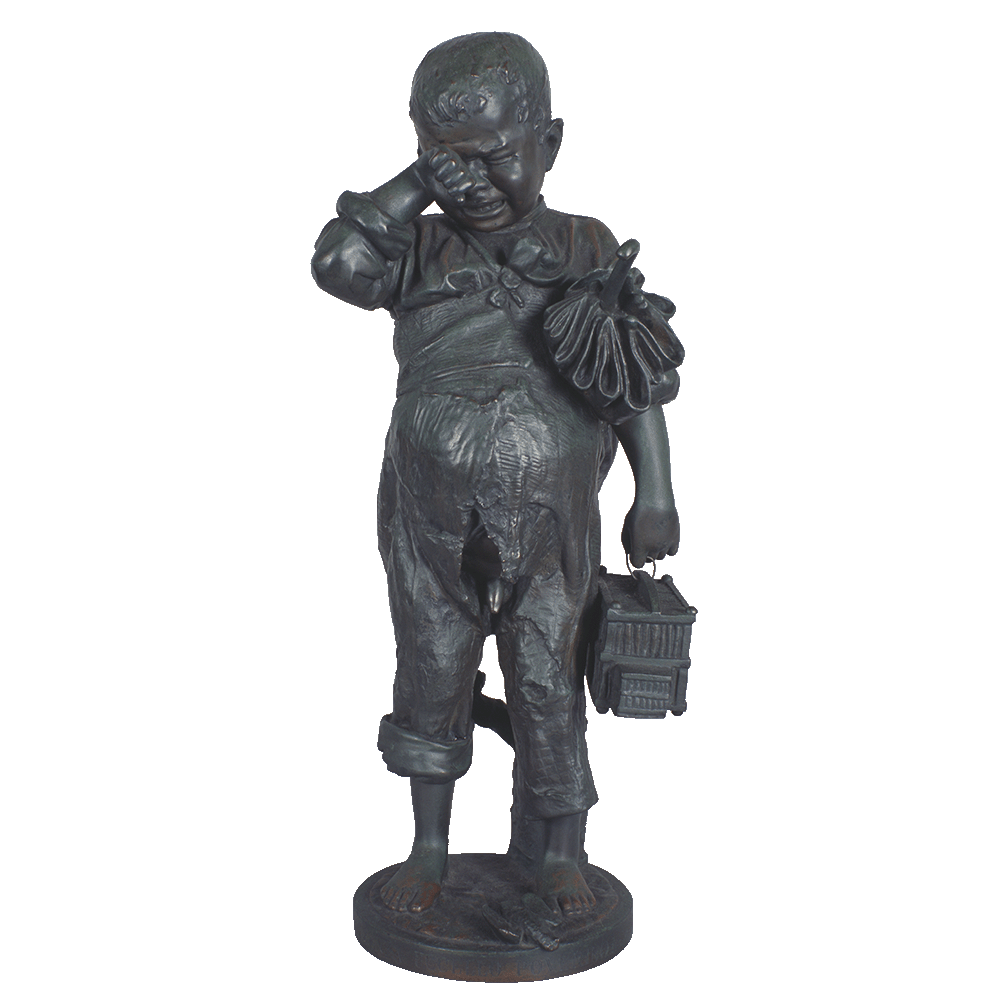
Torquat Tasso, Lost bird, poor boy!!, Barcelona, c. 1891 1891. Bronze with a black patina, lost-wax casting (Fundició F. Usich). Cau Ferrat, Sitges
Childhood isn’t always depicted as fun and games or happy faces, it’s also frequently represented as the fragile boundary between laughter and crying, and how quickly and starkly these moods can change in children’s lives. Smiles and tears are equally intense sensations. In this case, however, the child isn’t crying because he got caught breaking the rules, but rather due to losing his bird, whose body lies motionless at his feet. This is a realistic and tender portrait, following the trend in this genre of sculpture and the interest in images with a story to tell. The piece was initially presented in terracotta at the Exhibition of Fine Arts of the Sala Parés in February 1884 and was subsequently cast in bronze. In addition to this example by Santiago Rusiñol preserved at Cau Ferrat, a second copy of the sculpture was on display in spring 1891 at the First General Fine Arts Exhibition in Barcelona, where it was acquired by the Diputació de Barcelona.
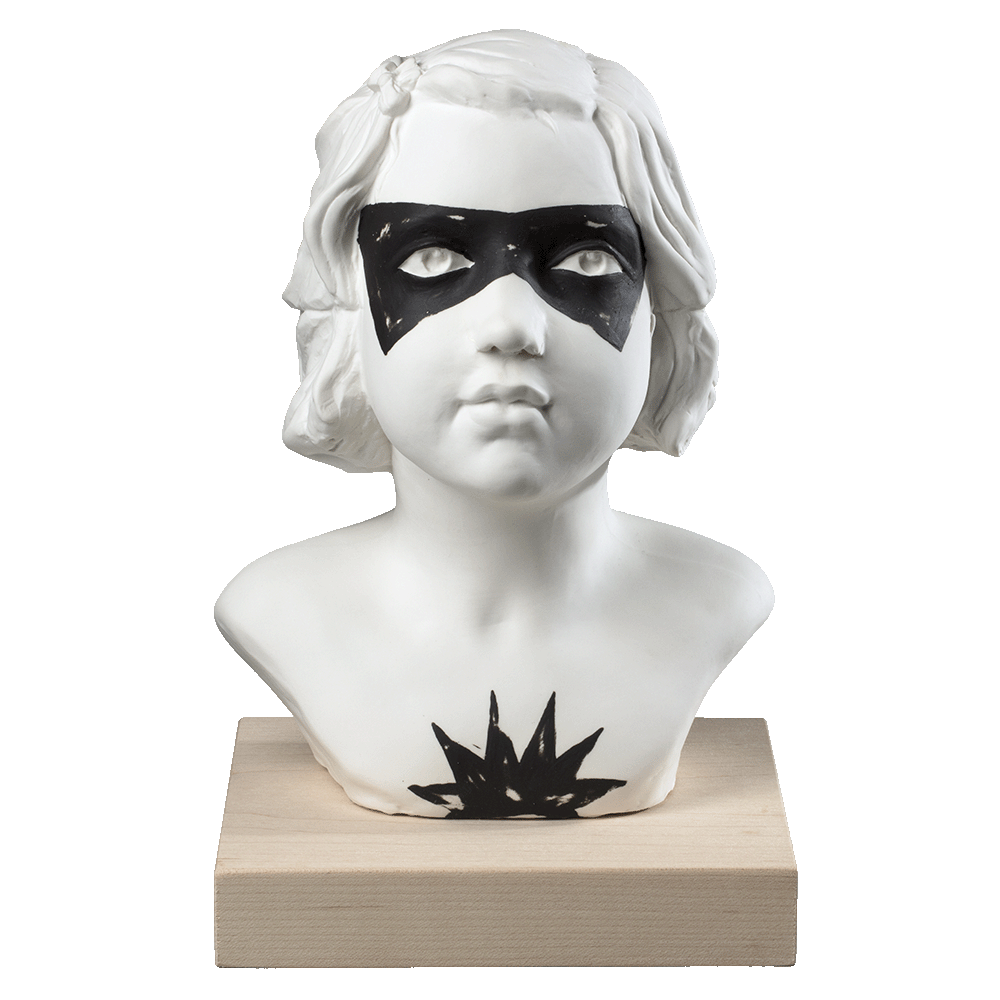
Núria Torres, Superheroes, 2017, Porcelain. Museu del Disseny. Photography: Guillem Fernández-Huerta
With the series Superheroes, Núria Torres, who frequently works with both marble and porcelain sculptures, approached childhood from an adult’s perspective, with complete admiration. The various childlike busts of boys and girls from the series were conceived by playing with the effects of the material’s white colour and use of polychrome applied to porcelain, in this case with only masks and emblems in black. Thus, starting from the apparent oxymoron of a porcelain heroine (is anything more fragile than porcelain or more resistant and noble than a superhero?), the artist manages to portray the inexhaustible imagination of childhood and its worlds of dreams and fantasy.
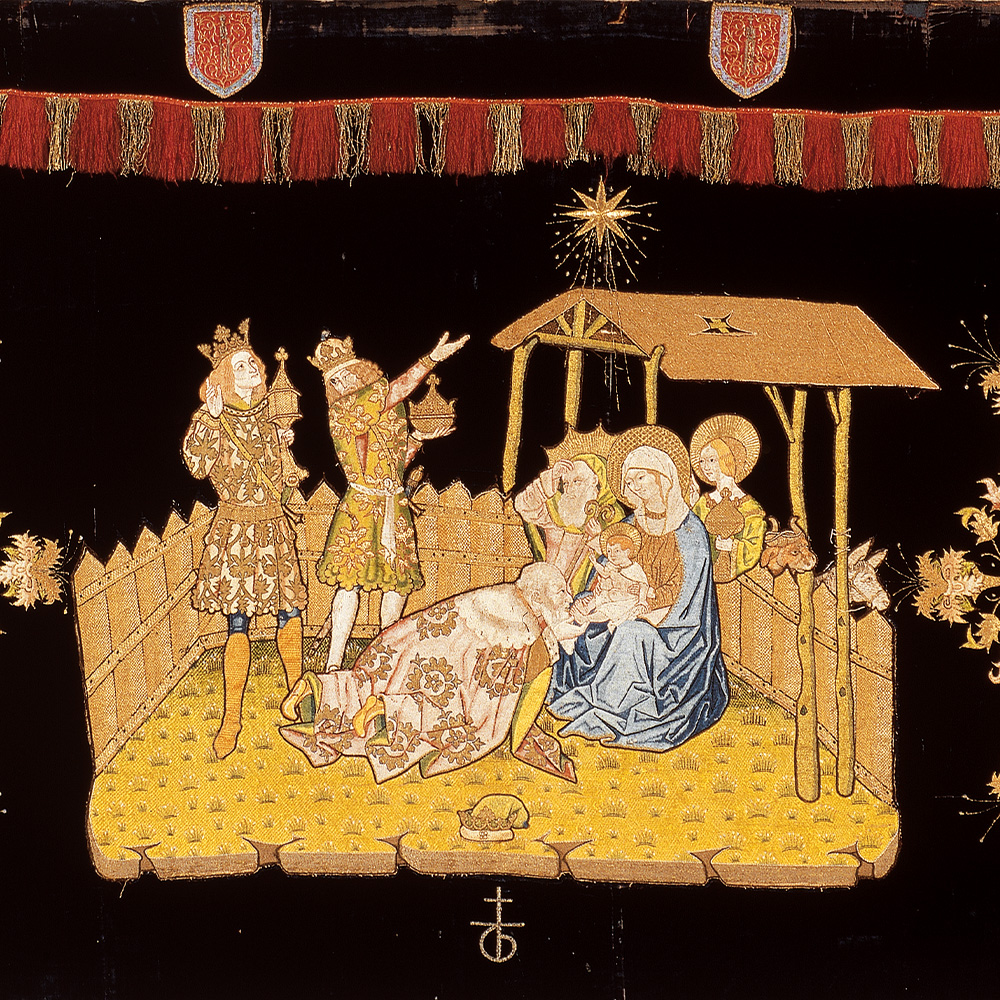
Frontal of the Epiphany, Second half of the 15th century, Linen, silk, silver, gold and silver sequins
Museu Episcopal de Vic, MEV no. 1949. Photography: © Museu Episcopal de Vic, photographer: Joan M. Díaz
The description of the Epiphany in the Gospel of Matthew, as well as in other subsequent texts, quickly spread to become one of the most widely represented scenes of Christ’s childhood. Later, it became the origin of one of the most highly anticipated Christmas traditions for children. The Museu Episcopal de Vic, which features one of the most important liturgical textile and garment collections in Catalonia, includes a valuable piece that reflects this: the Frontal of the Epiphany. From the monastery of Sant Joan de les Abadesses, the piece was commissioned in the mid-15th century by the priest Joan de Robia and Jaume Tenes. The piece stands out for the exquisite scene of the three kings embroidered on velvet with an incredible pictorial sense. In the manger we can see the Virgin Mary with the Baby Jesus sitting on her lap, accompanied by Saint Joseph, Salome, the midwife that the apocryphal gospels mention, the ox and the mule. In front of the Holy Family we find the three wise men dressed as 15th-century nobles: Melchior kisses the baby’s feet, while Balthasar and Caspar, with the offerings in their hands, gaze at the star that has guided them to the manger.
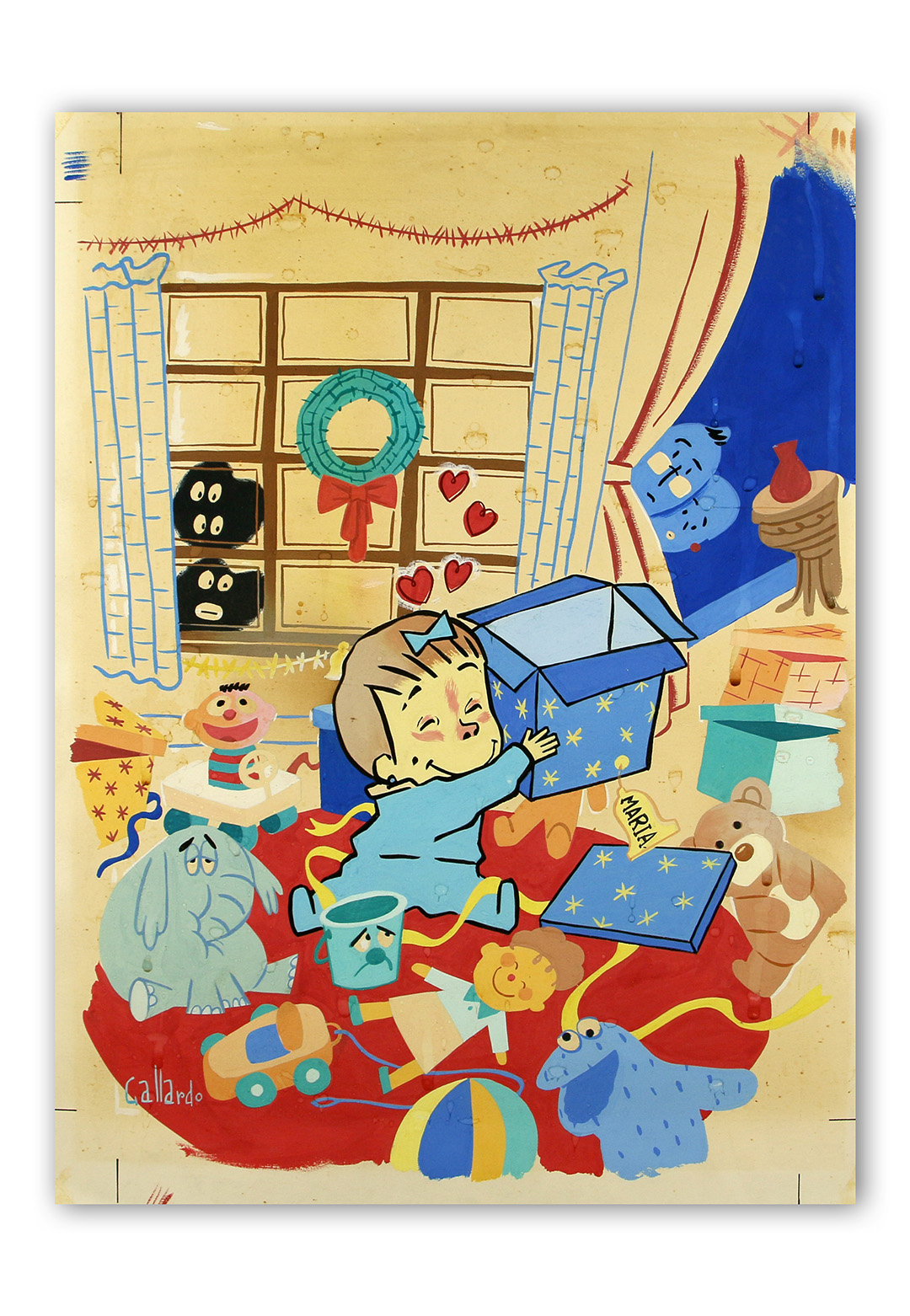
Miguel Ángel Gallardo, Untitled (María), Gouache on paper, Museu Morera, Lleida, no. 4530 4530
Children excitedly await receiving gifts like nothing else, especially birthday gifts or holiday gifts from the Three Kings, Santa Claus or Father Christmas. Just as the Catalan visual industry helped make illustrated publications commonplace, the images of children with their wish lists for Three Kings Night became increasingly frequent, especially once the first kids’ magazines started to appear, like En Patufet (1904) or, years later, Cavall Fort (1961). This imaginary has always been present since then, with endless representations of children with their favourite toys.
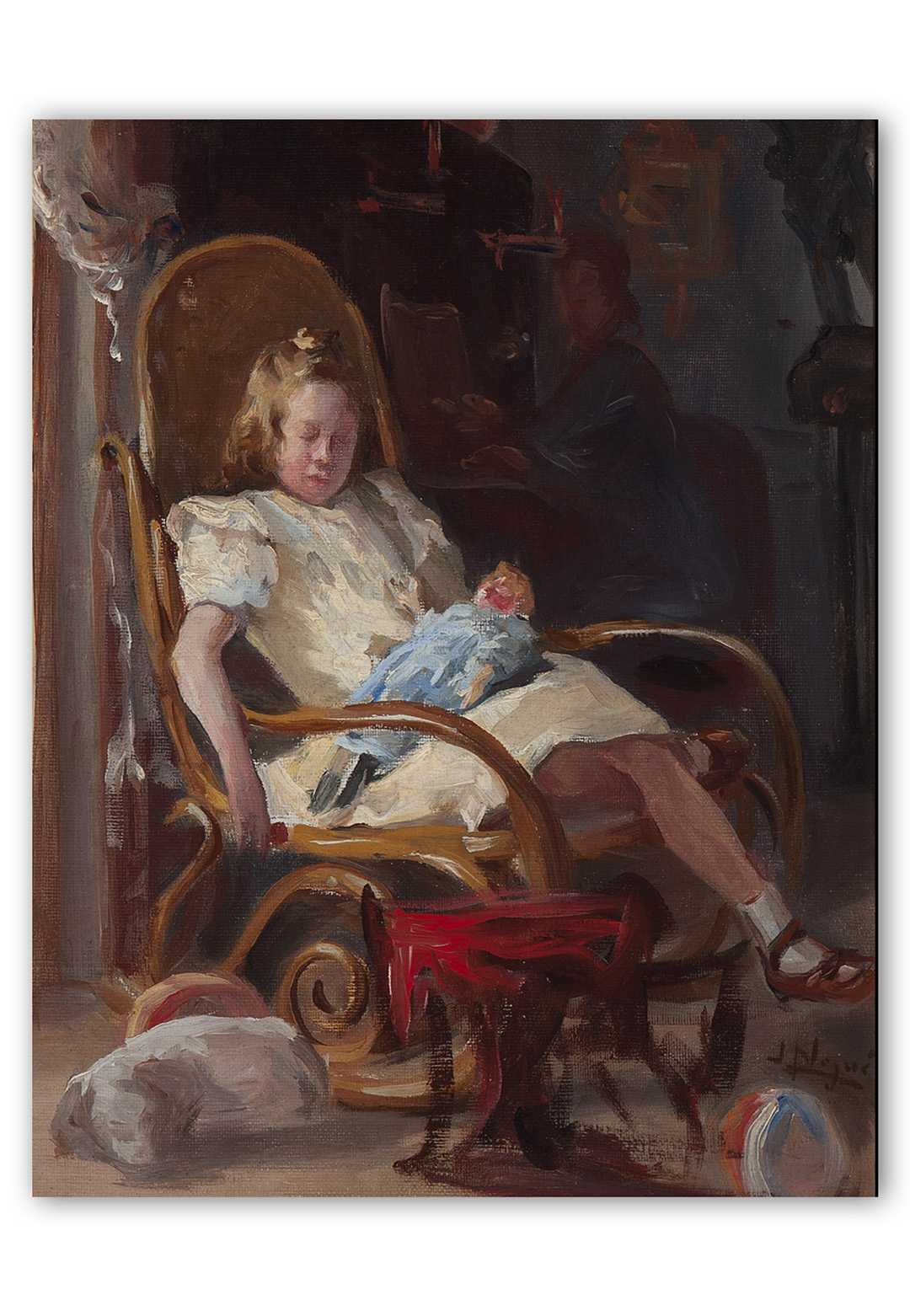
José Nogué, So happy!, 1901, Oil on canvas. Museu d’Art Modern de Tarragona, no. 1260
1260. Photography: Diputació de Tarragona. Museu d’Art Modern. Arxiu fotogràfic (Lila Alberich Fotografia)
While boys often appear in action-packed games, whether riding piggyback or in the middle of the street, girls on the other hand are often represented in domestic spheres in less active situations, generally playing placidly with dolls at home. In large part, childhood games and toys, falsely considered innocent, established rules of behaviour and customs that adulthood would reinforce. In this way these games reproduced the gender stereotypes and roles that society upheld for them during adulthood, while the games themselves became a way of learning through trial and error: “A girl without a doll is just as much a disgrace and as impossible as a mother without children”, Victor Hugo wrote in Les Misérables. This was made evident in this painting by José Nogué, a painter from Santa Coloma de Queralt who trained in Madrid, when representing a pensive, happy little girl sitting in a rocking chair with her doll on her lap.
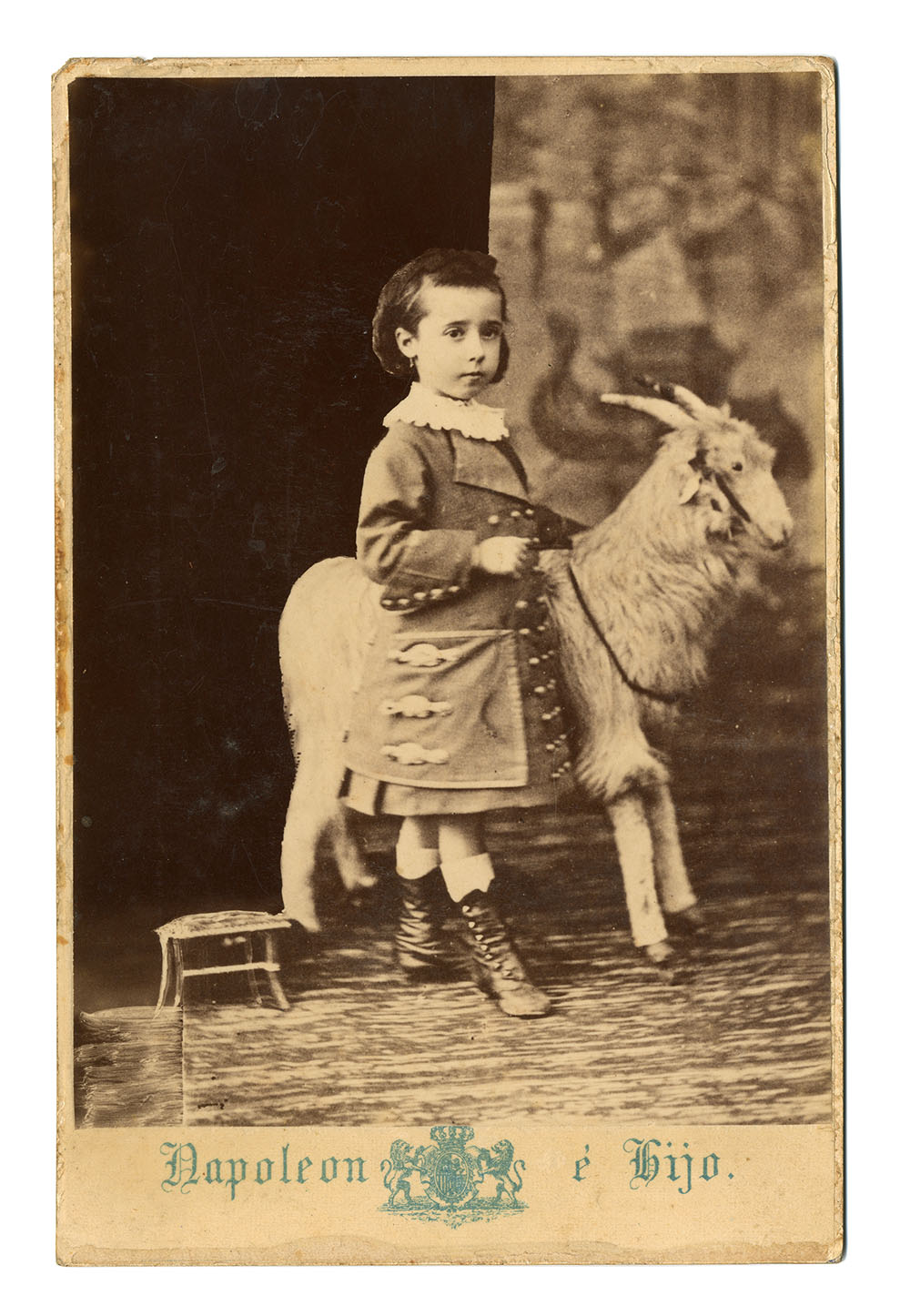
Napoleón e hijo, Portrait of the young girl Concepció Salgado Mercader, c. 1880-1890 4864. Photography: © Museu Frederic Marès
As advances in photography started spreading and especially after A.A.E. Disderi patented the carte de visite in 1854, photography became more democratic and turned into a widespread, affordable social practice to remember the family members in their different stages of life, including childhood. In this case, the girl was portrayed with one of the fancy toys that must have been in the studio of the renowned photographers Napoleon e hijo in Barcelona, posing in front of a goat with her hand on it to stay quite still and ensure that the image didn’t turn out blurry.
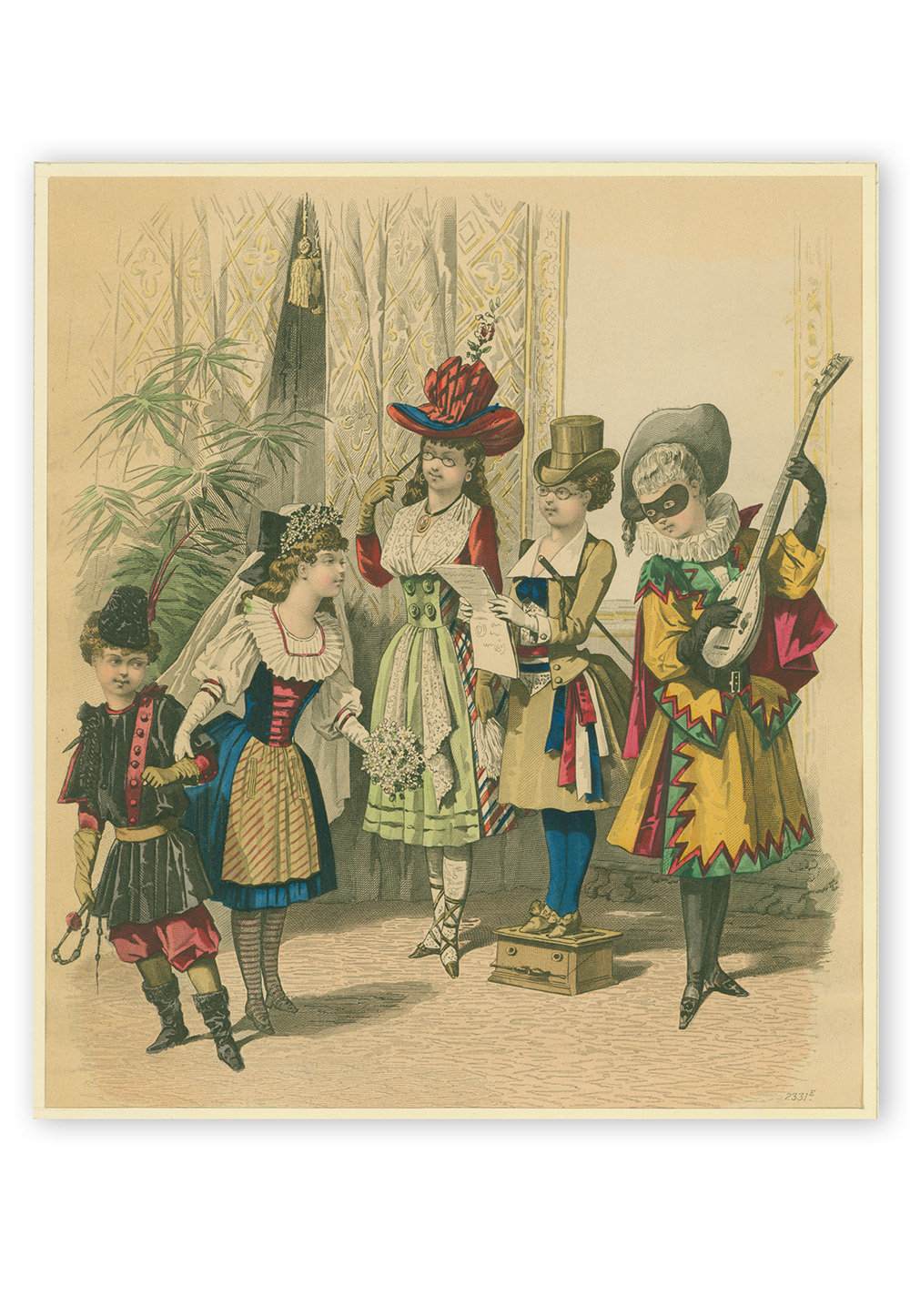
Fashion plate, c. 1880, Colour engraving. Museu Frederic Marès, MFM no. S-1062. Photography: © Museu Frederic Marès
L’avenç de la tecnologia de la impressió i la difusió de la litografia van fer del segle XIX un segle marcat per l’augment de les imatges, que es van difondre en gran quantitat i a baix cost entre tota la població. Cases d’impressió franceses com les de Selle & Châlon o Mome et Falconer distributed a great number of illustrated colour prints throughout the second half of the 19th century that portrayed Parisian fashions and customs, many of which included in regular publications (Les modes parisiennes, Le moniteur de la mode, Journal des demoiselles, etc.), along with others sold separately. These scenes were mostly dedicated to the latest changes in women’s fashion, though they increasingly included images of childhood, like this Carnival stamp. Throughout the second half of the 19th century, masquerade balls and costume parties during Carnival progressively included costume contests, dances and parties intended for children, organized in some of the city’s main theatres.
Josep Palau i Oller, a multifaceted designer and artist, started his career as a cartoonist for the children’s magazine Papitu and a few years later, when his son Josep Palau i Fabre was born, he also delved into the world of designing and manufacturing toys. Researching the latest trends in the world of foreign-made toys and after visiting several trade fairs held in Barcelona, in 1917 he designed an initial line of artisanal and artistic toys that were put on sale in two of the city’s renowned art spaces: Galeries Laietanes and the Faianç Català. Palau i Oller’s toys were dynamic, they had a sort of device that allowed them to incorporate movement, and they may have had an influence on the creation of the famous wooden toys by Joaquim Torres-Garcia in subsequent years that were intended to be both constructive and educational.
Josep Palau Oller, Toy Model, 1917, Ink and gouache on paper. Fundació Palau
At the height of the Noucentisme movement, Marià Espinal approached the aesthetics of the new currents that revived classicism spreading throughout Catalan art with portraits like Child and kite (1915), preserved at the Museu d’Art de Cerdanyola, which evoked the image of children as a pure soul, a symbol of peace and innocence. Years later, during the bombardments of Barcelona at the height of the Spanish Civil War, while his family was sealed off in the basement of their home in Cerdanyola, Espinal made this popular toy for his three daughters: cutouts of female figurines made of paper, models of women to dress up with different outfits, whether as peasants or in the art déco fashion. As a Noucentista artist, Espinal had three daughters born within the movement’s ideal who went to play music (Abundia), do theatre and translation (Adelaida) and play sport (Núria). Of the three, only one ever got married. As the others always said, and as Laura Albéniz would also say, they got bored with men.
Marià Espinal, Cutouts, c. 1936-1939, Pencil and colour on paper. Museu d’Art de Cerdanyola, MAC
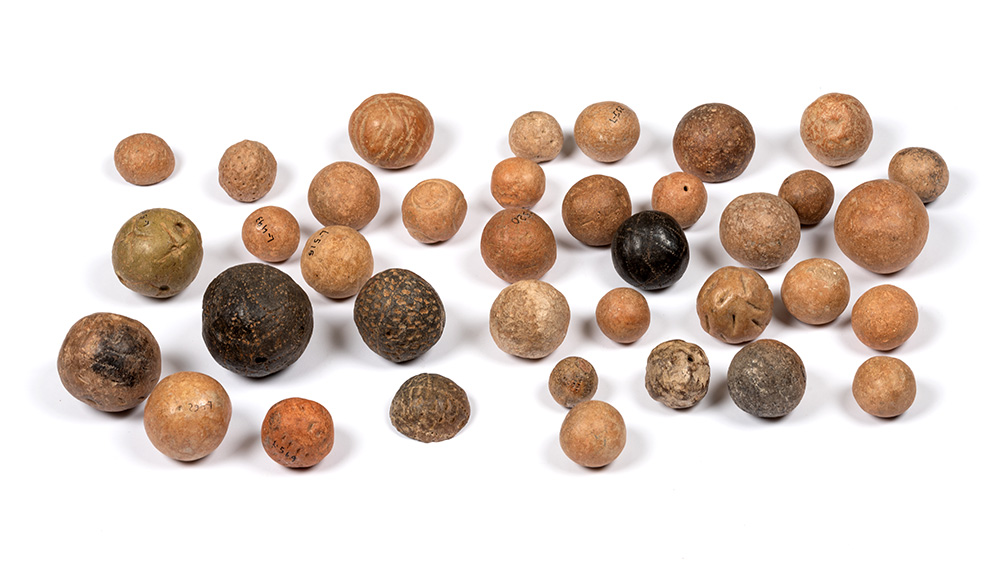
Balls and token, Late Iron Age Iberia, 3rd-2nd century BC, Ceramic. Museu Diocesà de Lleida, L-5682, L-5676, L-5678, L-5683, L-5684. Caixa 216.
Archaeology offers a solid testament for grasping and documenting how play has formed part of the lives of children, youth and even adults throughout the centuries. Archaeologists have found traces of this through ceramic fragments, stones, along with other lasting materials such as wood and ivory, in the form of figures, game boards, pieces and, for example, marbles. This is the case of the rocking horses, the little figures and balls of clay decorated in the Iberian age located in Poblat del Gebut, Soses (Segrià).
Society as a guide: Gender and education
The notions of childhood and family have not always remained static throughout history, but in the European case, the Catholic Church and the entire structure of the ancien régime rigidly defined a single model of Christian family, married, monogamous and patriarchal, which was continuously reproduced in art. This fact established a clear and defined role both for men and women, as well as for boys and girls. It wasn’t until the late 18th century that a modern conception of childhood development and growth started to appear, formed and understood per se based on Enlightenment thinking and the idea of freedom. In any case, despite the spread of modern educational and philosophical ideas, from the youngest age, boys and girls continued to be trained and guided through social institutions along a path marked by obedience, respect and submission within a rigidly pre-established hierarchical, authoritarian and sexist system. The family, the Church and social norms staked out a single destination for childhood that did not begin to crack until the 20th century thanks to the arrival of novel educational methodologies, the feminist struggle and the questioning of gender roles.
This poster, whose message remains relevant even today, captures the Noucentista ideal of the Mancomunitat de Catalunya to defend Catalan language and culture through one of its essential pillars, schools. The piece was commissioned by the Catalan Education Protection Association (APEC) with the goal of promoting childhood education in Catalan in a society and a country which, despite the attempts of cultural decimation, was still home to Catalan as the main language among the local population. The drawing by Josep Obiols, with vibrant tones, but also a tranquil spirit, shows the desire of so many Noucentista artists who, like Josep Aragay, sought out identity in the ideal representation of an eminently Mediterranean land, one that was civil, cultured, and for everyone, where people could live and grow up speaking Catalan from childhood.
Josep Obiols, Are you a member of the Catalan Education Protection Association?, 1921
Lithography in colour. Museu de Reus (IMRC, MR13305)
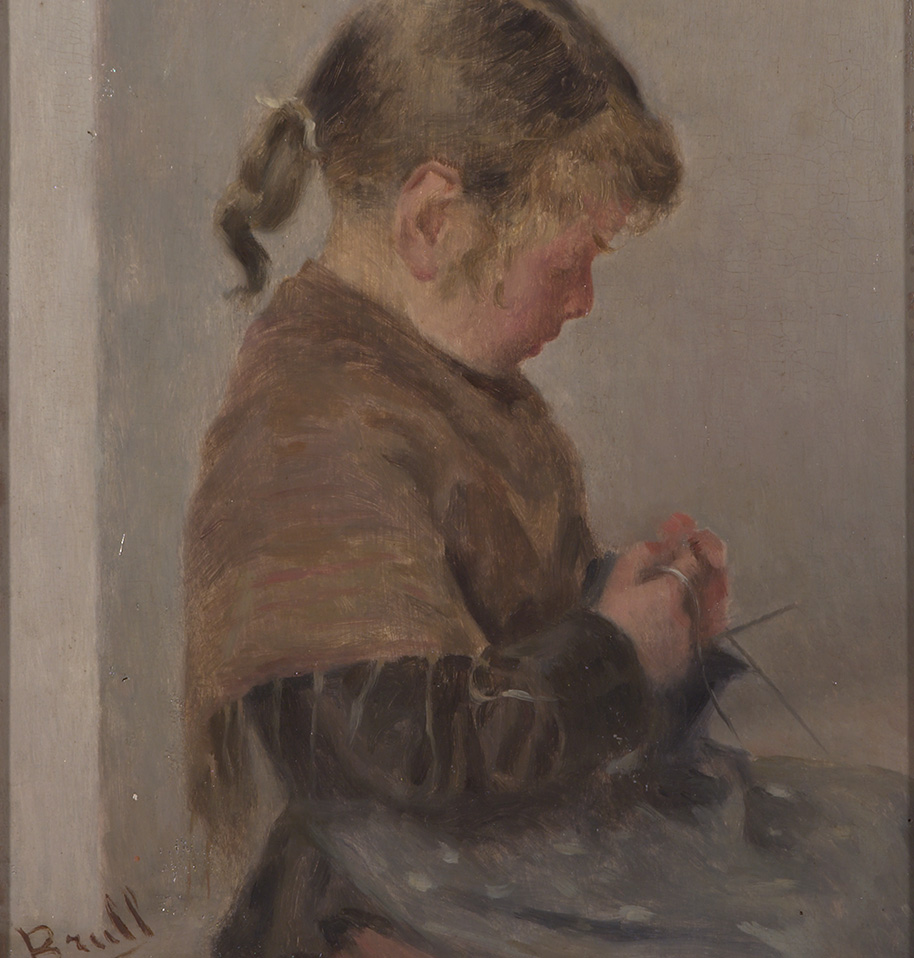
Joan Brull, Girl knitting, 1890, Oil on canvas. Museu d’Art de Girona, no. 250313. 250.313. Diputació de Girona Art Fund. Photography: Rafel Bosch.
Oil paintings such as Girl sewing (c. 1720) by Antonio Amorosi, preserved at the Museu Nacional d’Art de Catalunya, highlight how paintings featuring children spread throughout Europe during the 18th century. These scenes could either have a mythological or religious basis or be allegorical portraits or images faithful to the modern world. This is the case of Girl knitting by Brull, two copies of which are preserved in the Xarxa de Museus d’Art de Catalunya. Unlike the portraits of boys, who often appear drawing, reading, playing or engaging in other leisure-time activities, the painting Girl knitting shows the role of young girls, dedicated to learning how to serve and handle household chores. Modestly dressed, neither smiling nor looking at the viewer, the girl remains focused on her work, dedicated and obedient, knitting.
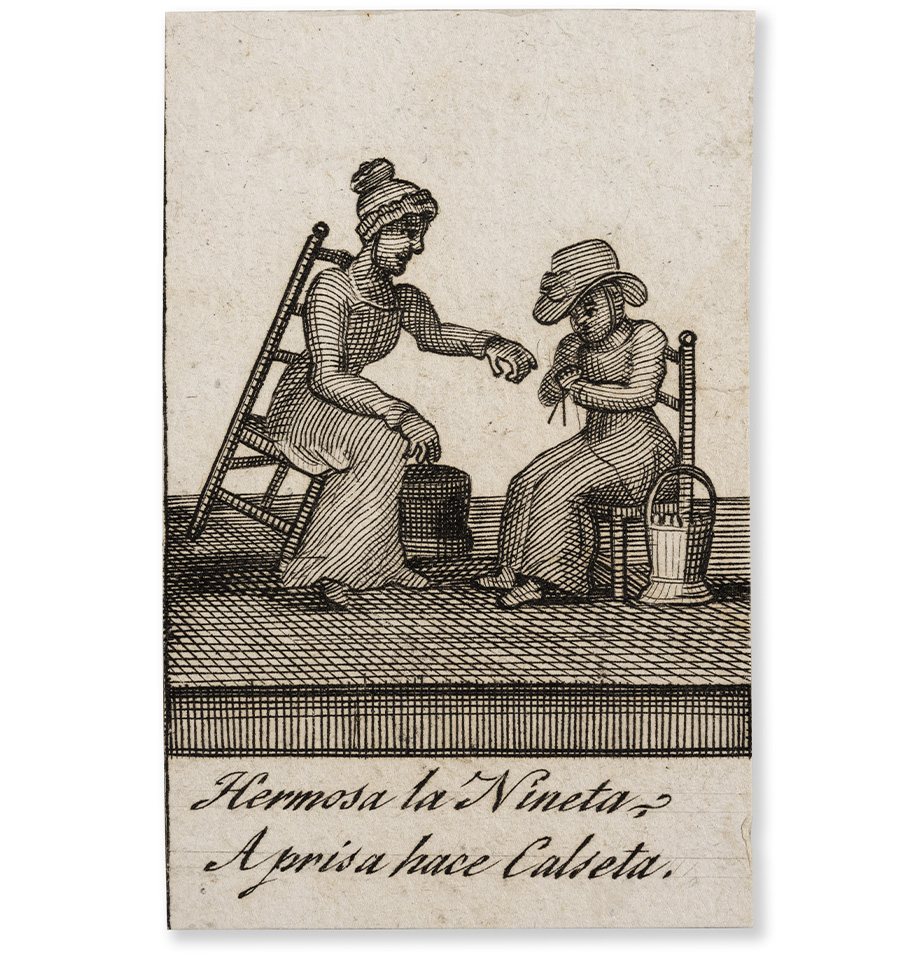
Cigarette paper booklet: Beautiful little girl, she quickly makes her sock / Dedicated to her work, she sews with care, 19th century, Engraving, Museu Frederic Marès, MFM no. S-15368, S-15369<br>Photography: © Pep Herrero
The great oil painting portraits are not the only evidence of how gender roles spread to childhood. To the contrary, they are only the most elite representation and the tip of the iceberg of an imaginary that extended to all social strata and was thus reproduced in all sorts of images that affirmed and reinforced the social behaviours of feminine obedience, industriousness and docility. We can find this segmentation from childhood in both literature as well as in popular imagery, in cheap mass-produced engravings and woodcuttings that spread through households in the 18th and 19th centuries. This is the case of these two fragments of a 19th-century auca with verses that accompany the images of two girls learning how to sew: <br>Beautiful little girl, she quickly makes her sock <br>Dedicated to her work, she sews with care
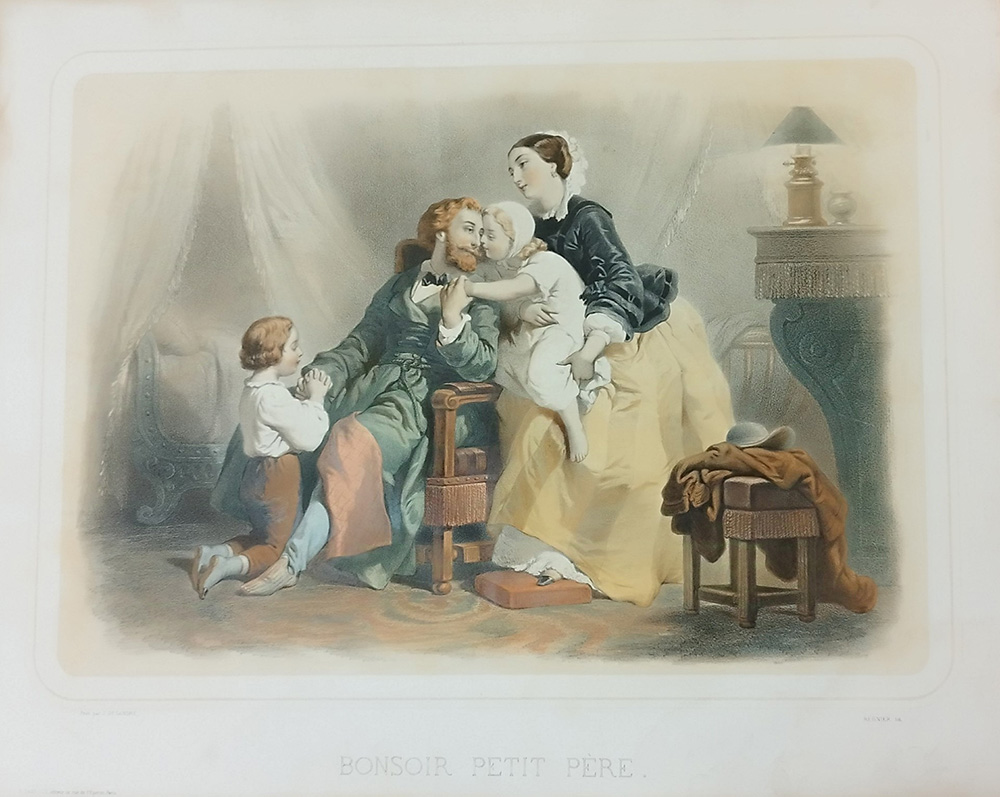
Jules Marie Désandré, Bonsoir, petit père, Paris, c. 1840-1860, Chromolithography by Claude Régnier, E. Dardoize, éditeur. Museu d’Art de Sabadell, no. 9813 9813
Throughout the 18th and 19th centuries, illustrated references of virtuous behaviour imparted an idealized model of family representation based on a married couple and children, where everyone occupied a specific place in society. The father held a public role, working outside the home and acting as the authority and head of the family, while the mother had a role focused on the private sphere, the home and raising children. From Greuze’s oil paintings that received praise at the Parisian Salons to the widespread engravings throughout the 18th and 19th centuries, such as the lithographs of works by Jules Marie Désandré, numerous channels appeared that depicted the same family model in line with the morality of the age and the dictates of the Catholic Church. The technical ability to reproduce images enabled the rapid spread of these kinds of lithographs that perpetuated gender roles as well as models of moral and social behaviour.
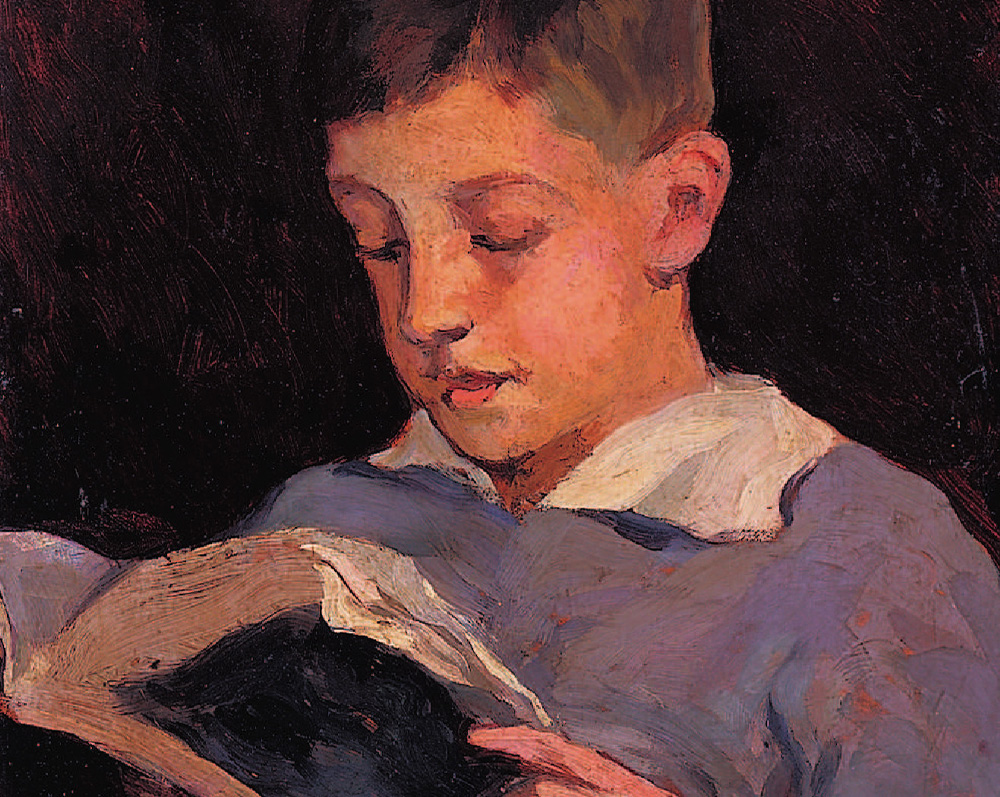
Frederic Masriera Vila, Portrait of a boy reading, c. 1910, Oil on canvas. Museu Abelló
Frederic Masriera Vila (Masvila), the son of Frederic Masriera Manovens and Antonia Vila, and thus the cousin of the jeweller Lluís Masriera Roses, formed part of the legacy of Masriera artists by training at the Escola de Llotja, working in the family jewellery shop and also dedicating himself to painting. With an interest in the genre of portraiture and in childhood and youth, evident among others in the illustrations for magazines such as En Patufet, he worked on numerous depictions of motherhood and portraits like this one. In this case, Masriera selected a canonical image of a middle class, bourgeois boy who, as an educated and literate child, calmly reads a book with curiosity on his face, eager to learn, grow up and mature.
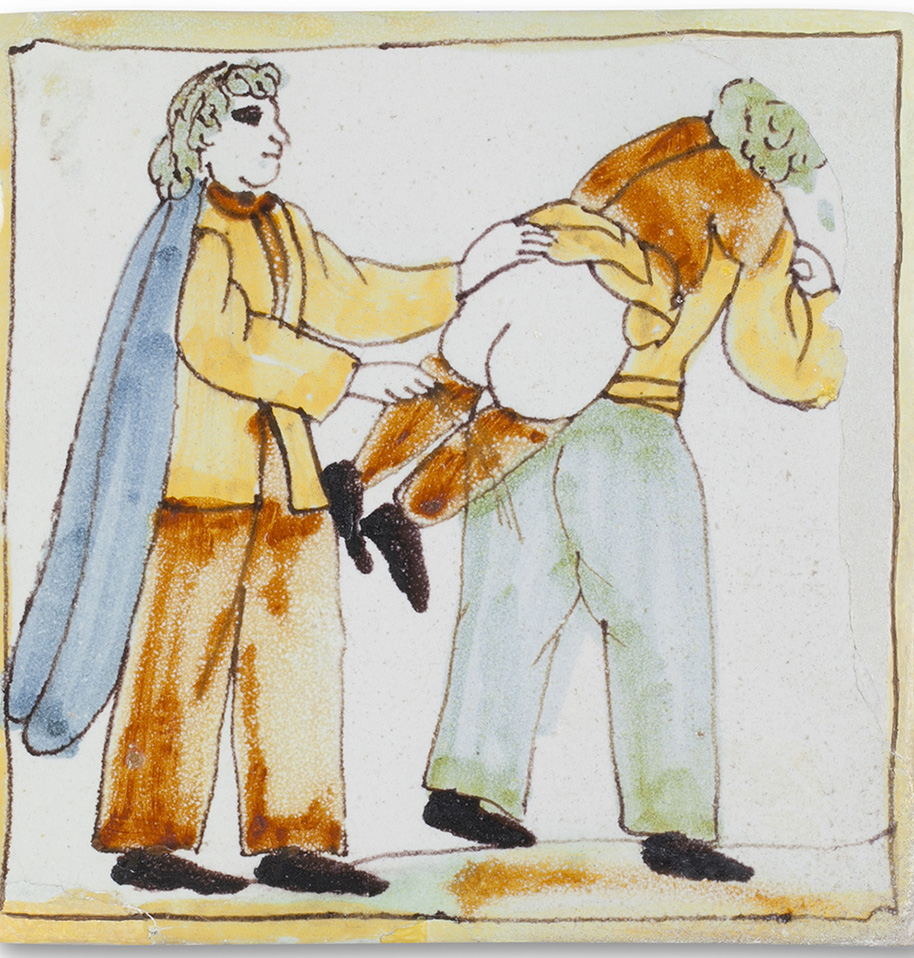
Teacher punishing a student, Tile, 18th century, Polychrome pottery. Cau Ferrat, Sitges
Starting in the mid-17th century and throughout the 18th and the first half of the 19th century, a new type of highly peculiar ceramic pieces started to spread in Catalonia: tiles with motifs that represented the common people, often representing arts and trades, but also showing unique scenes of the everyday lives of men, women and children in all kinds of daily behaviours. There is often only a single step between playing around and making mischief. Just as art has represented some of the vices and naughtiness, these tiles also sometimes represented the corporal punishment of children in schools as a corrective measure. Corporal punishment at school was practised until the 20th century and all sorts of recent artistic and literary testimonies have borne witness to this, some of them as explicit as in Roald Dahl’s Boy: Tales of Childhood.
Work and interrupted childhoods
Although childhood is typically associated with fun and games, happiness is made up of fleeting moments. Like everyone else, children have had to cope with poverty, disease, despair and injustice. These experiences of childhood, as commonplace as they are unwanted, were reflected in drawing, painting and sculpture, starting from the moment that art started to be humanized through a modern, free-thinking perspective. From this standpoint, children, those who express themselves without fear, taboos or lies, have also served as a reflection of societies that have had to endure child labour, indigence and disease.
Starting in the 17th and 18th centuries, during the Baroque era, images of private life started to spread with a naturalist perspective that allowed previously unknown scenes to be depicted, including representations of poverty and marginalization. In this case, the scene depicts children begging. The scene shows two hapless boys dressed in rags, the nearest one with crutches and his arm outstretched, begging for alms. The theme and the style of the painting have allowed us to attribute the work to an anonymous late-17th century painter from the north of Italy known as the “Master of blue jeans”, thus named due to the fact that the natural portraits attributed to him represent family scenes with children often dressed in patches of poorly sewn clothing dyed with a blue jean colour.
Master of the blue jeans, Children begging, 1680-1700, Oil on canvas. Museu Nacional d’Art de Catalunya, no. 24245 24245
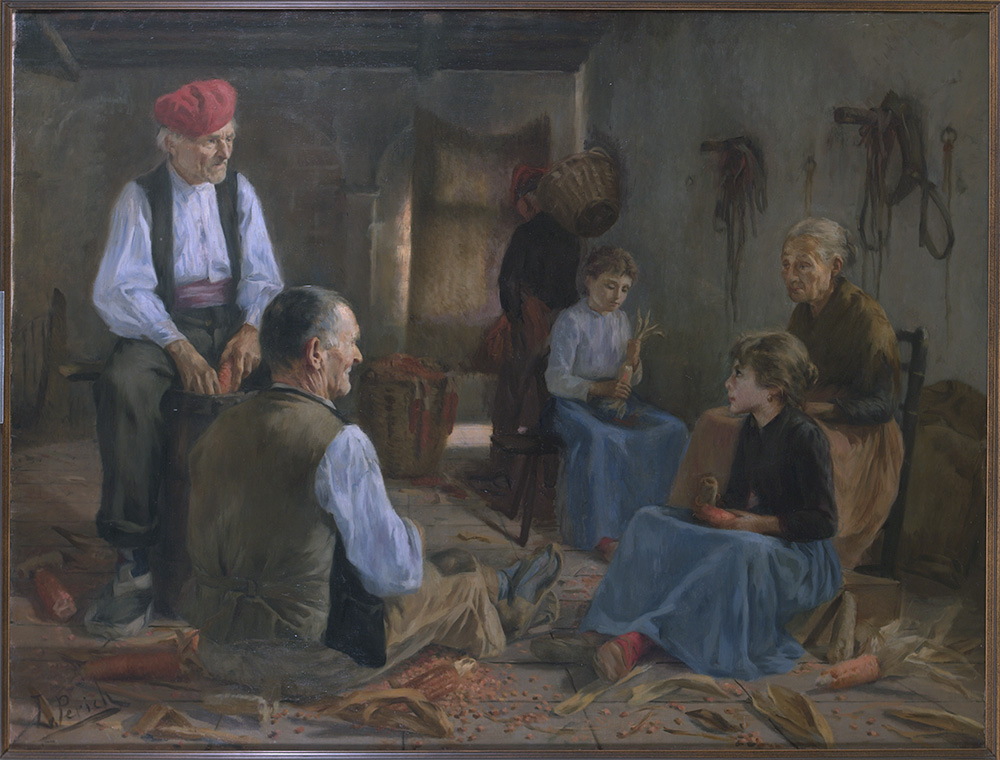
Lluís Perich, Shucking corn, 1895, Oil on canvas. Museu d’Art de Girona, no. 250329. 250.329. Diputació de Girona Art Fund. Photography: Rafel Bosch
Family life in the 19th-century peasant and working class was vastly different from the bourgeois family models. Their living conditions were structured by a day-to-day existence in which all the members of the family, including the children, acted collaboratively in the fields. In these families, children started to take on responsibilities and chores from an early age. These class realities were often reflected in the art of the time through a social realism and costumbrista painting, with scenes of peasant families, children included, helping and working on the same activity. Starting from the last quarter of the 19th century, this new realism, both costumbrista and uncritical, was predominant among the most successful commercial paintings at salons and in contests.
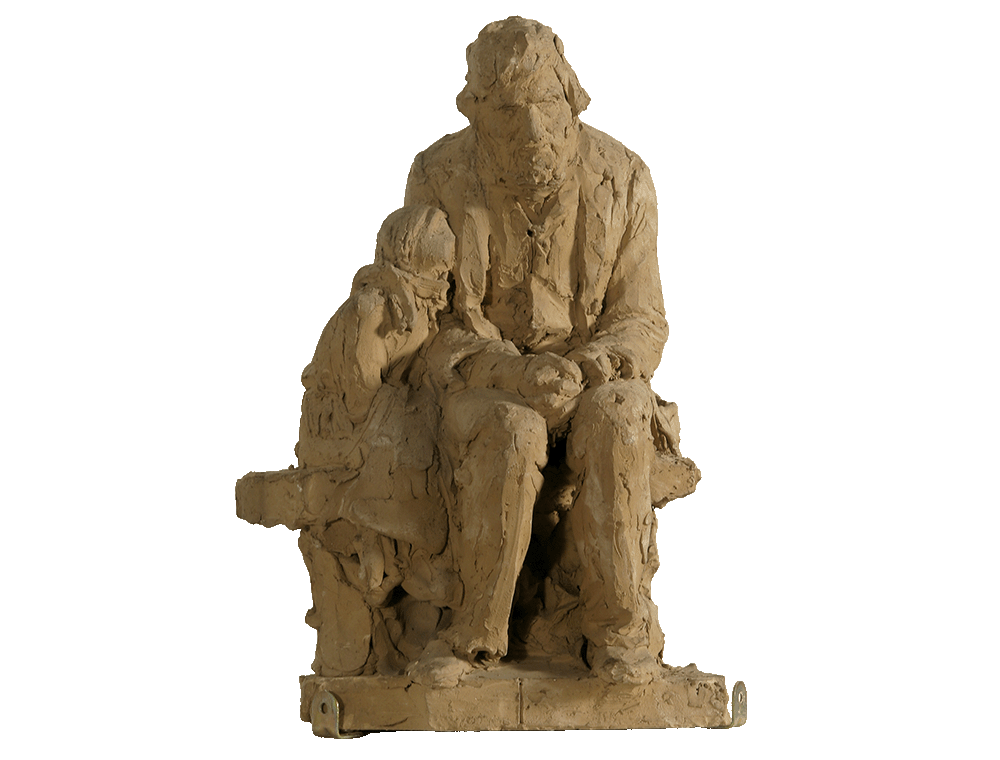
Miquel Blay, Preparatory sculpture of the First Cold, 1892, Terracotta. Museu d’Art de Girona, no. 026547. 026.547. Diputació de Girona Art Fund. Photography: Rafel Bosch
In line with the naturalist realism trend dominant in 19th-century Catalan statues, during his time as a student living off a grant in Rome, in 1892 Miquel Blay modelled this piece which over the years became one of his most important creations: The First Cold. This first preparatory work in terracotta, preserved in Girona, shows how at the beginning the sculpture was made up of an old man sitting on a bench together with a little girl nestled in his arms. In subsequent versions both figures are represented nude, with a more modern modelling style, to provide a rawer evocation of the helplessness and suffering of the poor pair facing the arrival of the cold. The first version was presented at the International Exhibition of Fine Arts of Madrid in 1882, where it earned high praise and a gold medal. Concerning this piece, considered one of the defining sculptures of Modernisme, we have numerous copies preserved in terracotta, plaster, marble and bronze in the Xarxa de Museus d’Art de Catalunya.
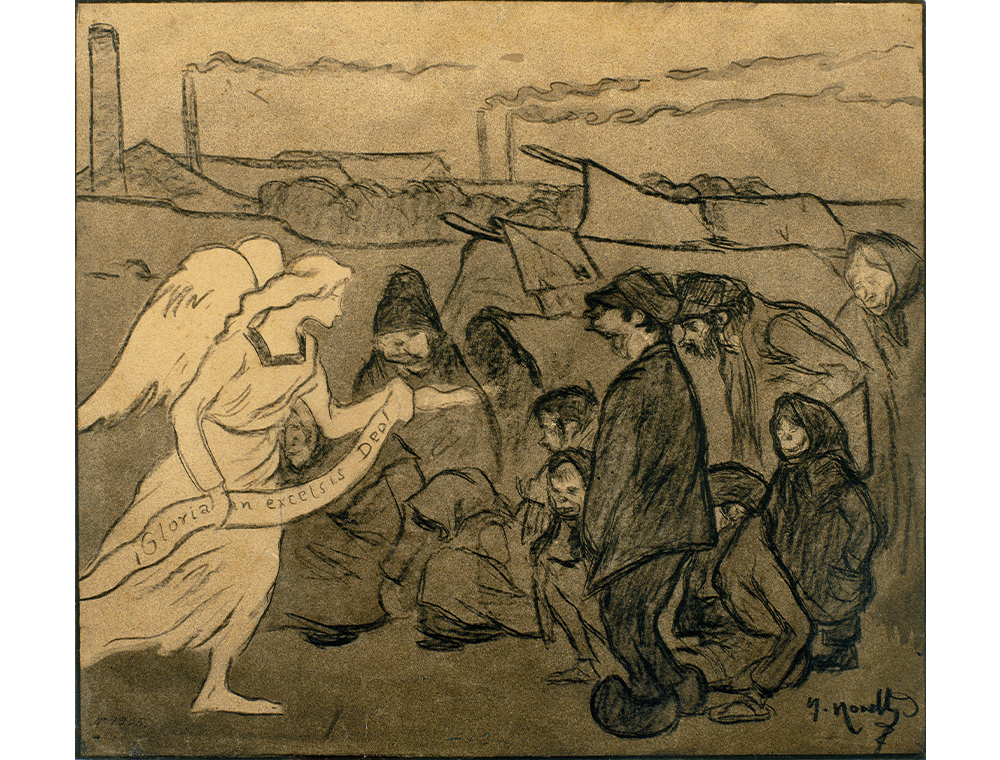
Isidre Nonell, L’Anunciata. (The Annunciation). Gloria in excelsis c. 1896, Charcoal, lithographic pencil and Chinese ink on paper. Museu Nacional d’Art de Catalunya, no. 026881-D
In the midst of major social conflict marked by the tension brought on by class differences, Nonell selected eminently social topics, portraying and denouncing the misery, injustice and life of the poor in industrial cities. Humble, helpless, orphaned, destitute and otherwise needy people, including children, became the central characters and the hallmark of many of his works. This drawing, reproduced in the new year’s supplement of La Vanguardia in 1897, shows Nonell’s concern for the marginalized through the children who lived or barely scraped by in the factory towns around Barcelona. The faces, which recall the downtrodden people that he had discovered in the Vall de Boí the previous summer, and the misery that the entire scene evokes critically and deliberately contrasts with the unreal presence of an angel announcing the good news of the birth of the Son of God.
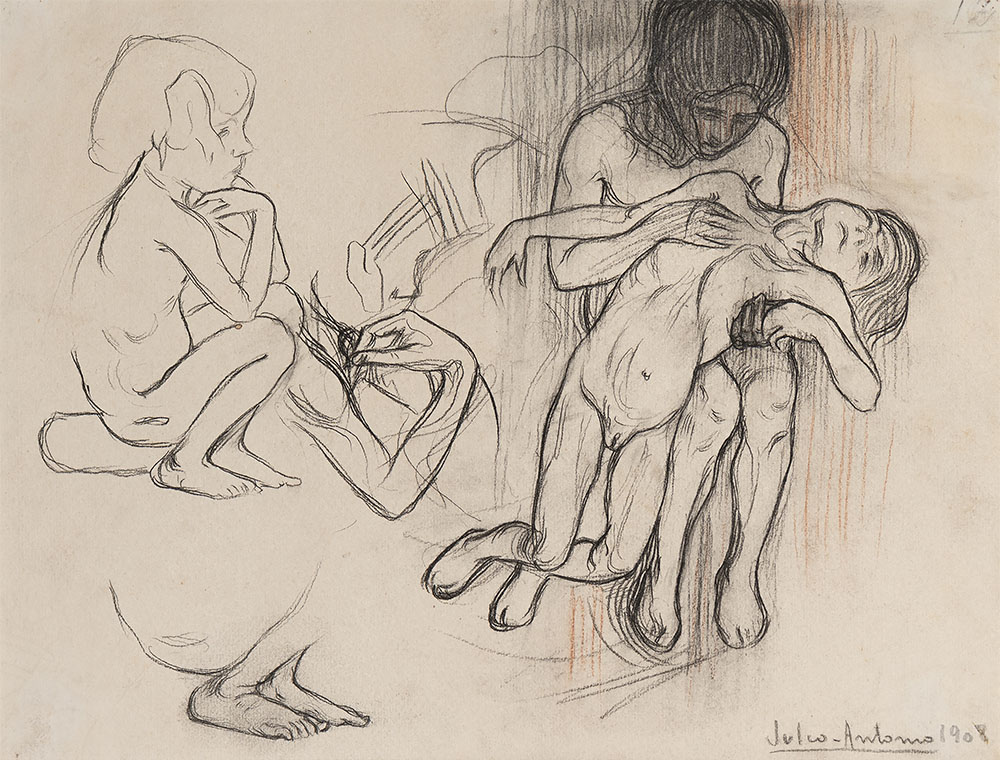
Julio Antonio (Antonio Rodríguez Hernández), Figures of children, 1908, Charcoal and sanguine drawing. Museu d’Art Modern de Tarragona, no. 600. 600. Photography: Diputació de Tarragona Museu d’Art Modern. Arxiu fotogràfic (Lila Alberich Fotografia)
Born in Móra d’Ebre in 1889 and passing away at a tender age in 1919, Julio Antonio was one of the most renowned Catalan sculptors of his time. This drawing may have been one of the different preparatory notes in charcoal and sanguine made between Toledo and Madrid exhibited in 1908 in Tarragona. Julio Antonio was interested in the most vulnerable classes, gypsies, the poor and miserable, occasionally seeking an expressionism that recalls The Degenerates by Cales Mani. In this case, the drawing, featuring an unclothed girl who seems to have fainted, could refer to preparatory notes for a previous set of sculptures before the Monument to the heroes of Tarragona project, which he started working on between 1909 and 1910. That piece depicts a woman holding a dead hero along with a wounded one.
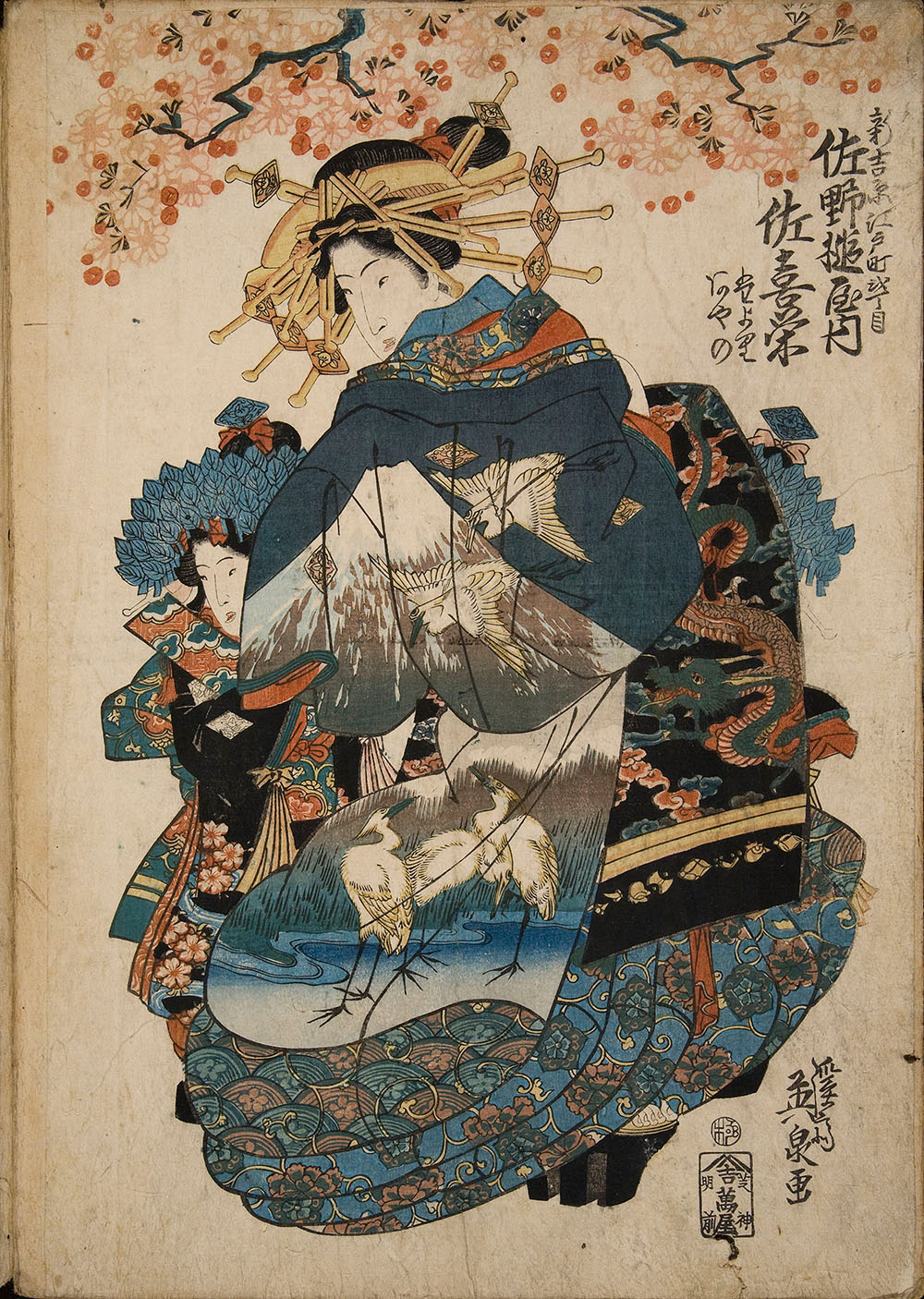
As with many large urban areas, the main cities in 18th- and 19th-century Japan had their own red-light districts that offered prostitution services, as was the case of courtesans in the Yoshiwara neighbourhood of Edo, today’s Tokyo. They had the help of the kamuro, girls between 7 and 9 years old who assisted high-end courtesans. The courtesans were in turn training the kamuro to take their place in the brothels in the future. In many cases the kamuro were brought to the brothels by poor families who had no other resources yet held hope that in the future the girls could be freed, bought or even married off. This stamp shows the courtesan Sakie, of the Sanotsuchiya house, in Shin-Yoshiwara (Edo), luxuriously dressed and accompanied by her two kamuro assistants, named Tayori and Ayano, dressed in matching kimonos, to celebrate the popular parade held once a year under the neighbourhood’s cherry blossoms.
Keisai Eisen, The courtesan Sakie, of the Sanotsuchiya house, with the kamuro Tayori and Ayano
c. 1830, Publisher Yorozuya Kichibei, Colour woodcut. Museu Nacional d’Art de Catalunya, Gabinet de Dibuixos i Gravats
Stolen childhoods
Until the modern era, and practically until the 20th century, child mortality, danger and disease were a common constant. We should be aware that estimations calculate that half of the children who were born died before the age of eight in the 18th century. The high birth rate, thus, went hand-in-hand with a high child mortality rate, children whose lives were cut short, mostly by disease and health problems, but also due to abandonment, abortion or even infanticide. Consequently, emotional bonds with newborns were often not as close as they would be with the change of mindset at the end of the ancien régime. Furthermore, in more modern times, starting from the moment in which artists understood that the images of children easily lent themselves to creating allegories, as they were the most vulnerable to violence, the relationship between childhood and death in art also became a powerful and emotional resource to represent pain, injustice, fragility, suffering, hunger, horror and war.
The commission for this altarpiece, intended for the central apse of the convent of Santa Clara of Vic, was made during the time of the abbess Margarida Jofre. The piece was painted between 1414 and 1415 by Lluís Borrassà, one of the leading representatives of International Gothic, following a new stylistic current with a more harmonious and naturalist aesthetic that came from Europe and reached Catalonia around 1375. This altarpiece is considered one of the best known works by Borrassà, painted with the help of a well-documented and trained workshop to create a highly original and detailed iconic piece. This scene depicts the massacre of the innocents perpetrated by King Herod the Great, one of the most commonly represented themes in Christian art in terms of the death of children, which is commemorated every 28 December. We often find infanticide in art represented through religious or mythological stories, such as Cronus devouring his children and the story of the children of Jason and Medea.
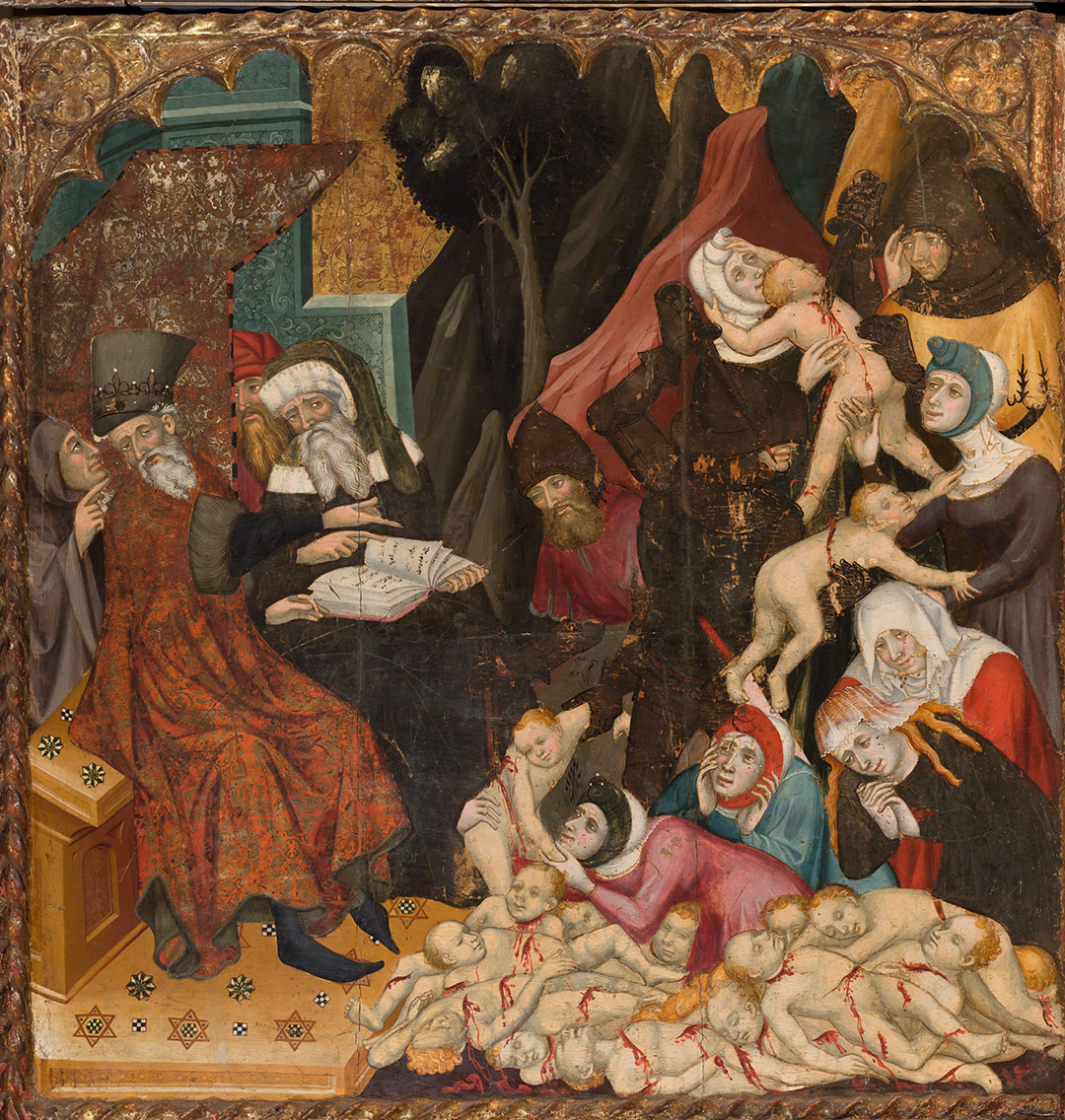
Lluís Borrassà, Massacre of the innocents, Franciscan altarpiece, from the convent of Santa Clara de Vic, 1414-1415, Tempera and gold leaf on wood, Museu Episcopal de Vic, MEV no. 718. Photography: © Museu Episcopal de Vic, file: The Mad Pixel Factory
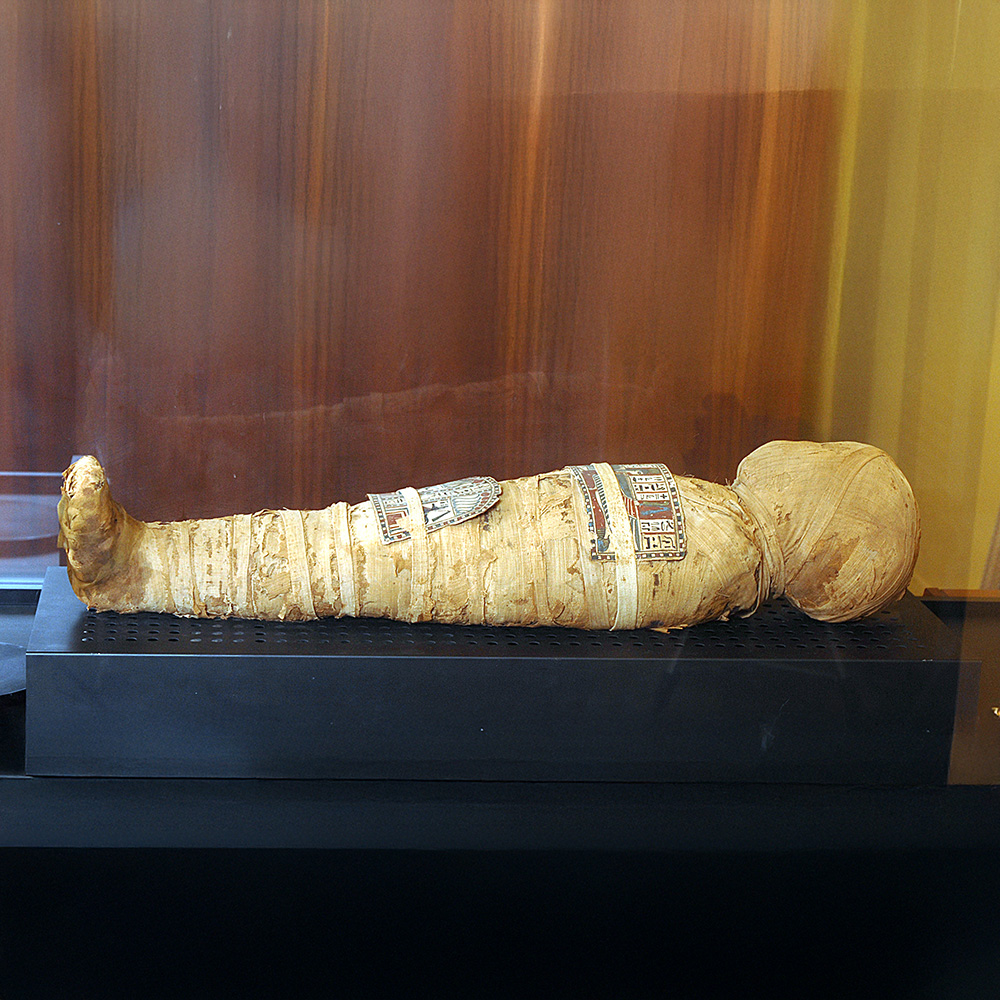
Nesi the Mummy, 20th Dynasty of Ancient Egypt (1186-1070 B.C.). Biblioteca Museu Víctor Balaguer, Vilanova i la Geltrú
As a method to preserve the body and ensure the life beyond, child mummification has been practiced by numerous cultures. We can find highly diverse examples of it including mummies from Pre-Colombian cultures in Peru, mummies in the catacombs of the Capuchins in Palermo and, obviously, the mummies in Ancient Egypt. Among the latter group, here in Catalonia we have the mummy Nesi from the tomb of Sennedjem in Deir al-Madinah, which was acquired by Eudald Toda during his time in Cairo as the Spanish consul between 1884 and 1886. This body of a five-year-old boy or girl was mummified and wrapped in linen. The child did not suffer from any apparent diseases that allow us to know the causes of death, although death was often caused by disease or health issues, such as anaemia. In the upper part, the mummy Nesi preserves two pads with hieroglyphics, with words of protection from the goddess Nut.
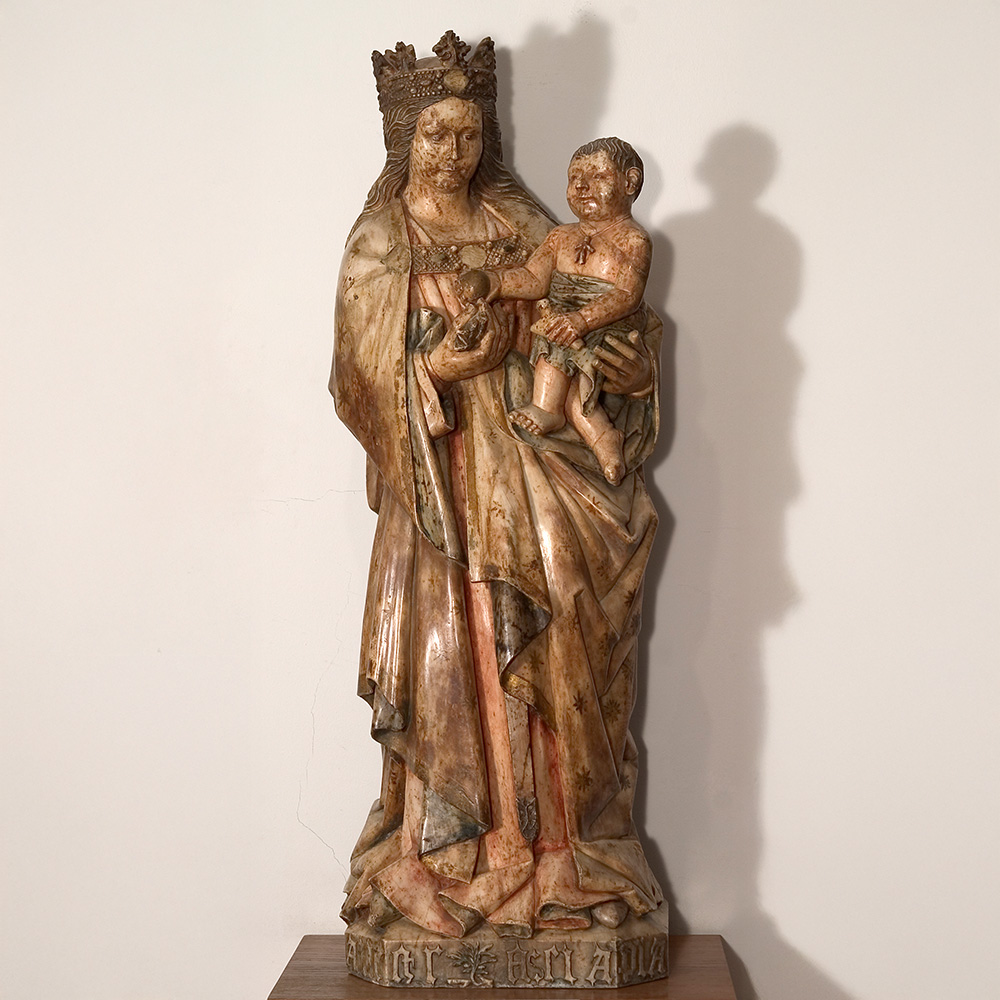
Virgin of Pontós, 15th century, Alabaster. Museu d’Art de Girona, no. 130753. 130.753. Diputació de Girona Art Fund. Photography: Rafel Bosch
Aware of the high child mortality rates in preindustrial society, where only half of the population that was born managed to survive childhood, the use of apotropaic objects or materials as protection during both pregnancy and childbirth as well as during the first years of life remained a constant over time. Death was omnipresent at every age and the grief that this entailed for families encouraged the use of red coral. Since Antiquity, authors such as Pliny the Elder (Natural History) had claimed that red coral was ideal to ward off evil and provide protection from danger. This practice was upheld over the following centuries and became Christianized. In many images of the Infant Jesus starting in the 14th and 15th centuries, we can see how the child has a protective red coral amulet hanging around his neck, like many children from the era. This long-standing practice had notable examples such as the portrait of the infanta Ana Mauricia of Austria, the first-born daughter of Philip III, painted in 1602 by Juan Pantoja de la Cruz and preserved in the Monasterio de las Descalzas Reales in Madrid.
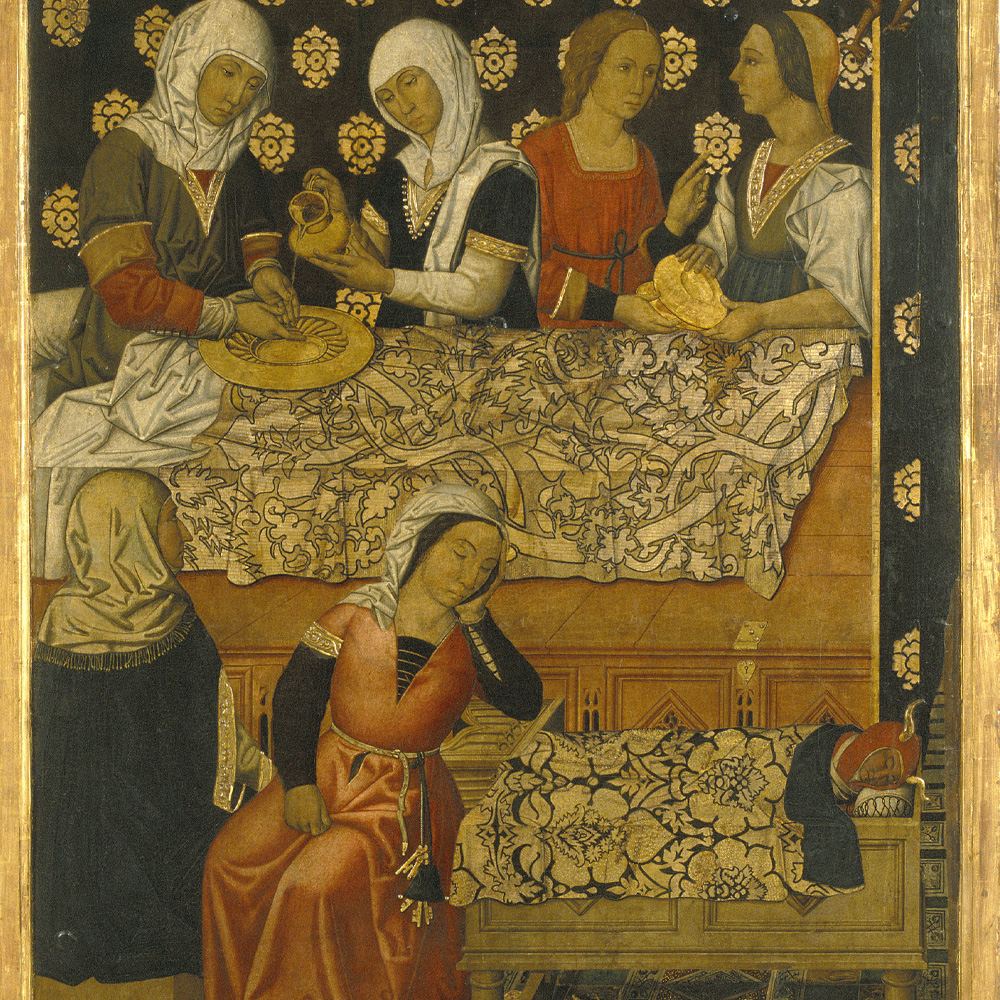
Vergós Family Workshop, Replacement of the newborn Saint Stephen by the devil, a table from the altarpiece of the church of Sant Esteve de Granollers, Tempera and gold leaf on wood, 1495-1500. Museu Nacional d’Art de Catalunya, no. 015876 015876
In the late Mediaeval era, at a time when literature about marvels and demons proliferated throughout Catalonia, apocryphal stories started to spread, often associated with saints, like Stephen and Bartholomew, of children who were stolen and replaced by diabolical creatures. These abductions would be used to explain certain illnesses or behaviours. This tradition also reached the field of images painted on Gothic altarpieces where a newborn saint was sometimes replaced by a tiny devil. This is the case of one of the tables from the altarpiece of Saint Esteve de Granollers where, recalling the tale told in the Vita fabulosa sancti Stephani protomartyris. The piece represents how a demon kidnapped the newborn Saint Stephen and exchanged him for a small demon that looked like the saint after his nanny had fallen asleep.
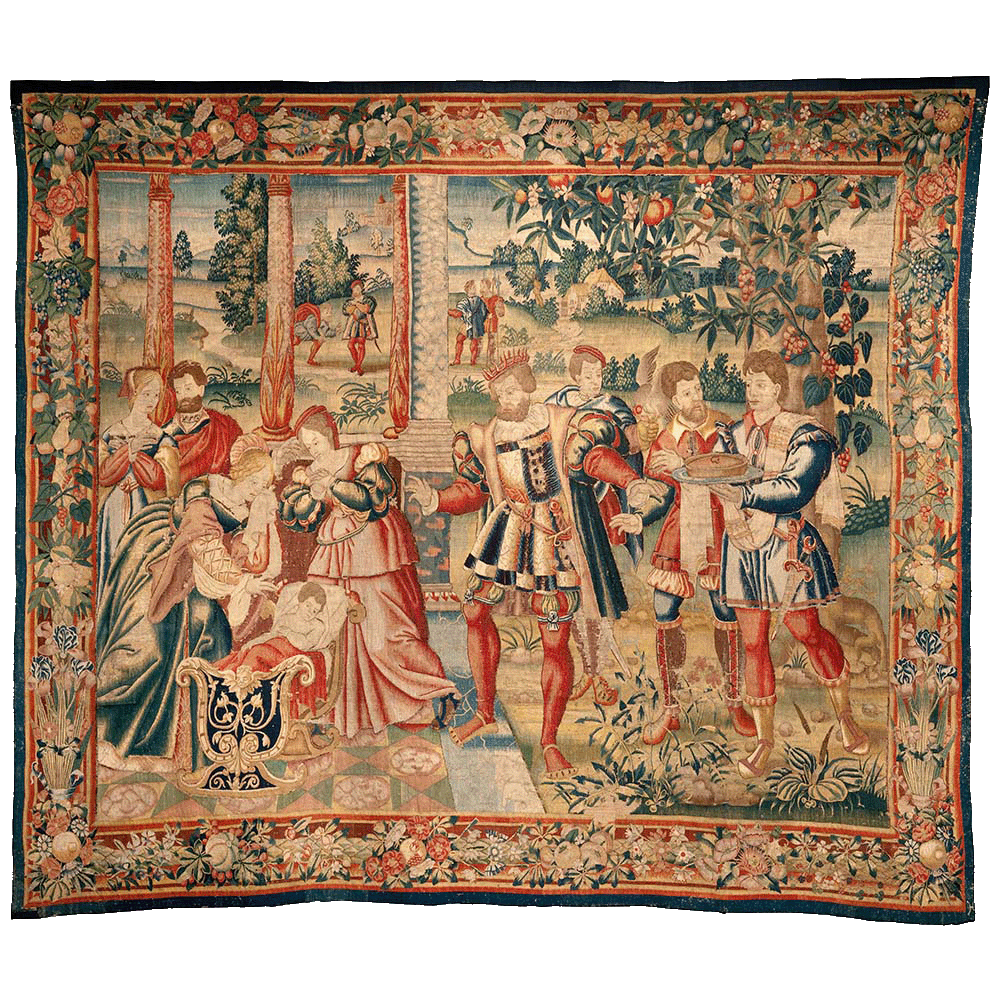
Anonymous tapestry, Death of David and Bathsheba’s son, c.1530-1540. Museu de Lleida
This tapestry, from the extraordinary series of fifteen tapestries woven in Brussels and intended for la Seu Vella de Lleida, shows the last episode in the story of David and Bathsheba, the parents of King Solomon. The scene, taken from the Book of Samuel (2 Sa, 11-12), shows the death of the couple’s first-born son. Bathsheba, who was married to Uriah, had an affair with King David. Blinded by lust for Bathsheba, David committed the crime of killing her husband by deliberately sending him to the front line of the war. The child’s death is portrayed as divine retribution for his parents’ adulterous behaviour as announced by the prophet Nathan. The series of tapestries dedicated to the story of David and Bathsheba were donated by the bishop Ferran de Loaces in 1548 to decorate the main chapel in la Seu Vella.
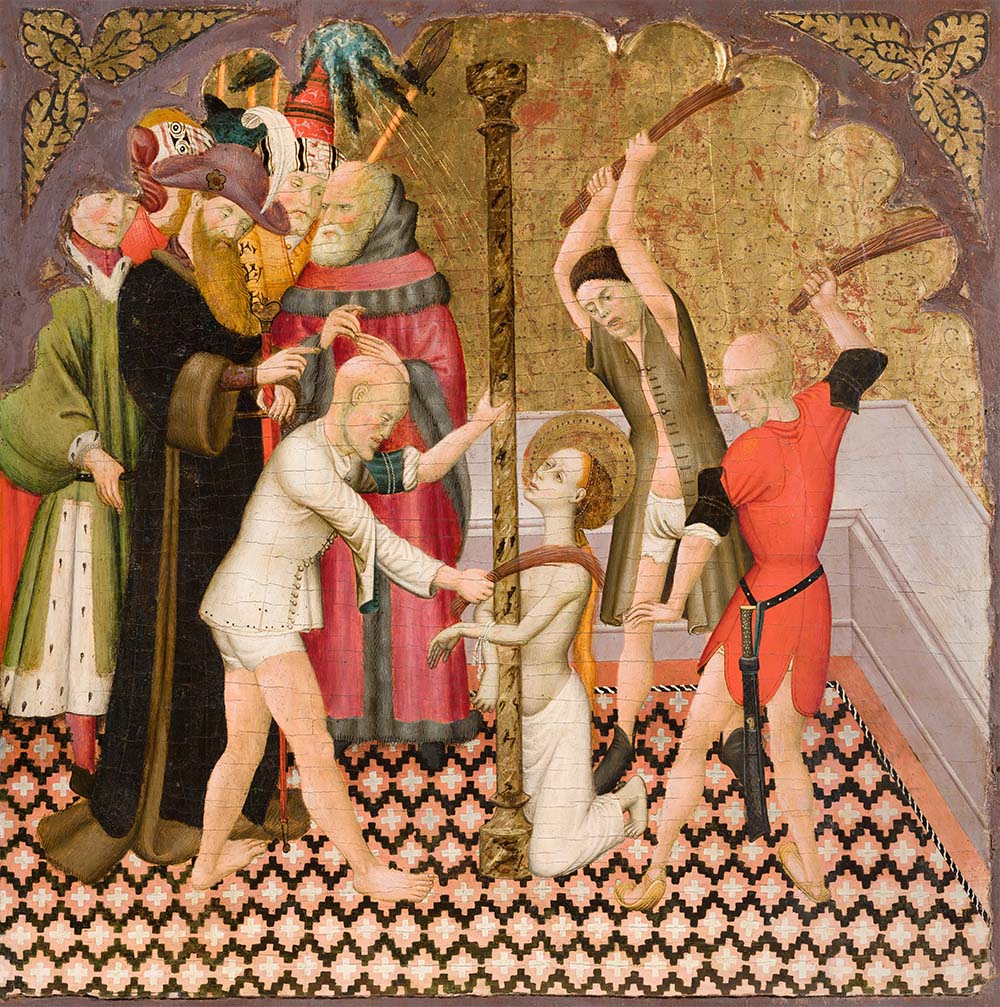
Bernat Martorell, Compartment of an altarpiece with the flagellation of Saint Eulalia, 1427-1437
Tempera and gilded with gold leaf on wood. Museu Episcopal de Vic, MEV no. 10738 10738
The hagiography of Saint Eulalia tells us of a Christian girl who was condemned to be martyred thirteen times, the same number as her age in years, until she died by crucifixion in Barcino around the year 304 A.D. Eulalia joined a large group of Christian martyrs who died during early childhood (infantia, 0-7 years old) or as a young child (pueritia, 7-14 years). This was the legendary case of Saint Simon (Simonet) of Trento, a child martyred between the age of 2 and 3. Over time, Saint Simon became venerated and beatified making him the patron saint of child kidnapping victims. This compartment, likely from an altarpiece of the Cathedral of Vic, shows one of the various martyrdoms of Saint Eulalia, who is being violently flagellated by the Romans. The scene, which is preserved along with a second image of martyrs, was painted by Bernat Martorell shortly after the death of Lluís Borrassà.
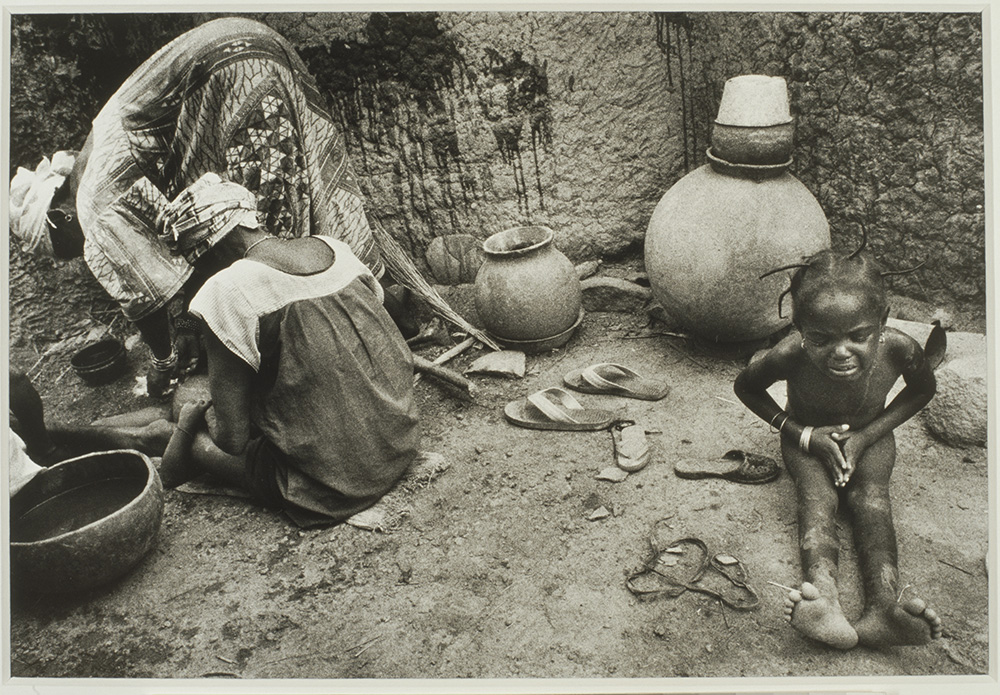
Kim Manresa, Ablation of the child Kadi in a Sub-Saharan country, 1997, Photograph. Museu Nacional d’Art de Catalunya, no. 205741 205741
Clitoral ablation, also known as female genital mutilation, is an excruciating process particularly widespread in Sub-Saharan Africa which is considered a human rights violation by international organizations. The process consists of removing female genitalia at a young age in order to eliminate women’s future sexual pleasure. Attracted to photojournalism from a young age, Kim Manresa has made photography a weapon for social activism capable of stirring people’s consciences to advocate for human rights around the world. Among his projects, the 1997 photo series he created in Burkina Faso stands out, where he documented the tragedy of genital mutilation that he had previously seen on an earlier trip to Africa. The few photographs that Manresa was able to take of the mutilation of the young girl Kadi, who was only five years old, were selected by The Associated Press as one of the best photojournalism reports of the 20th century.
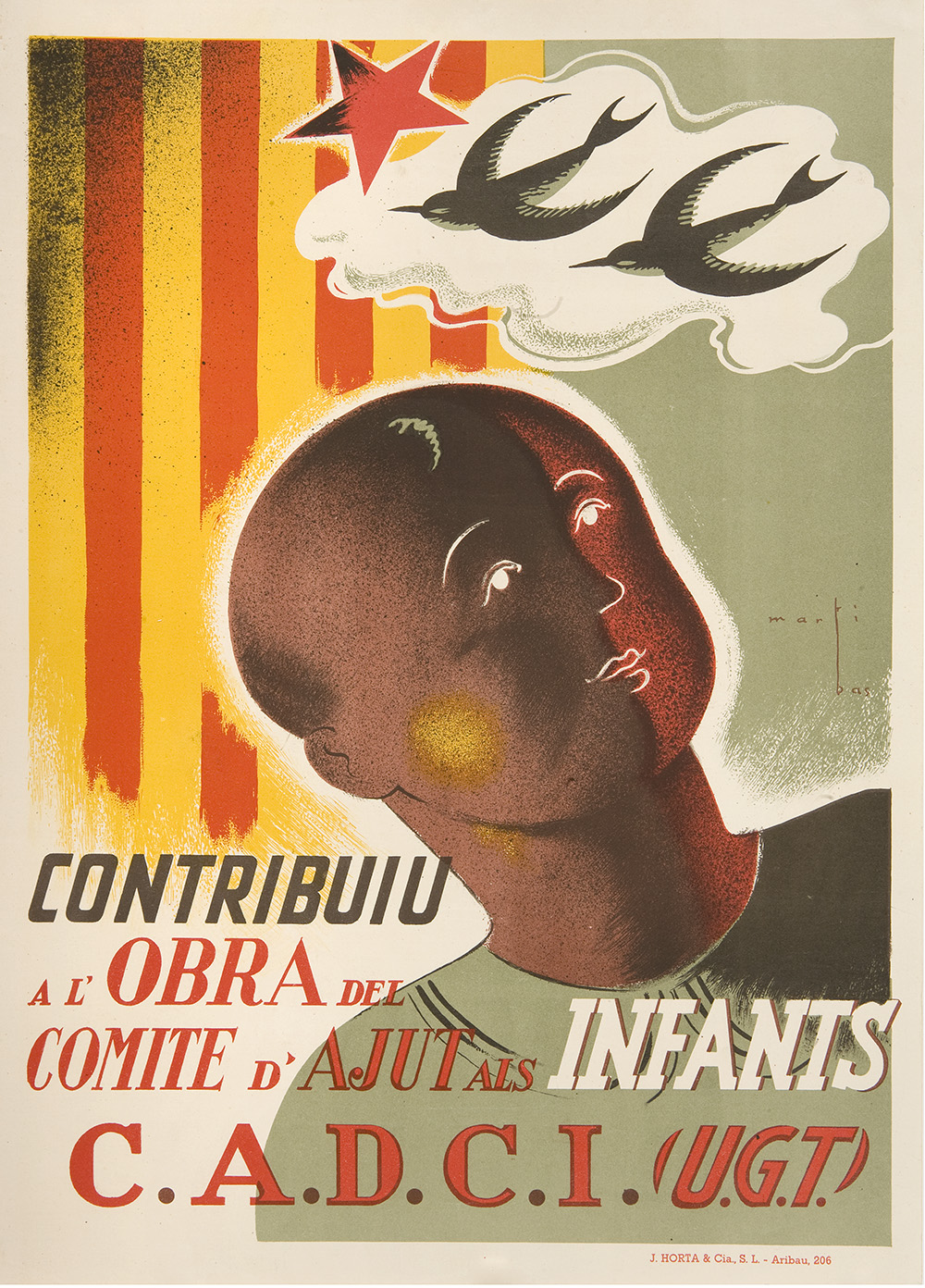
Joaquim Martí-Bas, Contribute to the work of the Children’s Aid Committee, 1936-1937
Print by J. Horta & Cia, Colour lithography. Museu del Disseny, GAGB 15/08, Photography: Xavi Padrós
In war, children are the first victims, the most innocent and unprotected. That’s why, in addition to being a symbol of injustice, they have also been a source of particular concern. This poster shows one of the many republican initiatives promoted in the midst of the Spanish Civil War to help children through the Children’s Aid Committee of the Autonomous Centre for the dependents of Commerce and Industry Workers (CADCI), founded in 1903. Aware of how important posters were in terms of wartime propaganda and as a means of communication, Martí-Bas, one of the most prolific republican and anti-fascist poster artists involved in the war, drew a boy gazing at the swallows in the sky as they fly over a background that features a senyera estalada (Catalan flag) to raise money intended to help children. Martí-Bas was also the artist behind many other posters such as Education Workers. For Socialist Schools! (1936) and Help the children behind the front lines. Make a contribution (1937), made before he was expelled from the Union of Professional Illustrators in January 1937.
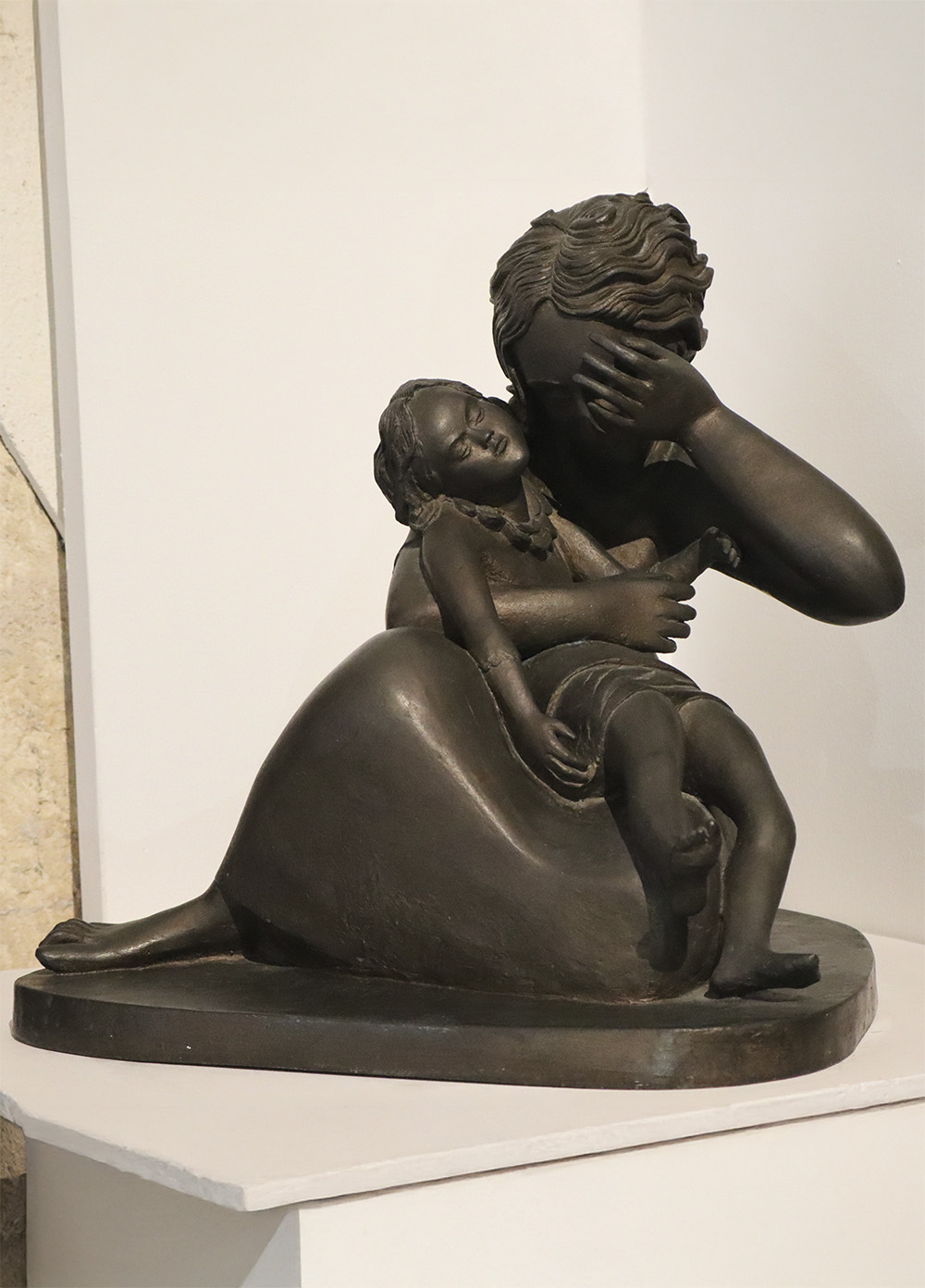
Apel·les Fenosa, Lleida, 1938, Bronze, Fundació Apel·les Fenosa, El Vendrell
In scenes of war, women often appear together with their children as helpless victims. Since ancient times, artists have often resorted to these images to fight against injustice and pain. This is the case of the oil painting Mother in front of her dying son (c. 1937) by Fernando García Alegría, preserved at the Museu Nacional d’Art de Catalunya, along with the sculpture Lleida, by Apel·les Fenosa, among others. That same impulse that moved Picasso to paint Guernica spurred Fenosa to model this sculpture in commemoration of and as a response to the aerial bombardments that the city of Lleida suffered on 2 November 1937. This attack by the Condor Legion caused more than three hundred deaths, most of whom were children from the city’s Liceu Escolar. The Museu Morera de Lleida preserves the terrifying photographs taken by Agustí Centelles of this human drama featuring children at the centre.
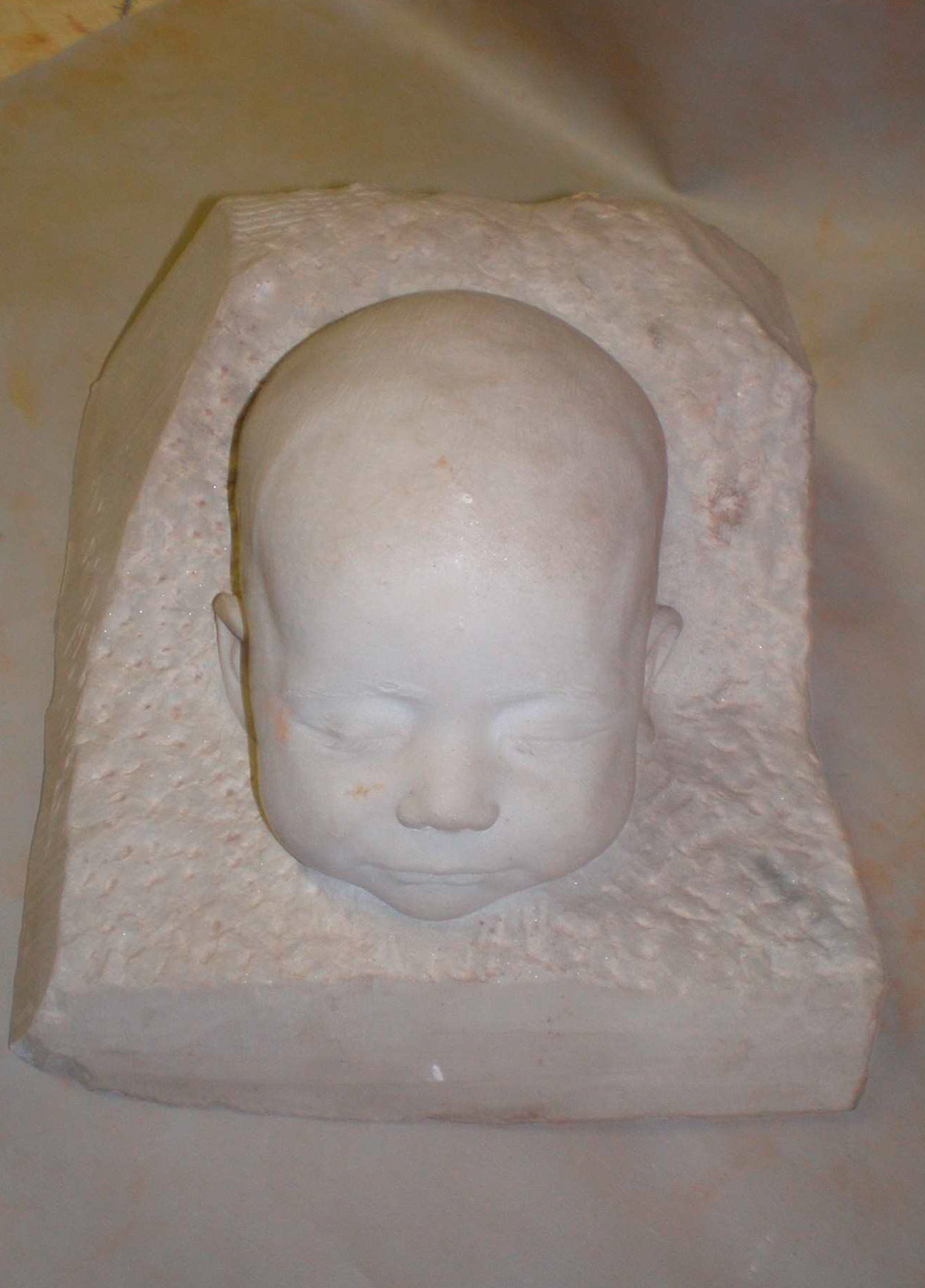
Francesc Juventeny, sculptor and mayor in Franco’s regime, Head of a dead child, c. 1930
Marble, Museu d’Art de Cerdanyola, MAC
Following a tradition that dates back to Antiquity, many artists in the last quarter of the 19th century created paintings that resorted to the symbol of an empty cradle to represent an infant’s death. In parallel to the typical commissions for adult mortuary masks, throughout the second half of the 1800s postmortem portraits of children started to spread. These were mostly photo portraits of children in their deathbed, though sometimes they were also sculpted by artists. This was the case of the son of Jaume Mimó, the first republican mayor of Cerdanyola del Vallès, who during his youth had frequented Els Quatre Gats and had become friends with Manuel Humbert and Josep Gimeno. Mimó, an art lover and collector, commissioned the sculptor Francesc Juventuny, the future mayor of Cerdanyola during Franco’s regime, to create a portrait of one of his young children.
Epilogue: Dreams and memories
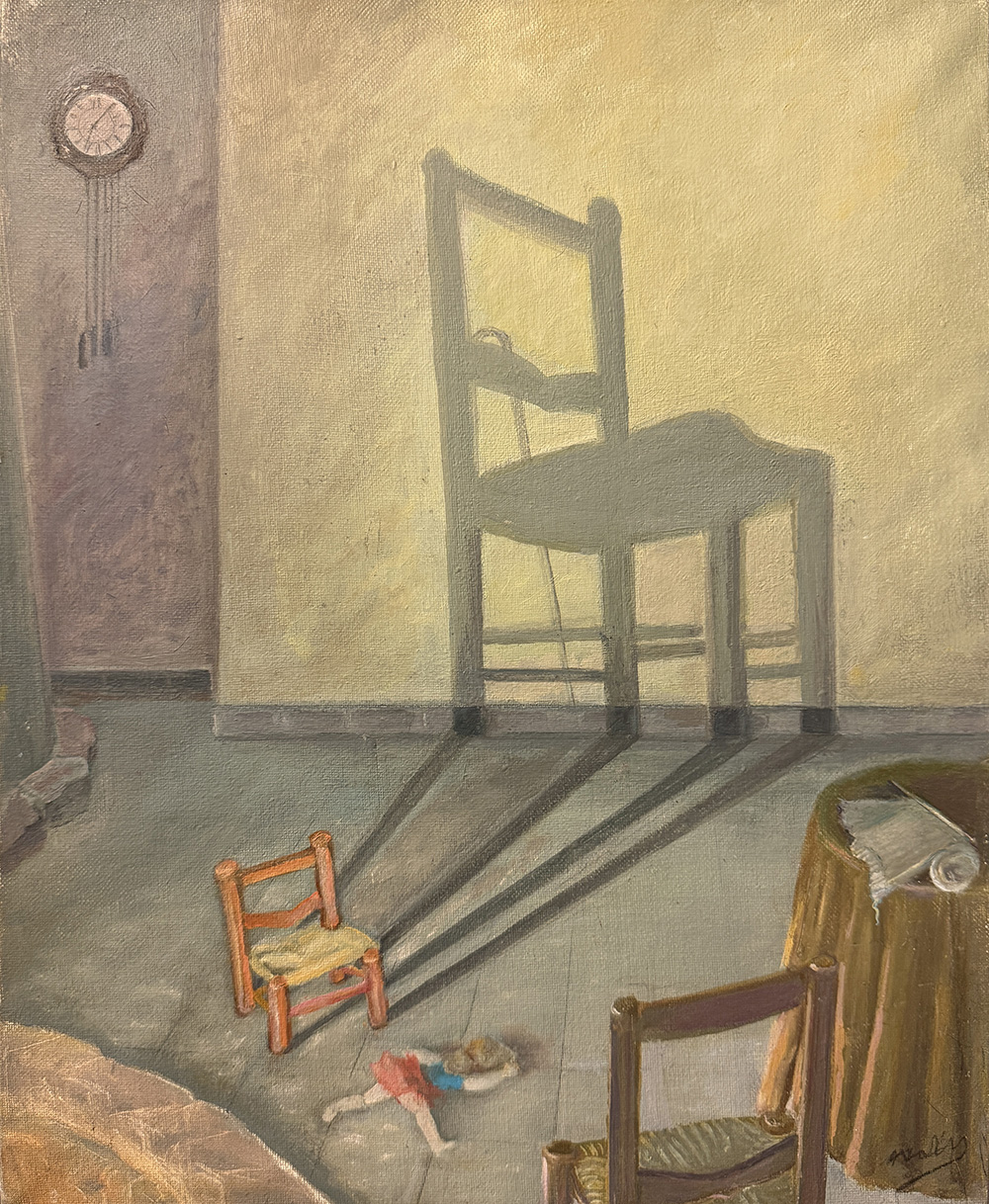
Maria Lluïsa Malibran, Untitled, undated, Oil on canvas. Museu d’Art de Cerdanyola, MAC
Maria Lluïsa Malibarn was one of the many 20th-century women who were born into well-educated families that were passionate about art and culture. She later decided to delve into artistic practice and intimate painting. Although she worked as a dressmaker during the postwar period, some of her pieces have reached us today, like this symbolic and melancholic scene of a woman looking back on her childhood, with its looming shadow always there throughout her entire life. Despite its multiple meanings, through the discarded doll and the clock on the wall, Malibarn seemed to have evoked the passage of time and the memory of a distant childhood, always idealized as a happy time and a paradise lost that is projected until adulthood, perhaps as a vanitas.
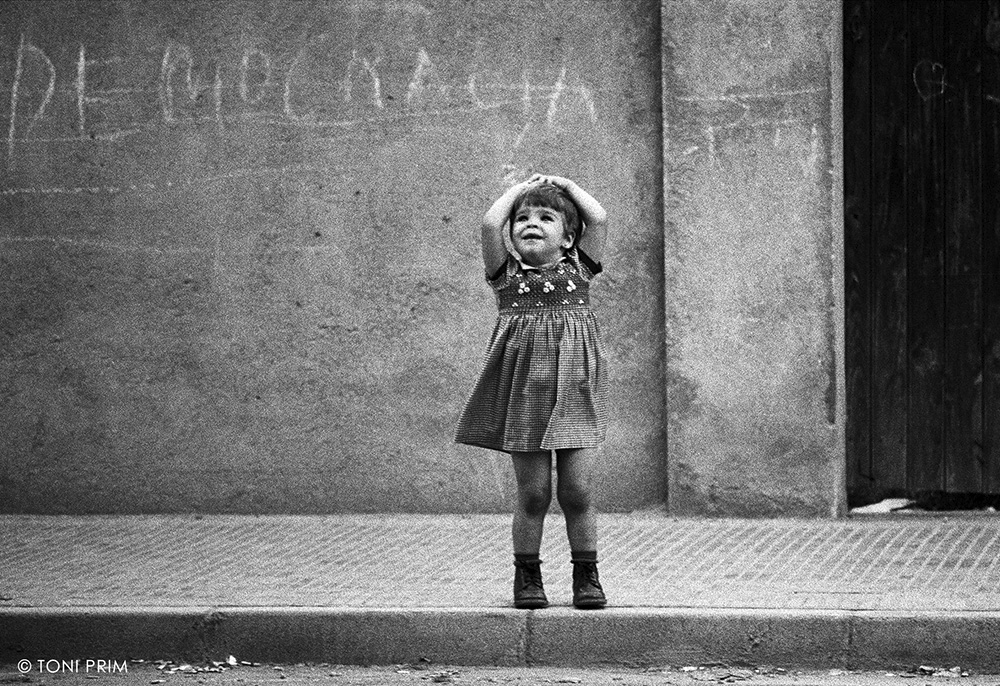
Toni Prim Ortís, Excitement. Lleida, 1977, Photography. Museu Morera, Lleida. Long-term loan from Col·lecció Nacional de Fotografia 2020
In 1977, Toni Prim, a renowned photographer from Lleida, portrayed this solitary, smiling child, with excitement written on her face, in front of a wall with the word Democracy scrawled on it. The dictator Francisco Franco had died only two years before and the country was in the midst of its democratic transition. Prim immortalized the little girl’s innocent and pure gaze as an authentic symbol of society’s longing for change, a reflection of the dreams of an entire generation.
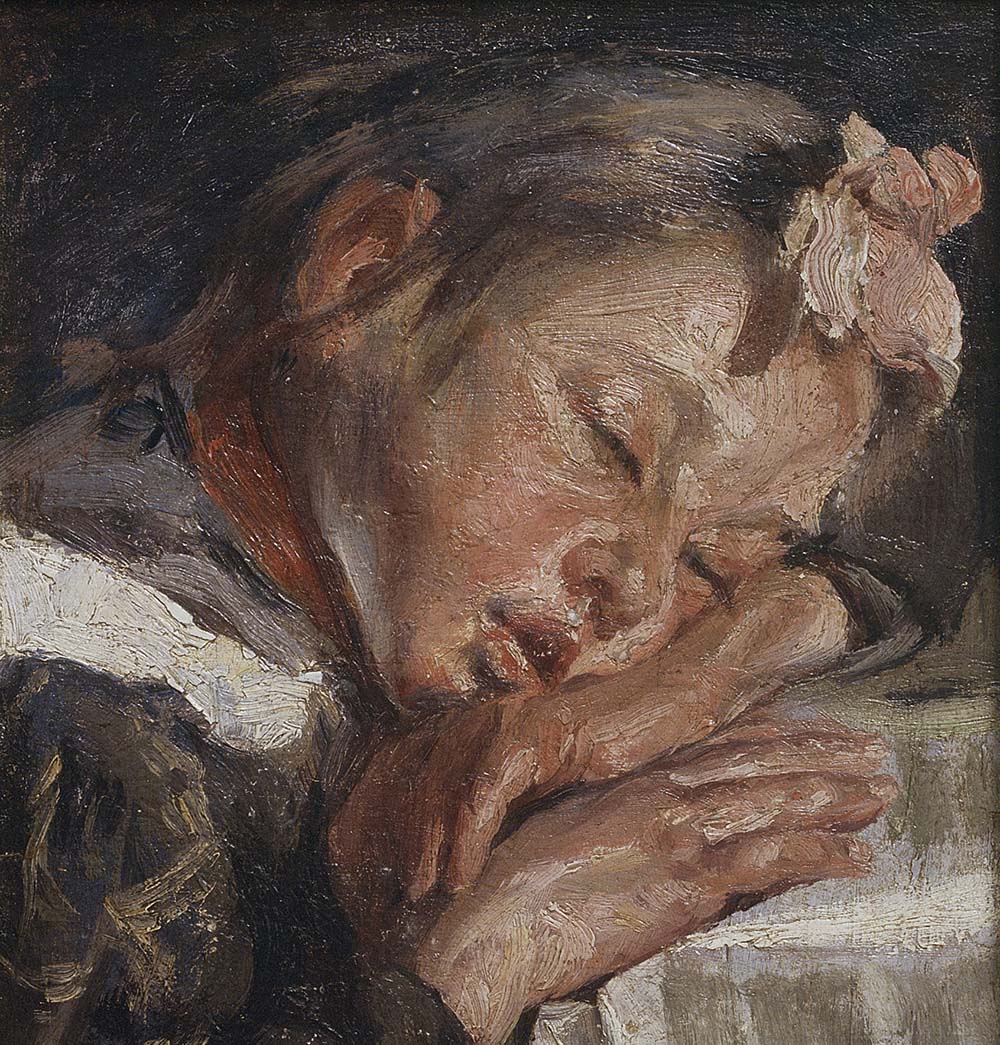
Francesc Gimeno, Girl sleeping, 1895-1898, Oil on canvas. Museu Nacional d’Art de Catalunya, no. 113135 113135
Francesc Gimeno was one of the most brilliant Catalan painters of his time, although he developed a free language far removed from the trends of Modernisme, frequently dominated by an earthy colour palette and a wide, loose and expressive brushstroke able to capture life’s most intimate vibrations. The girl in the work looks tired and resigned with her head and her tender hands resting on the pages of a book. To us, she looks as if she’s sleeping, far away from the noise of the world, evoking a dreamlike childhood that knows nothing of suffering.