


Photograph from the Lena Workshop, undated (1923-1931). Arxiu Municipal de Cerdanyola. Bequest by Albert Lázaro Arqueros.
Núria Tortras i Planas, <em>Nude</em>, 1974. Bronze, 52 x 19 x 36 cm. Museu d’Art Contemporani de Barcelona.
Marina Ramoneda, Little Red Riding Hood (The Better to Eat You With), 2006. Felt, tape and rose thorns, 75 x 67 x 10 cm. Museu d’Art de Sabadell.
Patrícia Maseda Calamita, Pandora, 2018. Kraft paper and bronze, 33 x 47 x 21 cm. Museu d’Art de Cerdanyola.
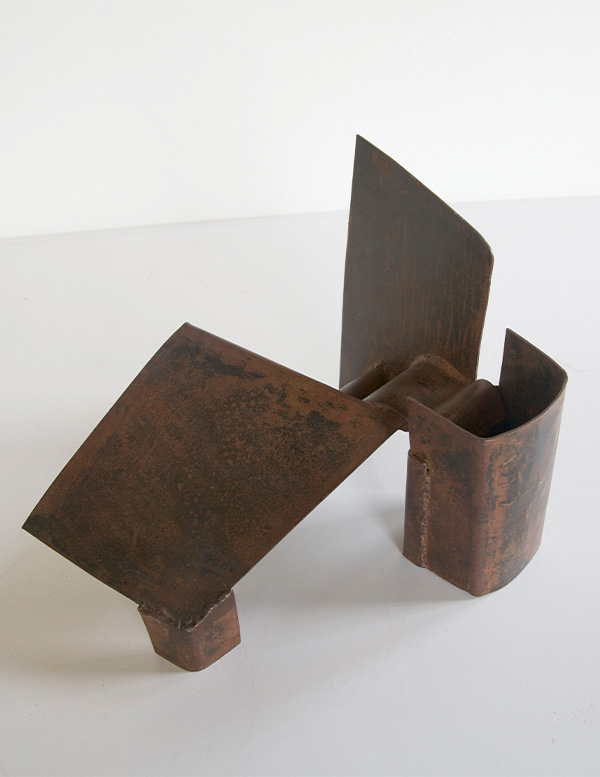
Susana Solano Rodríguez, <em>Tell Me, Tell Me Dear,</em> 1986. Iron, 25.5 x 29 x 19.5 cm and 15.5 x 10.2 x 6.4 cm. MACBA Collection. Long term loan from the Ajuntament de Barcelona © Susana Solano, VEGAP, Barcelona. Photo: Courtesy of the artist.
Introduction
Cristina Rodríguez-Samaniego
Associate Professor in the Department of Art History at the University of Barcelona. GRACMON research group.
Although evidence shows that female sculptors have been active for a very long time, their numbers are small compared to their male counterparts. This disparity did not start to change course until the 20th century, when female artists in general and female sculptors in particular started to overcome the obstacles that had limited their professional opportunities.
Based on the collections in the Xarxa de Museus d’Art de Catalunya, the exhibition entitled Female genealogies in Catalan sculpture is opening a window to sculpture made by women in Catalonia from around 1900 to today. The XMAC is inviting us to learn more about the works produced by several generations of female sculptors, their individual career paths, along with their personal contributions, some of which, even today, remain in the shadow of oblivion.
Beyond a chronological account, this exhibition offers a visual cartography that draws a more global overview, allowing us to establish relationships between artists, circumstances, and rich and diverse creative approaches. In this sense, the itinerary of this exhibition illustrates the evolution of sculpture styles, formats, and materials from a plural conception of modernity and contemporaneity. At the same time, the exhibition seeks to discover the history of an entire group: 20th century female sculptors in Catalonia.
A question of space
In her famous essay from 1929, A Room of One’s Own, Virginia Woolf argues that the lack of economic independence and, above all, of a specific space to work are the obstacles that have most limited professional opportunities for women throughout history. In the late 19th and early 20th centuries, female artists often set up their workshops in domestic rooms that were not “their own”, that is, they worked in rooms that also served other functions, such as a space for family use or to welcome visitors. Having a home workshop enabled middle- and high-class women to uphold the paradigm of bourgeois respectability that society demanded of them, but which at the same time held them back.
Workshops are both a physical and symbolic space, a space where ideas take shape, where what the artist has imagined becomes reality. In short, it is a space where artists experiment and create. Compared with other traditional disciplines such as painting, the creative processes involved in sculpture are more complex and may require additional space for structures, materials, and tools. The differences are to such an extent that in order for female sculptors to become professionals, the process entailed a change of workplace, from the home to the independent studio, among other factors.
We know of the existence of very few active female sculptors in Catalonia from the turn of the century and the first third of the 20th. Any extant work made before 1900 is very much the exception. In general, the works produced by many contemporary female sculptors have not been preserved or cannot be found today, and we only know of these pieces through photographs of the time.
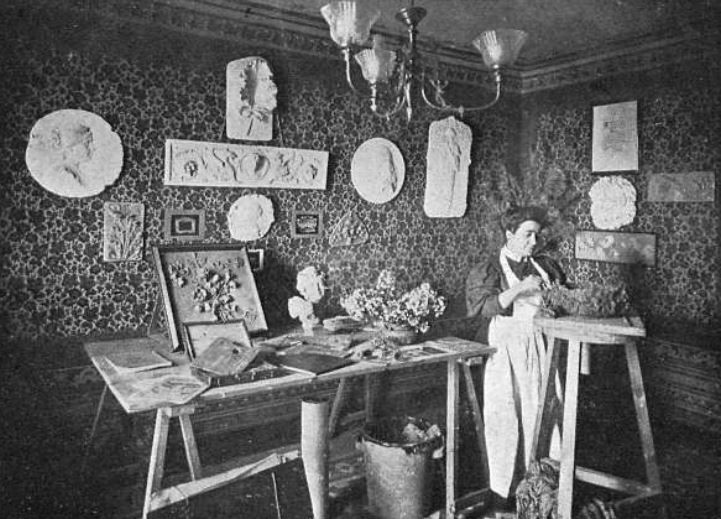
Pilar Portella i Estrada (1874-1941) in her workshop. Photograph by Thomas published in Feminal, no. 17, 1908. 17, 1908. Wikimedia Commons.
Pilar Portella is considered the first female student of sculpture at the Escola Llotja, the Barcelona School of Fine Arts. She subsequently joined the staff of the Escola Municipal d’Art (Municipal Art School) in the neighbourhood of Gràcia in Barcelona. The photos taken in her home workshop provide us a visual record of her work, which we would not know of otherwise today. Portella produced bas-reliefs, pedestals, ornamental vases, and portraits, mostly made with fragile materials, such as plaster and clay, sometimes in polychrome.
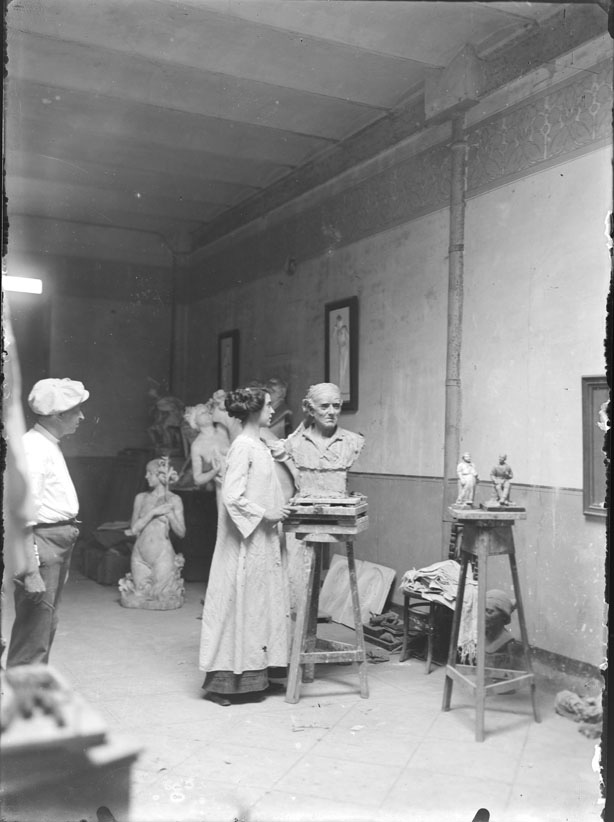
We know very little about Maria Riera, in fact we do not even know her second surname. She was born in 1894, and apart from working as a model for different artists, she also drew and published her illustrations in Feminal. Her work as a sculptor is more unknown, but no less interesting. In the photograph, she appears working on a male bust in a workshop next to the modernist sculptor Damià Pradell (1867-1947). This very fact allows us to consider that women were more commonplace in the sculpture workshops of the era than what the sources have indicated until now.
Maria Riera (c. 1894-?) working on a bust. Photograph by Antoni Rosal i Grelon, undated (1910-1920). Glass, b/w, 13 x 18 cm. Arxiu Nacional de Catalunya, ANC1-800-N-117.
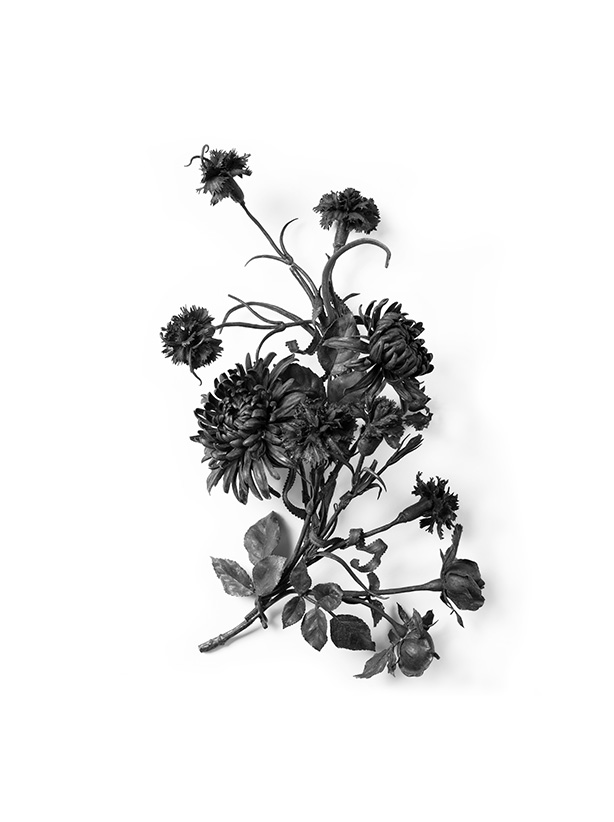
Pilar González was the daughter of the silversmith Concordio González. Together with her three siblings, Joan, Lola, and Juli, she worked in her father’s workshop in Barcelona, which specialised in the production of metallic art objects with shapes inspired by nature, before moving to Paris in 1900. This piece comes from the period when the workshop was at its highpoint. The materials and procedures used by González are reminiscent of future artists from the late 20th century who would also adopt metal as a material for their creations.
Pilar González i Pellicer (1870-1951), Bouquet of flowers, last quarter of the 19th century. Wrought, cut, chiselled, and laminated iron, 48 x 35 cm. Museu del Cau Ferrat, Sitges. Fons Cau Ferrat, inv. 571. © Arxiu Fotogràfic del Consorci del Patrimoni de Sitges.
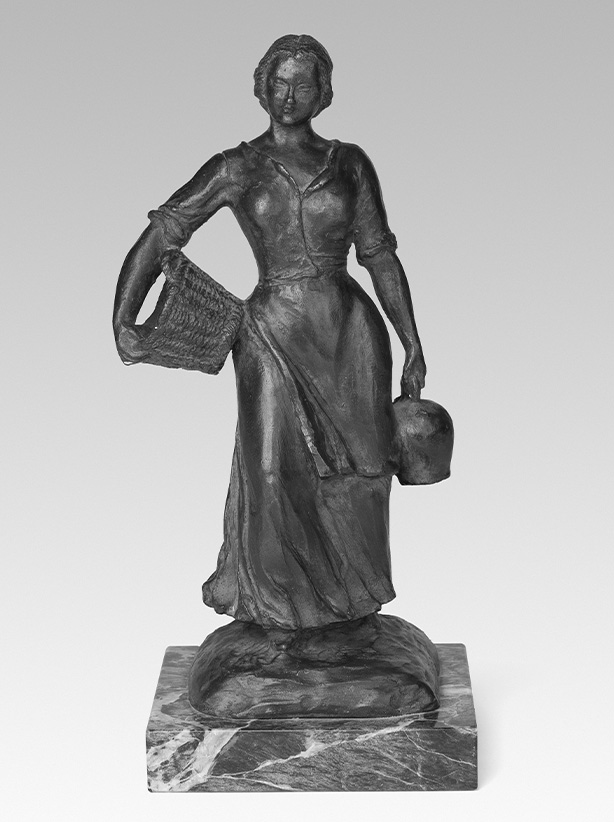
Lola Anglada is mainly known for her drawing and writing, despite having a fascinating career as a sculptor, especially during her first time living in Paris in 1918, when she started sculpting under the tutelage of Josep Clarà. In terms of both the subject matter and the stylistic traits, this piece falls fully under Noucentisme, with its vindication of rural characters and labour, which were considered the incarnation of Catalan identity.
Lola Anglada i Sarriera (1892-1984), The Harvester, c. 1924. Bronze, 29.4 x 14.5 x 11.5 cm (sculpture, no base). Museu de Maricel, Sitges. Fons Maricel, inv. no. FM 21. © Arxiu Fotogràfic del Consorci del Patrimoni de Sitges.
Sculpture, a “virile” art?
Traditionally, sculpture has been considered a “virile” art from a binary perspective and, as such, one that is more suitable for men. It was argued that sculpture required the use of physical strength and getting one’s hands dirty with the material. Sculpture was also considered more cerebral than painting, more complex and, thus, less accessible to women. Even in the early 20th century, one section among Spanish art critics argued that women were genetically less capable than men in capturing abstract concepts, a prejudice that was widespread in European society at the time.
Given this context, how works by female sculptors were received was always conditioned by their intrinsic “femininity”, as Isabel Rodrigo explains. Works by female sculptors were constantly compared against this paradigm, even pieces by sculptors active during the Spanish Republic when the number of female artists in Catalonia significantly increased. The social roles attributed to women during Franco’s regime contributed to perpetuating this gender bias. This all helps to explain the popularity of portraiture among female sculptors in the second third of the 20th century and, in particular, the art of sculpting women’s portraits.
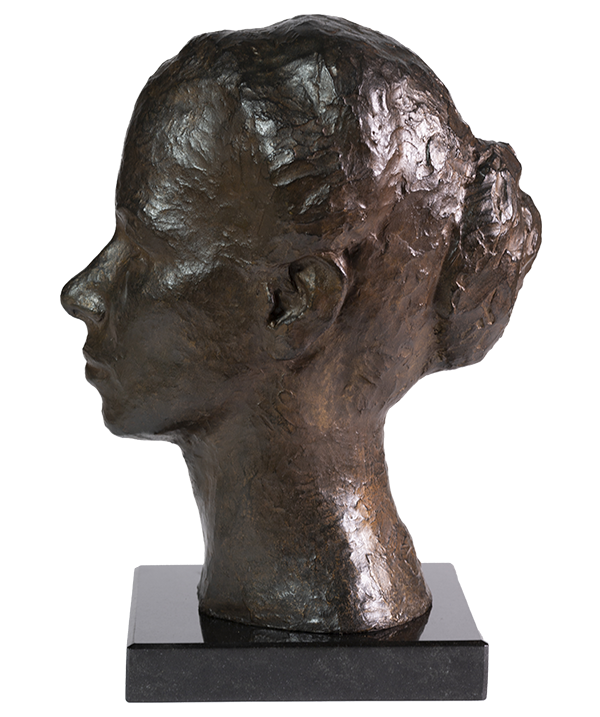
Palmira Collell i Canudas (c. 1918-2018), Portrait, 1954. Bronze (original in plaster from 1952), 32.5 x 18.5 x 26 cm. Museu Nacional d’Art de Catalunya.
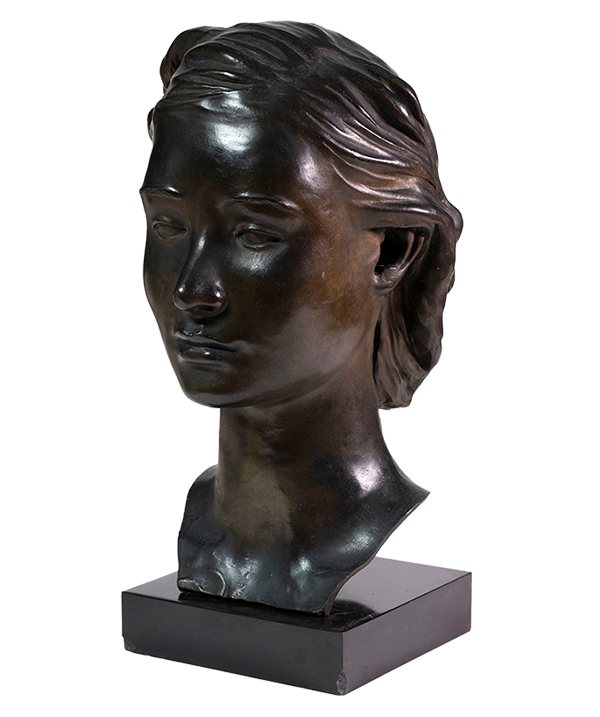
Maria Llimona i Benet (1894-1985), Youth, 1942. Bronze, 41 x 39 x 25,5 cm. Museu Nacional d’Art de Catalunya.
The original version of this piece, made in plaster, featured in the 1953 Barcelona Municipal Exhibition of Art and was acquired by the Ajuntament de Barcelona. A year later, the Bechini foundry created this piece in bronze. Collell trained at the Escola d’Arts i Oficis Artístics (School of Art and Artistic Trades) in the early 1950s, at a time when women represented a significant percentage of the total number of students in art education.
A member of a line of artists and the daughter of the modernist sculptor Josep Llimona, Maria Llimona delved into sculpture relatively late, during the Spanish Civil War while she was in exile in Italy. Her production includes religious statuary, a type of work that was booming at the time due to the numerous projects aimed at rebuilding churches and places of worship after the war. Yet she also dedicated herself to portraiture and allegorical work, as seen in Youth, for which she received an award at the Barcelona National Fine Arts Exhibition in 1942. At the time, she collaborated with Luisa Granero in her workshop in the neighbourhood of Farró in Barcelona.
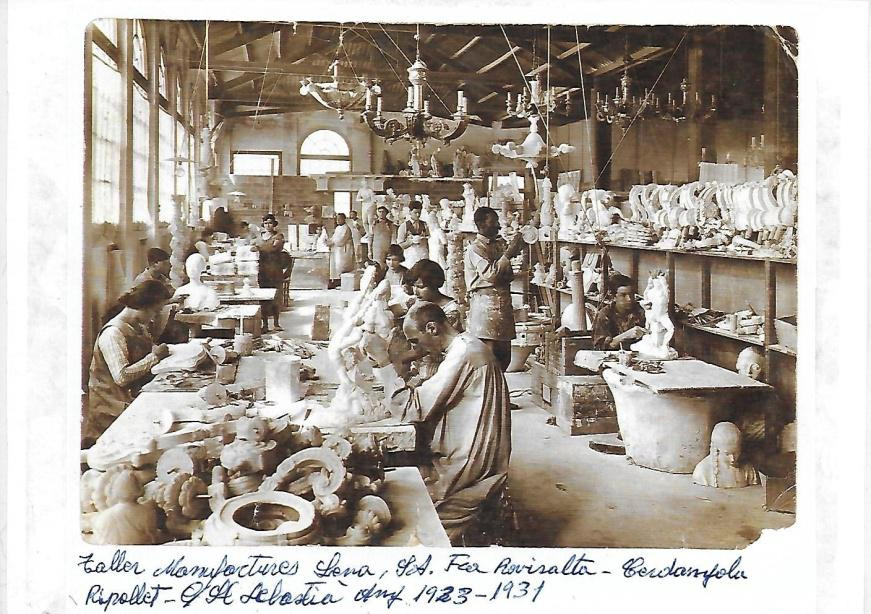
The Lena Workshop in Cerdanyola del Vallès, founded by the Italian caster Alberto Lena, specialised mostly in artistic reproductions and decorative sculpture. The company was known for having put together part of the original statuary that decorated Montjuïc for the celebration of the 1929 International Expo. Photos like this one show that women made up a good part of the workshop staff, a circumstance that was likely commonplace in the various sculpture workshops from this era. This was a highpoint in the process of including women into professional society, as they boasted a particularly important role in the industrial and applied arts sector. In the lower right-hand corner of the photograph, we can see a copy of Girl praying, a model from the Lena Workshop created around 1916.
Photograph from the Lena Workshop, undated (1923-1931). Arxiu Municipal de Cerdanyola. Bequest by Albert Lázaro Arqueros.
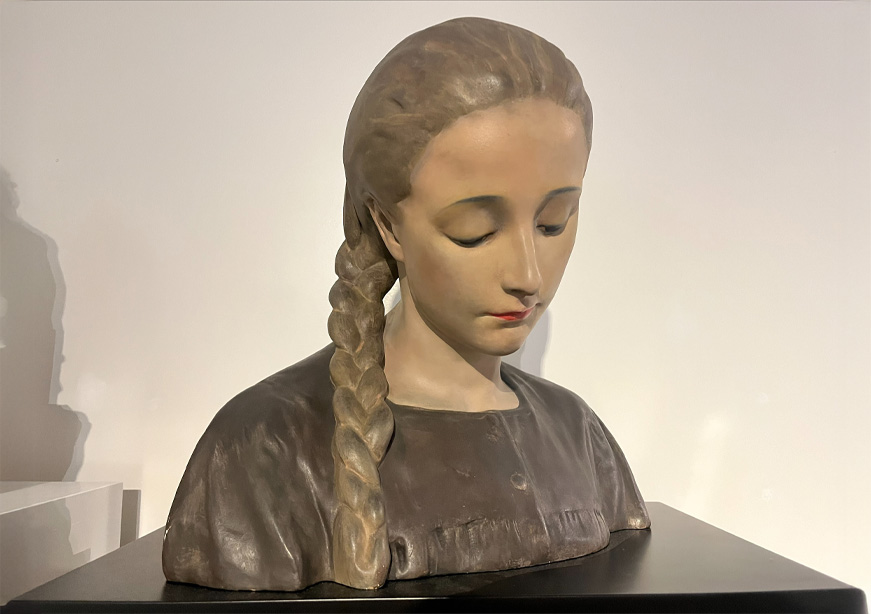
Lena Workshop, Girl praying, c. 1916 (original model). Polychrome Lena paste. 37 x 39 x 27 cm. Museu d’Art de Cerdanyola, Long term loan from the Martínez Montalbán Collection.
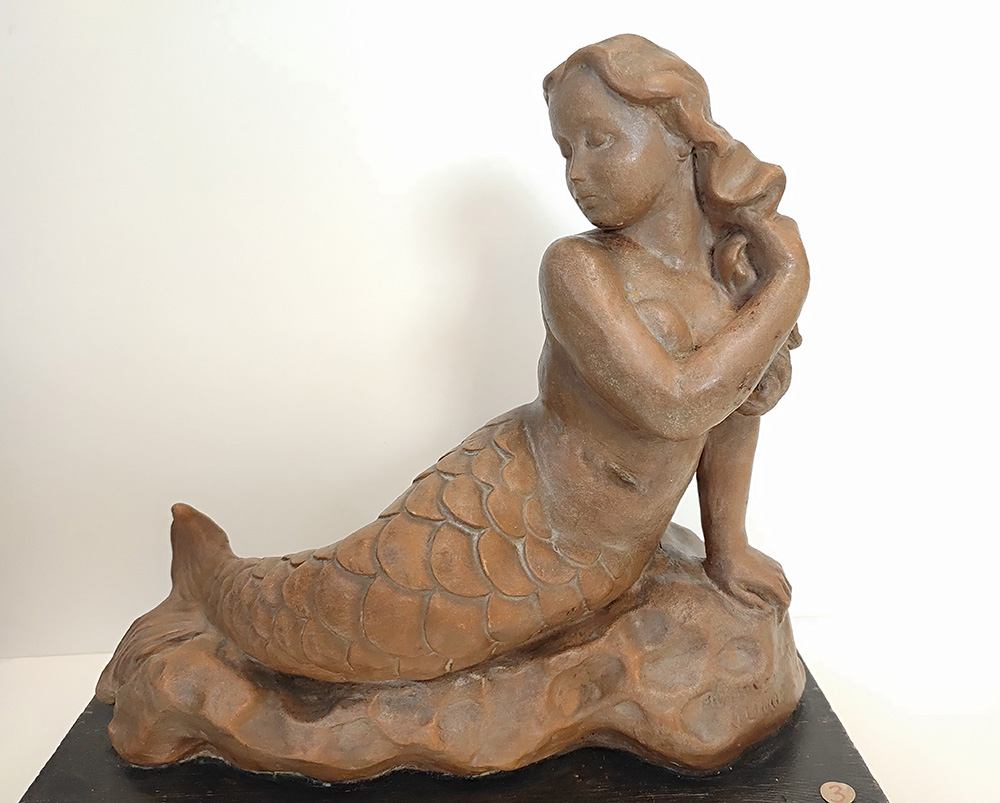
Montserrat Junoy i Ricart (1924-?), Little Mermaid, 1944. Terracotta, 21.5 x 24 x 11 cm. Museu Abelló.
Critics considered Montserrat Junoy the breakout sculptor from the Barcelona National Fine Arts Exhibition in 1944 together with Luisa Granero. However, her work would inevitably be received as an example of the “feminine” vision of sculpture, always linked to the figure of her father, the writer Josep Maria Junoy i Muns. Everything seems to indicate that after 1952, when the sculptor moved to São Paulo after getting married, she was no longer active, a phenomenon that was quite common among the female artists of her generation.
Nude representations
In the 1980s, the American activist group Guerrilla Girls studied the collections in the world’s most prestigious art museums and counted the number of female nudes in them. Representations of female nudes featured prominently, especially when compared to the limited number of female artists in the collections of the same institutions.
Female nudes are in fact one of the motifs par excellence in the history of Western art. They have been used to illustrate a wide array of topics since time immemorial. There is, however, a type of artistic nude designed to satisfy the heterosexual male gaze which, with the passage of time, became freed from the need to be justified through a specific historical, mythological, allegorical, or even religious narrative. Public sculpture has also utilised female nudes to convey a wide variety of messages, seeking to impart ideals, promote values, or propagate ideologies.
How can one represent the nude body? How can one depict the naked anatomy of another woman in three dimensions? While the female sculptors who trained in the second third of the 20th century reflected on these questions while still remaining reliant on the formats and styles of the late Noucentisme, female artists subsequently seemed to stray from these references and, even, abandon the subject matter altogether, opting for proposals related to women’s circumstances from a more conceptual and political standpoint.
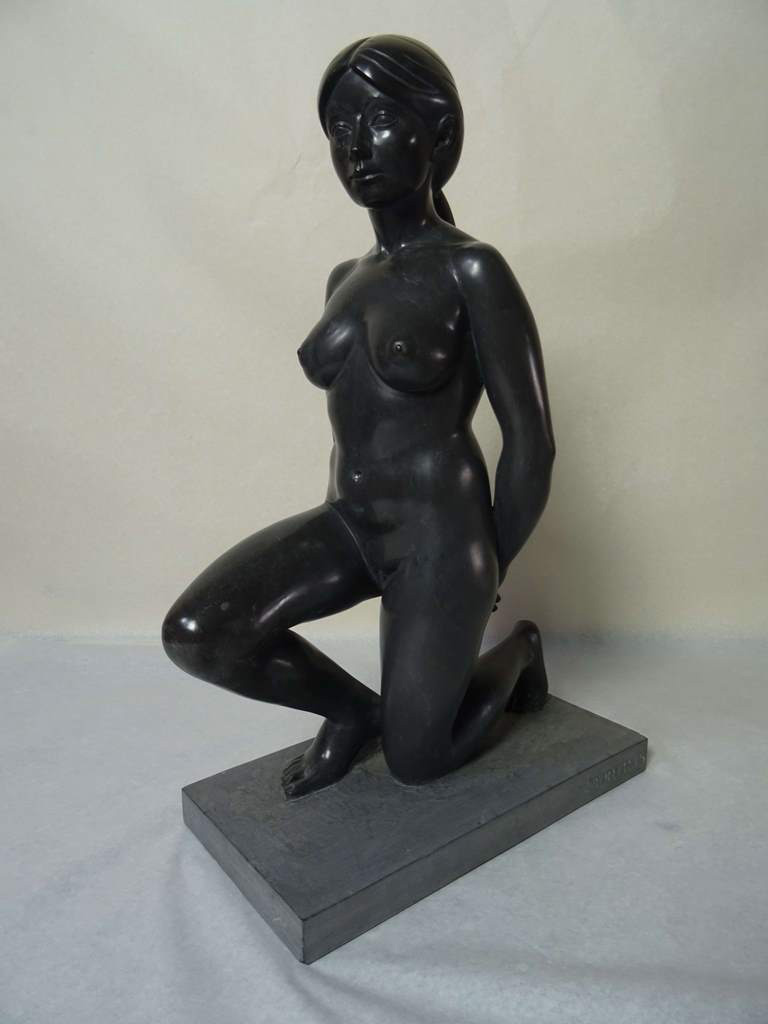
The female figure is the undisputed protagonist in the work of Núria Tortras, which always remained in dialogue with the aesthetics of Noucentisme. Her work featured homogeneous stylistic traits that remained practically unchanged throughout her career, during which she earned numerous awards and recognitions, including the prestigious Sant Jordi Cross in 2003.
Núria Tortras i Planas (1926-2013), Nude, 1974. Bronze, 52 x 19 x 36 cm. Museu d’Art Contemporani de Barcelona.
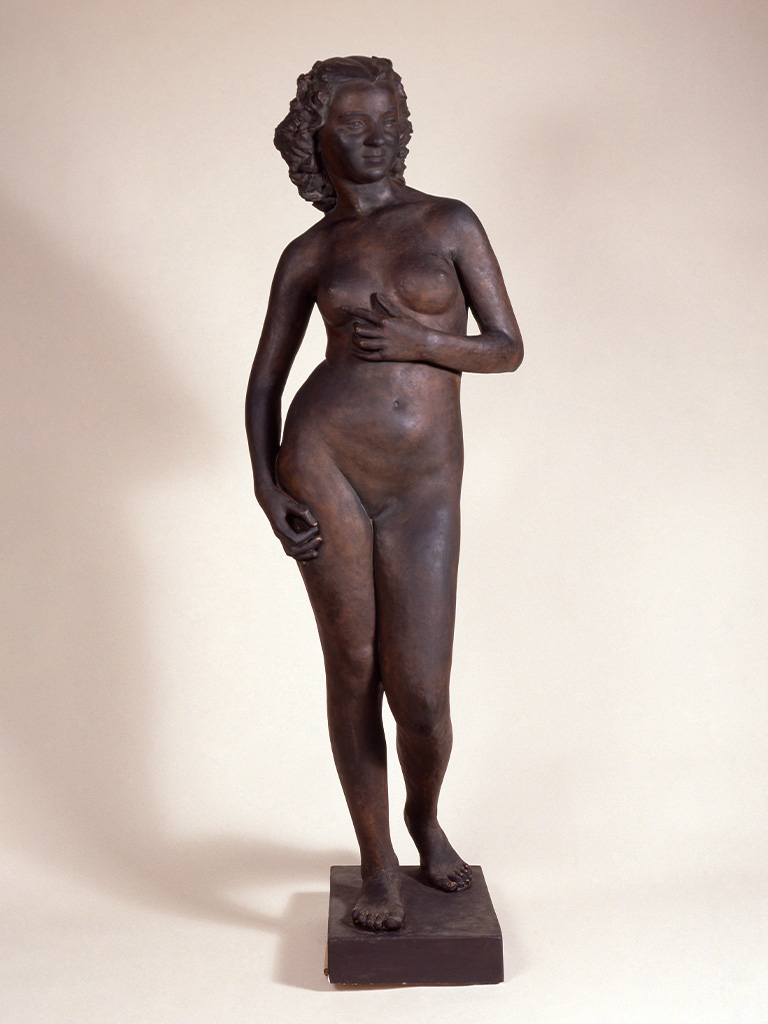
Trained in the renowned Taller Escola de Pintura i Escultura (Workshop School of Painting and Sculpture) of Tarragona, Ripoll gained fame while still very young due to her participation in exhibitions in the 1930s, until the outbreak of the Spanish Civil War halted the momentum she had gained in her career. This large-scale study of a figure features the stylistic traits typical of the genre in the 1940s, with a representation of the body that was an heir to the second Noucentisme and which emphasised the description of certain details, such as the hairstyle, that situate it in a specific time frame.
Maria Teresa Ripoll i Sahagún (1914-1987), Study, 1945. Patinated plaster, 162 x 52 x 47 cm. Diputació de Tarragona. Museu d’Art Modern. Arxiu Fotogràfic. Alberich fotògrafs.
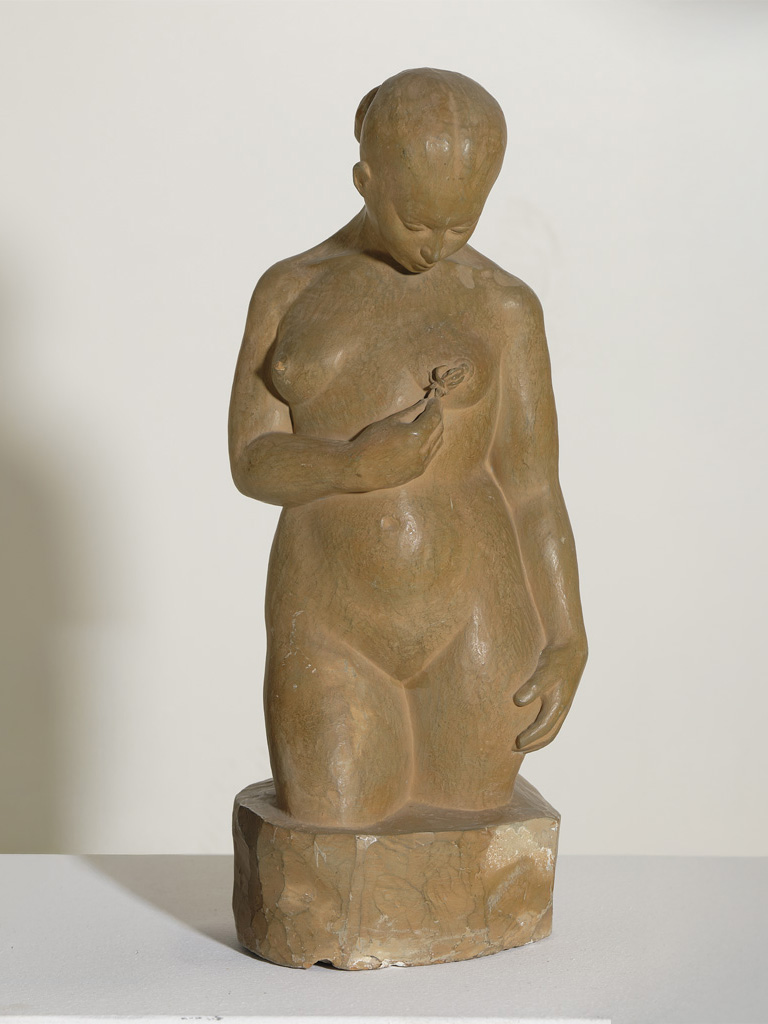
Recently rescued from oblivion, Carme Raurich was one of the most brilliant female sculptors among those who started their career in Girona during the first years of Franco’s regime. After she moved to Argentina in the mid 1950s, her work tended to focus on abstraction, but also on topics related to the indigenous themes that permeated Ibero-American sculpture at the time.
Carme Raurich i Saba (1920-?), Female nude, 1948. Terracotta, 39.5 x 16 x 15 cm. Museu d’Art de Girona.
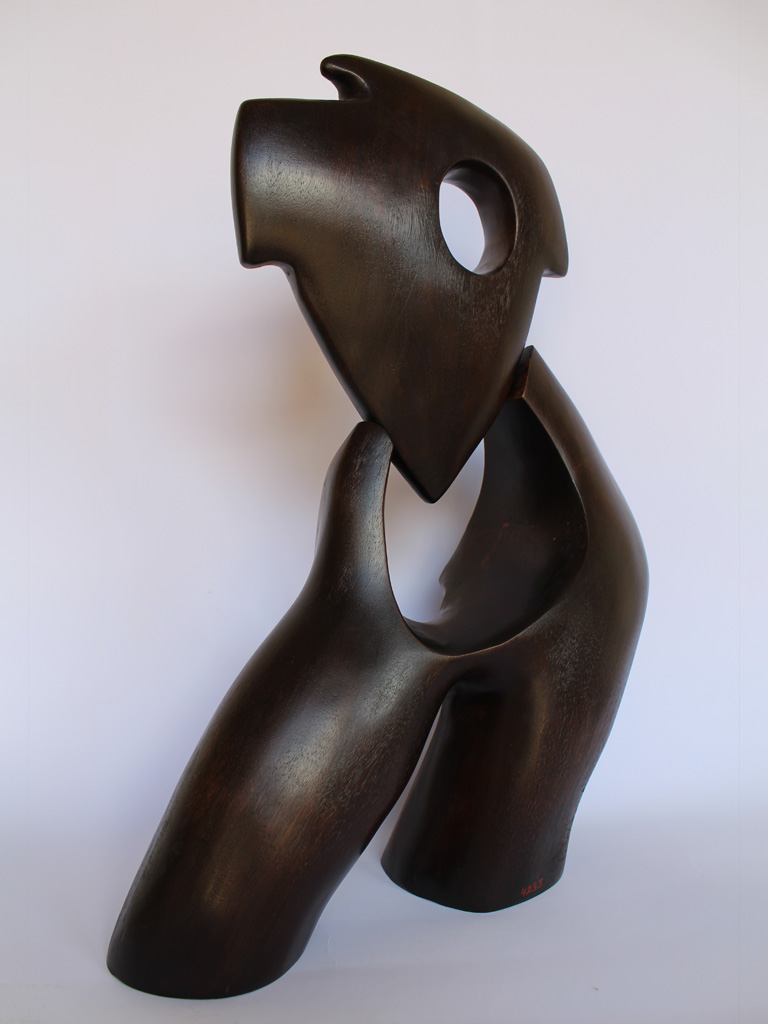
Full, rounded, solid, and opaque shapes contrast with the empty spaces and angles in this sculpture by Carmina Gibert that alludes to the volumes and structure of a woman’s body without representing them in their entirety. The emphasis on the heart and the womb are evident, a clear reference to women’s creative and emotional potential, observed from a perspective with a universal calling.
Carmina Gibert Fortet (1953), Female torso c. 1987. Wood, 48 x 38 x 13 cm. Museu de la Garrotxa.
Female sculptors at the academy
It was not until the late 19th century that Catalan women were able to access formal artistic training, in other words, when they could finally study art in official public schools. In Barcelona, the Escola de Dibuix i Pintura per a Nenes i Adultes (Drawing and Painting School for Women and Girls) opened in early 1883, while in 1885 we can find the first women enrolled in art education at the main campus of La Llotja, although it would be another 20 years until women were enrolled in sculpture classes. The main argument put forth to justify the exclusion of women from the academic education system was the presence of nude models in the classroom, who were intended to teach human anatomy.
As Linda Nochlin noted in the early 1970s, later access to education represented an important handicap for the female artists of the past, since not only did this circumstance make it more difficult for them to acquire certain theoretical and technical knowledge, but it also relegated them to an inferior status compared to their male colleagues. Education became an effective pathway for allowing female artists to become professionals, but also for those women who dedicated themselves to teaching.
In the 1955-56 academic year, Rosa Martínez Brau was appointed a full professor in the Modelling and Casting course at the Escola Superior de Belles Arts de Barcelona (Fine Arts School of Barcelona), where she had previously trained, at a time when we could see a growth in the number of women dedicated to formal artistic education in Catalonia. The work is one out of six pieces in different materials kept at the Museu Frederic Marès, all of them female figures dressed in modernist clothing. Martínez Brau was a disciple of the sculptor Marès. These works may have been classroom exercises, or a commission to decorate the so-called “Women’s Room” in the Museum.
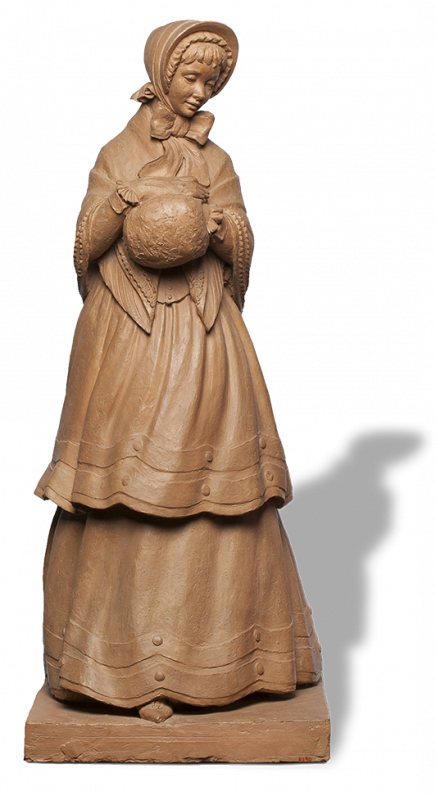
Rosa Martínez Brau (1923-2014), Female figure, second half of the 20th century. Terracotta, 82 x 33 x 44 cm. Museu Frederic Marès. © Foto: ArtWorkPhoto.eu
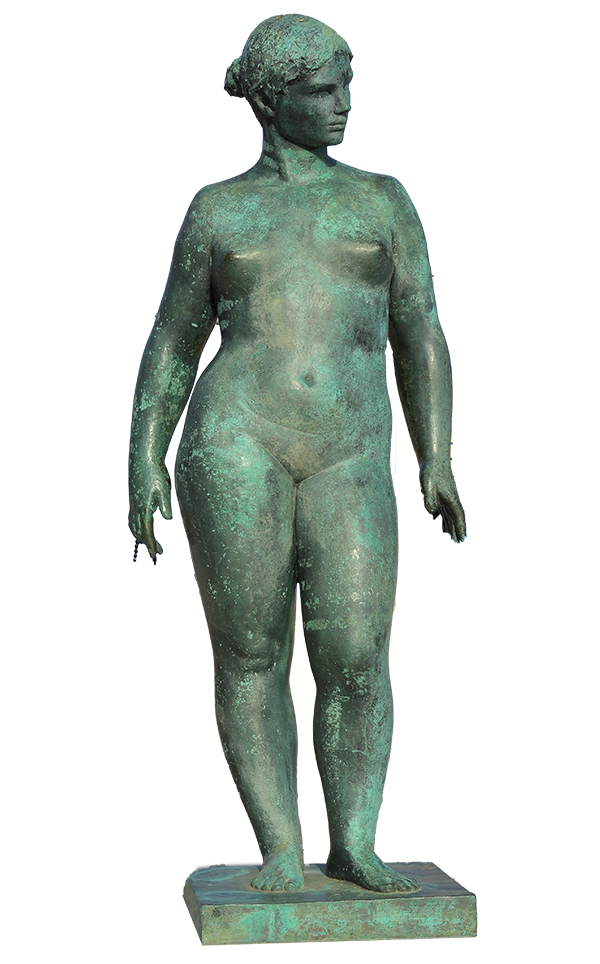
Luisa Granero Sierra (1924–2013), Mediterranean Woman, 2009 (original, 2007), bronze, 180 cm high, Sitges, Platja de Sant Sebastià. Photography: Jordi Ferrer. Wikimedia Commons.
Luisa Granero earned the professorship in Sculpture via civil service examination at the Escola Superior de Belles Arts de Barcelona in 1964, shortly before the classes transferred to the campus in Zona Universitària, where the main building’s façade still preserves several of the artist’s allegorical sculptures. A point of reference for contemporary Catalan figurative sculpture and a symbol of women’s access to university teaching positions, Granero taught classes until she retired in 1994, training several generations of male and female sculptors, some of whom are still active today.
Giving life
Crafting a sculpture, nurturing it, and making it evolve until it is finished reflects the need to give life to a form, to embody an idea. Just like a mother, but without adhering to any cultural ideal, sculptors also give birth in the sense that they generate new realities through the act of creation.
Shaping clay, more than any other material, is an activity loaded with symbolism due to the central role of the hands in exploring the expressive possibility of the material. Moreover, due to its qualities as a material, clay is often viewed by many cultures and traditions as the origin of life.
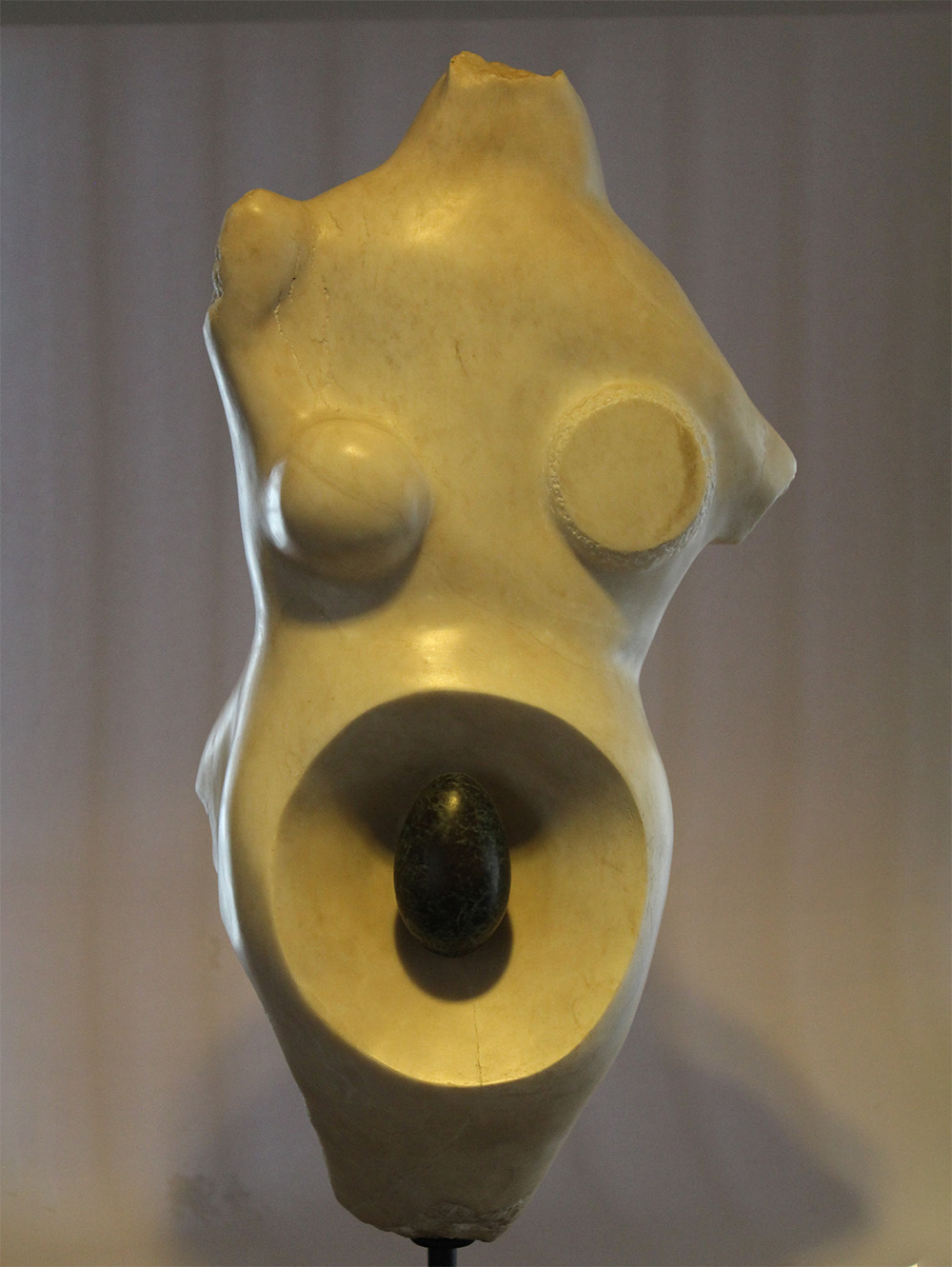
The title of the piece suggests that we are observing a double genesis, a double point of departure. On the one hand, it alludes to childbirth, the oval-shaped fruit in the womb of this figure, yet it also seems to poetically evoke the genesis of Western civilisation, the Mediterranean, whose shores gave rise to the historical cultures that ended up shaping our own.
Pilar Burch i de Rocafiguera (1933), Birth of the Mediterranean, 1998. Alabaster, bronze, and iron, 91 x 32 x 23 cm. Museu de la Garrotxa.
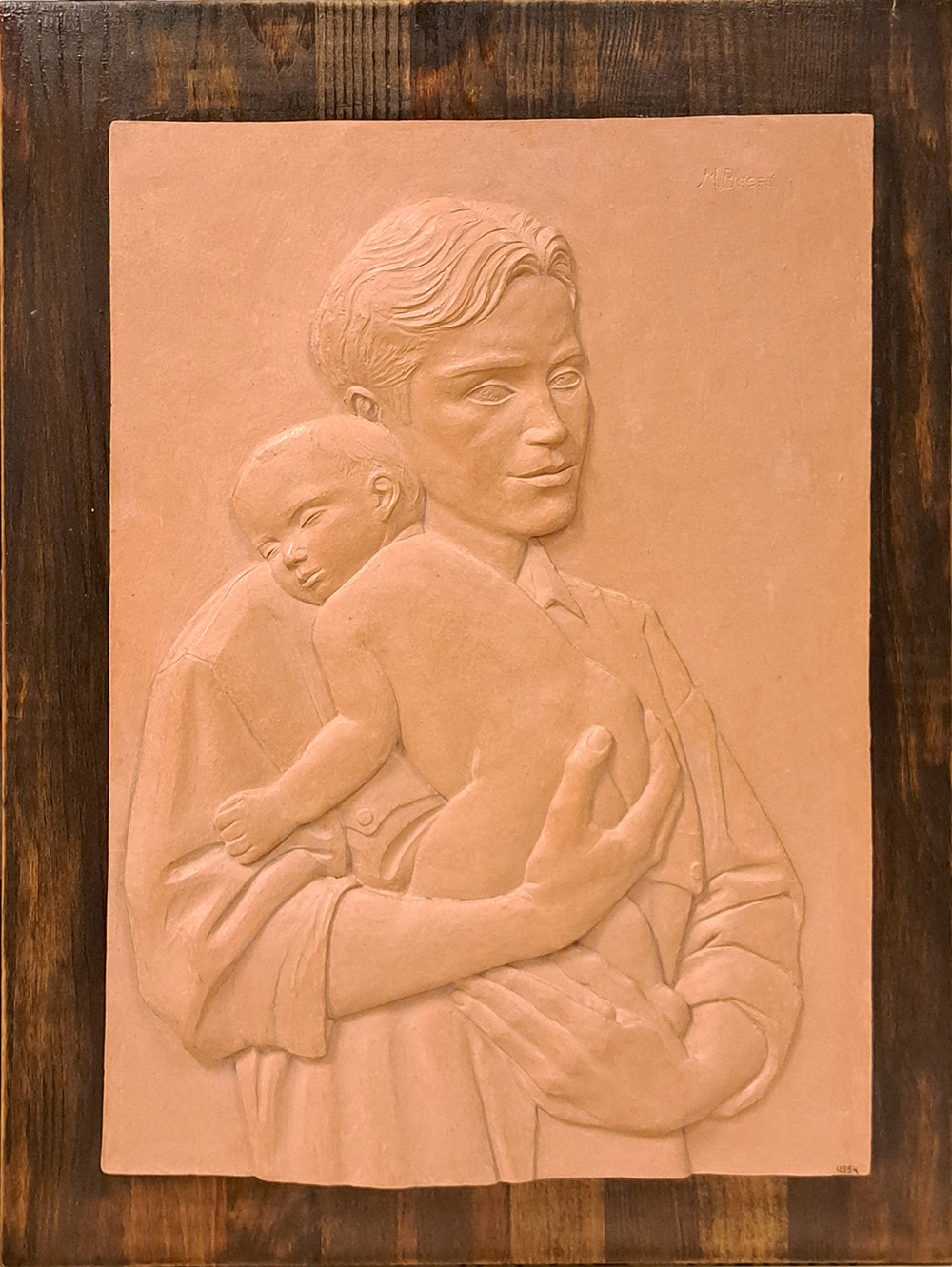
In this figurative bas-relief, Mercè Bessó depicts a moment of intimacy between mother and child. The piece follows the lines of a long-standing iconographic tradition, one which the artist also modernises. By straying from the timeless classicism that we often associate with gender, the image becomes more contemporary and boasts a greater potential for empathy.
Mercè Bessó Carreras (1968), Maternity, 2002. Terracotta, 51.7 x 36 cm. Museu de Reus.
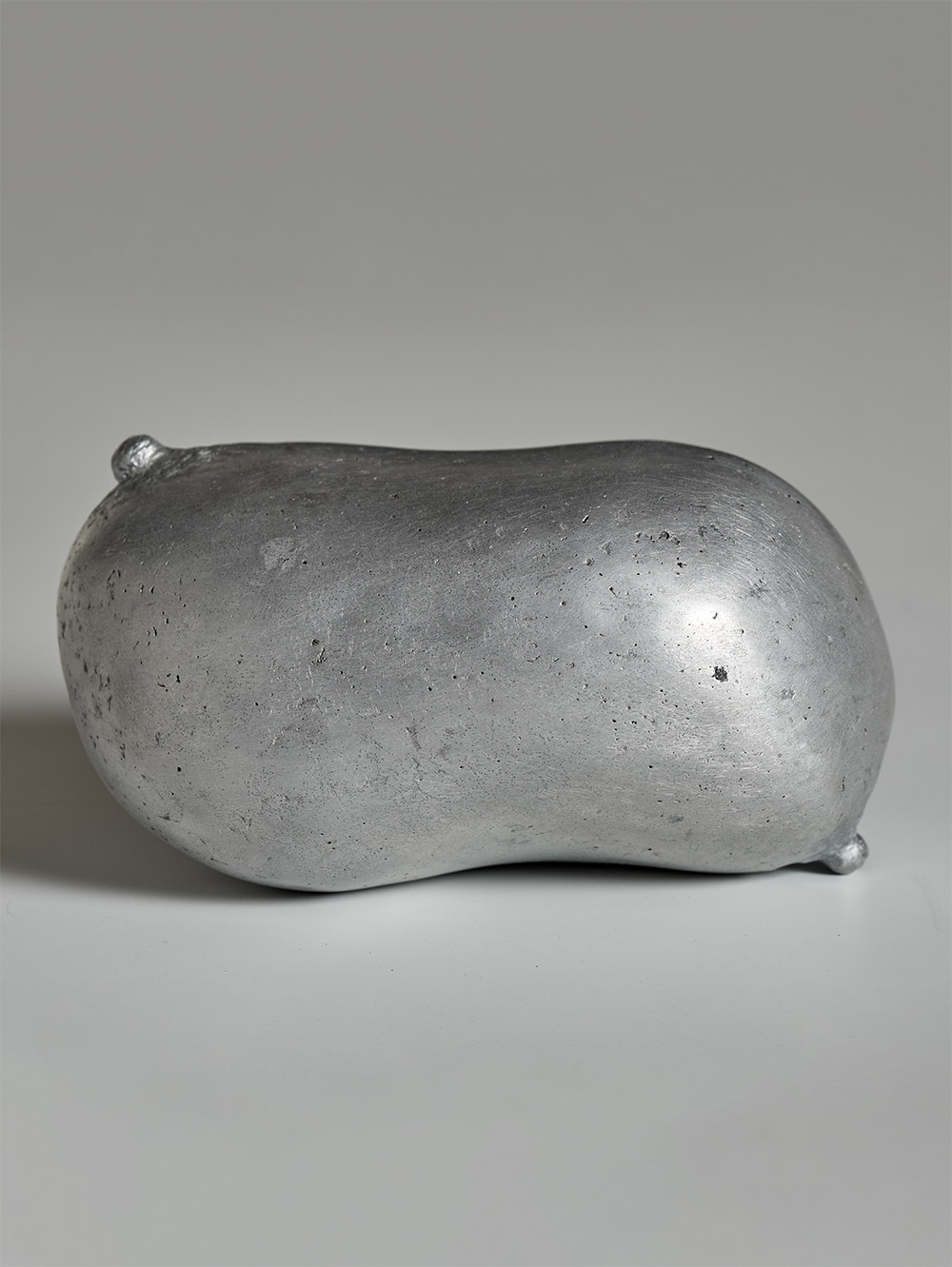
The work of Tura Sanglas features a space dedicated to pieces derived from partial moulds of her own body, small portions of her anatomy, which, once decontextualised and fragmentary, enable new ways to see everything the artist chooses to show us. Breast is the organ that produces mother’s milk and can thus nourish life. Yet, its name in Catalan (mama) is also a familiar name for mother, a fact that takes on particular interest when we know that Sanglas’s mother is also an artist.
Tura Sanglas (Tura Sanz Sanglas) (1992), Breast, 2016. Aluminium, 20 x 13 x 15 cm. Museu d’Art de Girona.
The public dimension
Although women had started to be involved in monumental sculpture in the 1950s, their presence increased in the 1990s, in part thanks to the impetus provided by the Barcelona Olympic Games and the urban renewal projects carried out that sought to modernise the city and remodel some of its neighbourhoods, dynamics that spread to the rest of Catalonia. The fact that female sculptors had access to these types of commissions is significant, especially since it gives them a public dimension that they had previously not enjoyed and allows them to leave their mark on the public space, while also contributing to building it.
In line with the predominant international styles, many of these female sculptors favour refined geometric shapes, sober and clean lines, clearly shying away from figuration. They feel at ease with the use of metal, which they often accompany with the use of mineral elements. It is no coincidence that many of the female artists who work on monumental sculpture have started their individual careers by first exploring ceramics before moving on to the use of wood and metal.
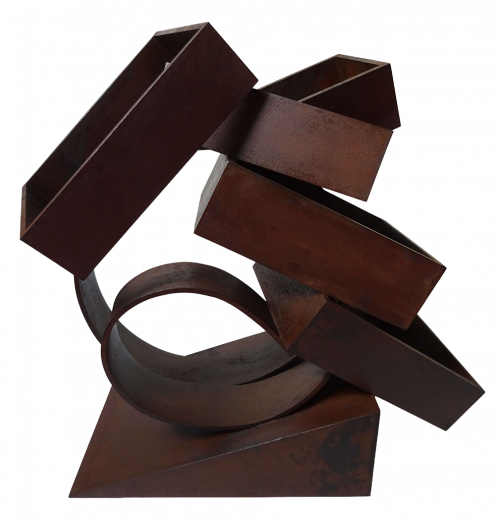
Elisa Arimany i Brossa (1933-2023), Games. 01. (Project for Atlanta ‘96), 1996. Rusted iron, 50.5 x 57 x 30 cm. Museu d’Art Contemporani de Barcelona.
Catalonia boasts a fine selection of the public work by Elisa Arimany, especially around Barcelona and in the Vallès, but we can also find them beyond our borders. In the United States she crafted numerous monumental sculptures intended for the cities of Miami, Philadelphia, New York, and Atlanta. The work in the MACBA is a smaller-sized project of the monument made in Atlanta to celebrate the 1996 Olympic Games. Here she used weathering steel, a material that the sculptor was particularly attracted to, with which she built a set formed by cylindrical shapes and open cubes, a reflection on the balance of masses and the contrast between full volumes and emptiness.
Tell Me, Tell Me Dear is the first public sculpture by Susana Solano. The piece was installed in Barcelona for the celebration of the 1992 Olympic Games, and it was built based on the work kept at the MACBA that dates back to 1986. Considered one of the artists who have rejuvenated the sculptural language in Catalonia since the 1980s, Solano is one of the female sculptors with the greatest presence outside of Catalonia today, as her work is represented in the collections of major international museums. Her enigmatic and essential shapes entail the refined and powerful use of metals and other materials, sometimes including organic matter.
Susana Solano Rodríguez (1946), Tell Me, Tell Me Dear, 1986. Iron, 25.5 x 29 x 19.5 cm and 15.5 x 10.2 x 6.4 cm. MACBA Collection. Long term loan from the Ajuntament de Barcelona © Susana Solano, VEGAP, Barcelona. Photo: Courtesy of the artist.
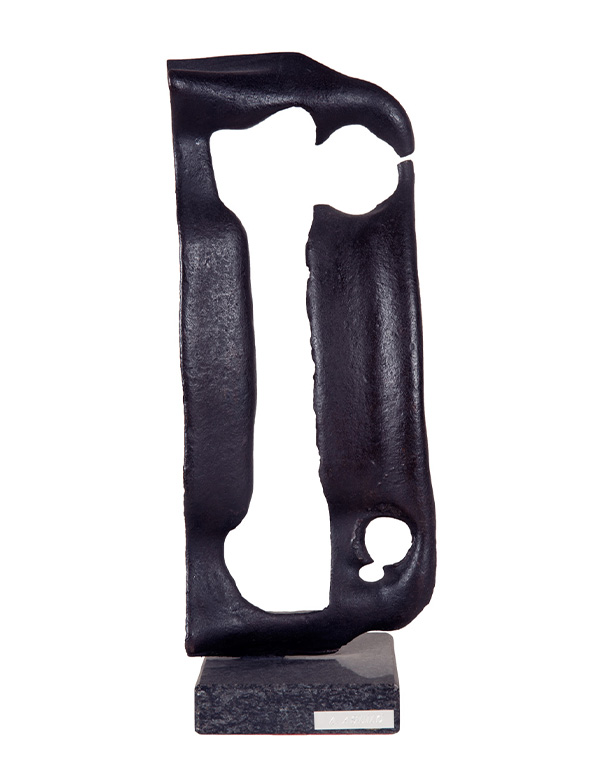
The public work of the Lleida-based artist Antònia Aguiló is concentrated in Ponent (Western Catalonia), although her work is also present in Spain and France. Chance is representative of her small-scale production, which always employs abstract shapes and features suggestive, poetic titles. Within monumental sculpture, Aguiló stood out for the ascending rhythms of her work and for the use of iron, sometimes combined with stone or concrete.
Antònia Aguiló Pascual (1927-2017), Chance, 1981. Bronze sculpture with a granite base, 40 x 16 x 12 cm. MORERA Collection. Museu d’Art Modern i Contemporani de Lleida 1325. Donation by Antònia Aguiló, 2000.
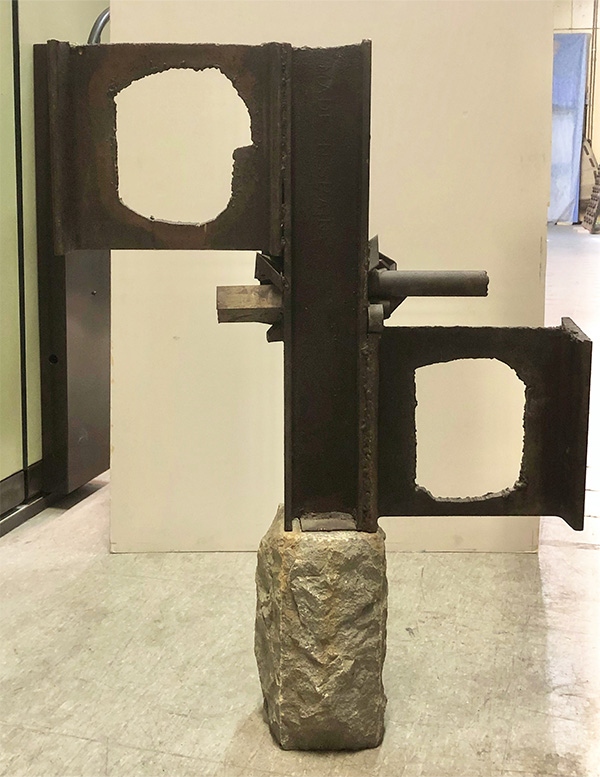
The public work by Àngels Freixanet can be found in Bages, Garraf, and Vallès, as well as in France and Portugal. Iron is the material par excellence in her work. Often folded in on itself, perforated, or ripped, iron takes the shapes conceived by the artist, as if the metal were a soft and easily malleable material. Her sculpture is close to informalism and is a ballad to the poetics of recycled materials, which always bear traces of what they once were.
Àngels Freixanet i Picanyol (1940), Abstract composition, 1991. Iron and stone, 109 x 76 x 15 cm. Biblioteca Museu Víctor Balaguer.
Fascination with metal
The last third of the 20th century witnessed a revival in the interest in metal among female sculptors, in part in response to American minimalism with its geometric volumes, right angles, and compositional sobriety. Iron, steel, lead, and brass all made a powerful comeback in order to open new creative horizons. As a material, metal makes it possible to overhaul formats and procedures, while also making it easier for artists to shy away from representation.
The work preserves the essence of the elements that comprise it. The piece does not mask the specificities, nor does it process them to excess. Artists work with the metal directly; they manipulate it, condition it, and adapt it, while at the same time exploring its expressive capacities. The resulting objects thus stray from the appearance of the castings in bronze and other metals found in sculpture throughout the centuries. Metal is now at the beginning and the end of the creative process.
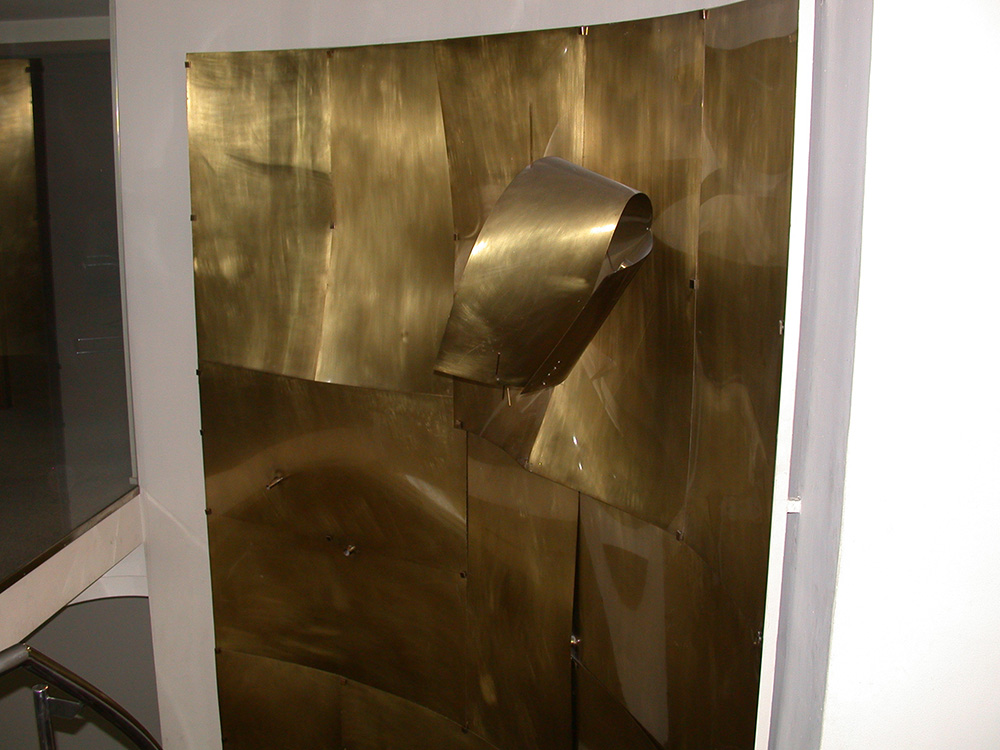
Emília Xargay i Pagès (1927-2002), Clinical Eye, 1951-2000. Brass plates, 381 x 338 cm. Museu d’Art de Girona.
As is the case with many female artists of her generation, Xargay is not well known today, despite being a notable figure of the art scene in Girona in the second half of the 20th century. She was particularly active between the 1970s and 1990s, with an extensive body of work that is well represented in the collections of the Museu d’Art de Girona and the Museu de l’Empordà. Clinical Eye was commissioned by the Physicians Association of Girona and presents an assembly of brass plates, from which the eye in the title seems to emerge, in a clear play on words that refers to the institution for which the piece was created.
Untitled offers a reflection on contours and volumes through the elements that comprise the piece. The work is almost like a visual translation of the artist’s creative process, which she often starts by drawing geometric segments on paper or cardboard before arranging them until obtaining the final composition. Then, the artist repeats the process using metal plates welded together, crafting shapes with refined, sober, and universal lines.
Dominica Sánchez (1945), <em>Untitled</em>, 2008. Painted iron, 39 x 24 x 32 cm (left); 78 x 47 x 57 cm (right). Museu d’Art de Cerdanyola.
Although the piece is a metal object built with an aluminium sheet, the work by Carla Cascales conveys the organicity, flexibility, and subtlety of the underwater plant that gives the work its name. The stem that forms Posidonia seems to sway with the ebb and flow of the water, occupying the space between balance and delicateness, with a monumentality that does not lack for lightness.
Carla Cascales Alimbau (1989), <em>Posidonia</em>, 2020. Aluminium and enamel, 220 x 12 x 0.3 cm. MACBA Collection. Long term loan from the Ajuntament de Barcelona. © Carla Cascales. Photo: Courtesy of the artist.
Poetics of fragility
While sculpture was traditionally prized for the qualities that gave it longevity and which endowed it a definitive character, in the work of many contemporary female sculptors we can observe an interest for everything that features a certain fragility, both in terms of the materials as well as the intrinsic nature of the creations, which stray from the strength and permanence conventionally associated with sculpture.
The use of organic materials, such as paper, fabric, and wood, in addition to inorganic matter, such as ash, glass, and porcelain, refers to the composition of our world, of the earth. At the same time, it evokes the relationship between nature and culture. The particularities of the different materials used in the work influence the projects. Artists make the materials enter into a dialogue with each other and the surrounding space, investigating how they behave, while observing and exploring their possibilities.
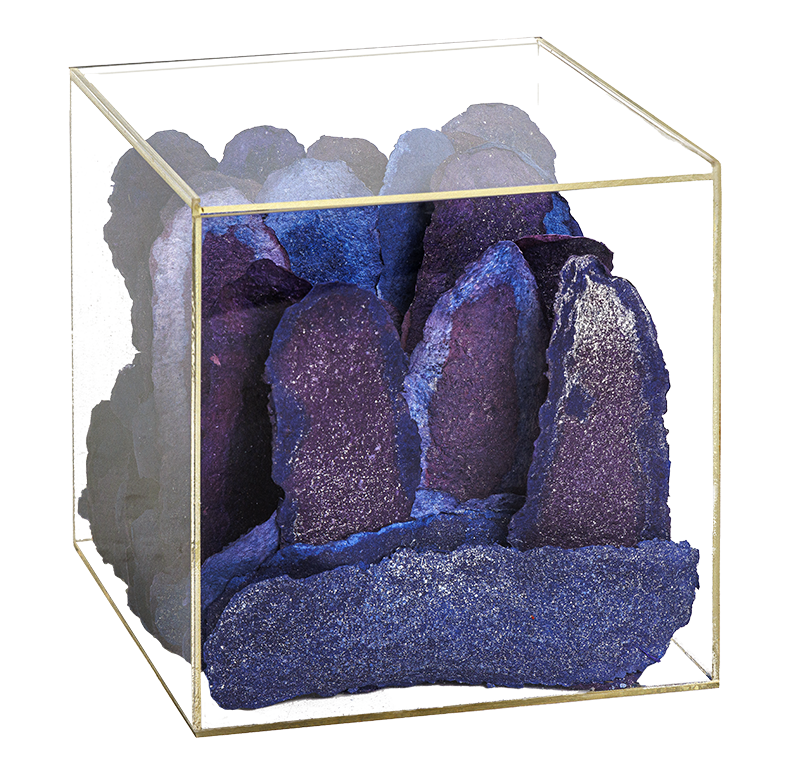
Aurèlia Muñoz Ventura (1926-2011), Untitled (Two figures), undated. Handmade paper, 25 x 25 x 25 cm. Museu de l’Empordà.
Aurèlia Muñoz is internationally renowned for her creations in the field of tapestry, which was her main focus mostly from the 1960s to the early 1980s. After that period, she developed an interest in working with handmade paper, a way of continuing to advocate for artisanship as a vehicle for cultural expression. The blue hues of Untitled (Two figures), as well as their organic character, point to the sea and the beings that inhabit it.
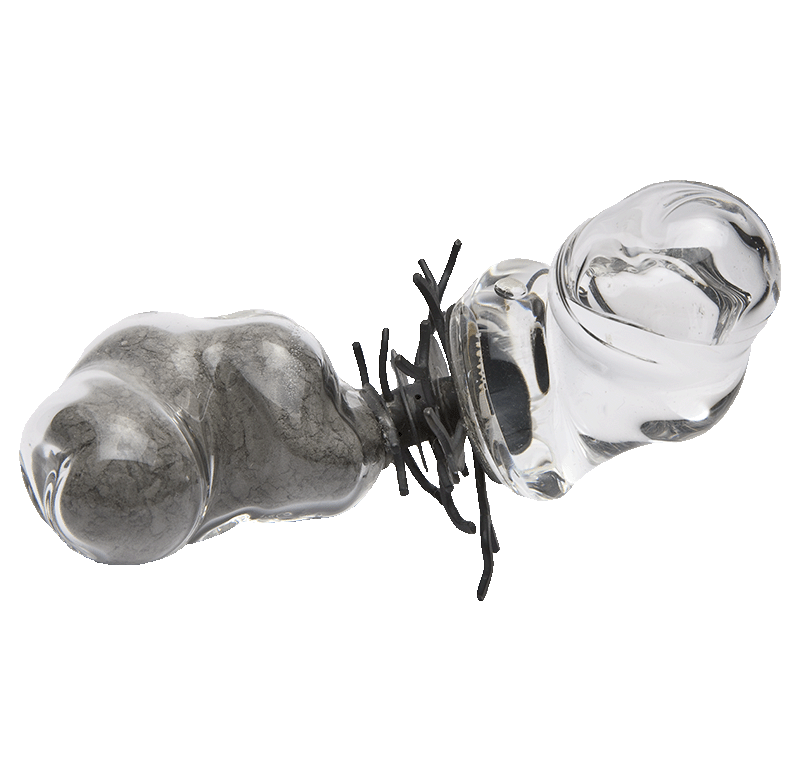
Estela Saez Vilanova (1977), From genesis to apocalypse (series entitled “Cassiopeia’s World”), 2007. Ash, silver and glass, 9 x 5 x 6 cm. Museu de l’Empordà.
In the series entitled “Cassiopeia’s World”, Estela Saez combines glass, metals, and natural materials to create small objects that boast biomorphic shapes. These pieces evoke strange and unusual, sometimes discomforting living organisms that approach the real from the imaginary, while linking with surrealism’s interest in dreamlike states. The title of the piece, From genesis to apocalypse, seems to allude to the finite nature of life, to the beginning and inevitable end of all existence.
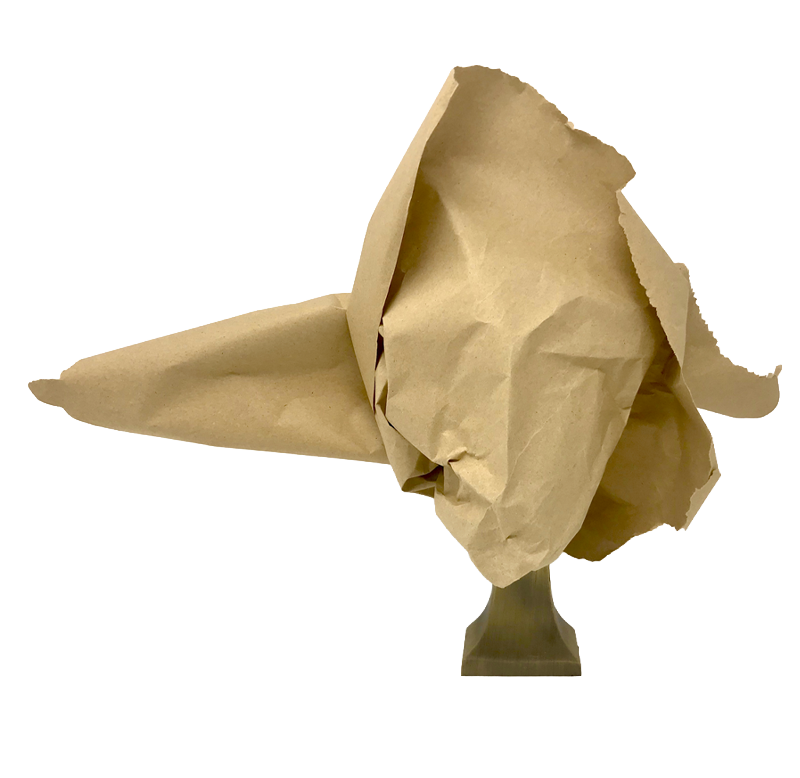
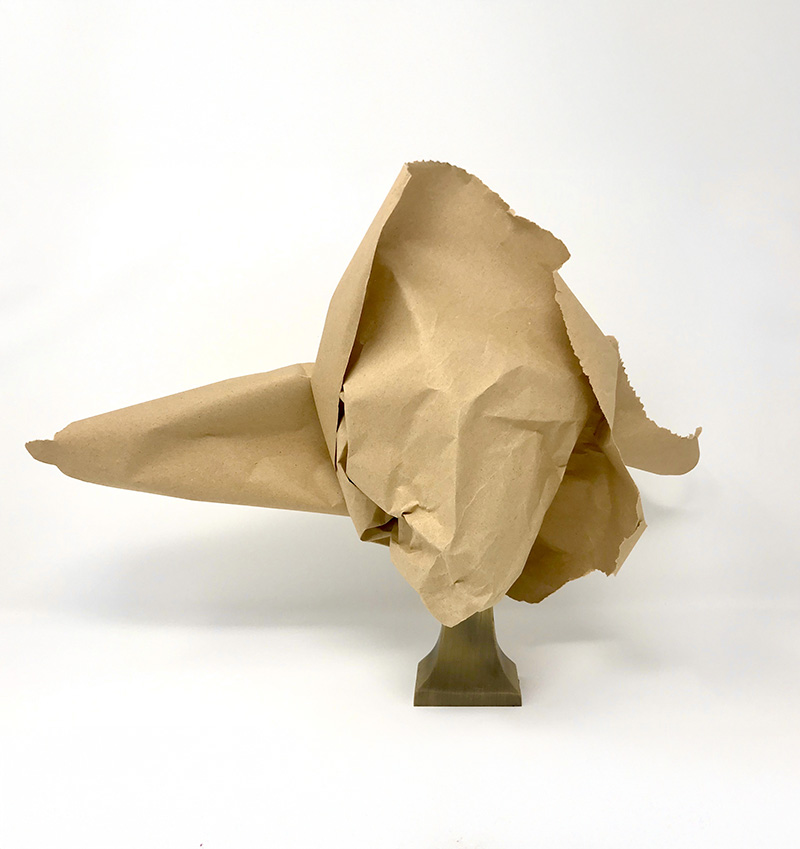
Patrícia Maseda Calamita (1977), Pandora, 2018. Kraft paper and bronze, 33 x 47 x 21 cm. Museu d’Art de Cerdanyola.
Paper is an essential material in the work of Patricia Maseda, but it is not the only one. In her artwork, we also find cardboard mesh and leather, among others, alone or combined with quartz, marble, bone, plastic, and more which the artist manipulates and arranges in order to craft myriad figures from the universe of myth and legend. The elusive traits of Pandora’s face call out to us and allow us to intuit the force hidden beneath an apparent fragility.
Viva voce
The career paths, works, and contexts of 20th century female sculptors allow us to trace genealogies among women, in other words, to illustrate constellations of ideas and stories that tie them together. Likewise, we can interpret what today’s active female artists are trying to explain to us as a result of their desire to forge bonds and discuss both with the present generation as well as those to come.
Through sculpture, they share personal experiences while unveiling part of their intimate universe. Listening to their voices can remind us of a shared reality, one that is not free of areas of conflict or future challenges. These often-startling first-person stories encourage us to reflect on our connection not only with others, but also with ourselves. They invite us to live, to interact, and to reflect, while demonstrating art’s capacity for agency and transformation.
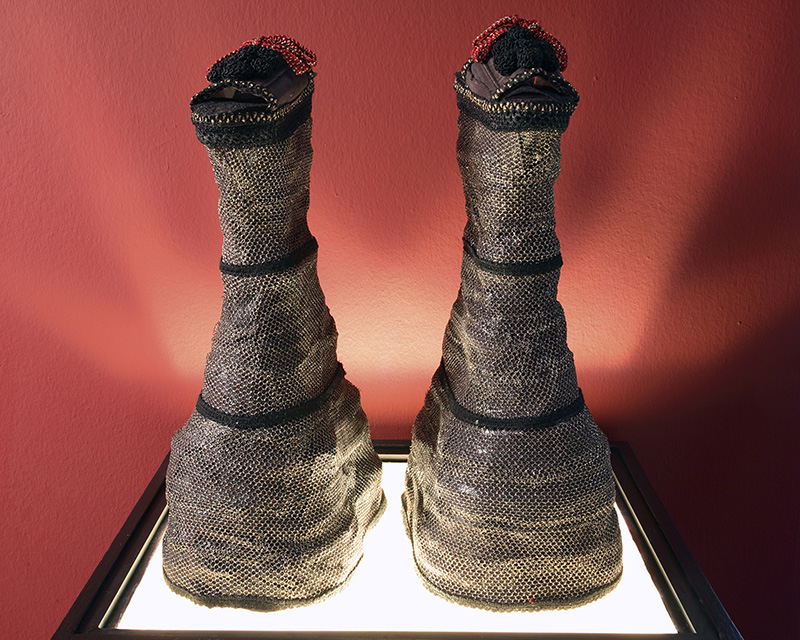
Isabel Granollers’s interest in the symbolic and emotional value of everyday items, as well as in the textures and sensations provided by humble, familiar materials, is perfectly evident in The pedestal woman. The piece includes two highly similar figures, one next to another, enigmatic but close, rustic, and earthly. They are the expression of one of the artist’s callings, which is to create objects capable of storing and conveying memories, preserving fragments of life, but also voices and moments of silence.
Isabel Granollers (1965), The pedestal woman, 2006. Textile material, 110 x 64 x 49 cm. Museu de Reus.
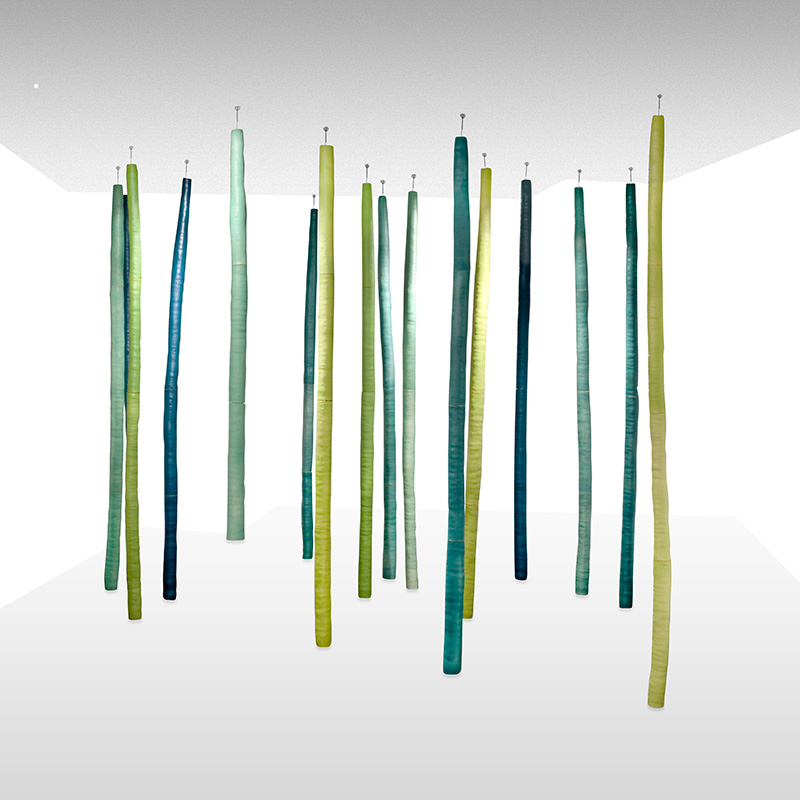
In Can’t see the forest for the trees, Rosa Cortiella plays with the tension between the literalness of the expression in the title and its figurative meaning. Here we can find trees in their physical dimension, trunks with a coarse surface that reach up to the sky, in different hues of green. Yet at the same time we intuit the forest, something which, as the saying goes, the trees should not prevent us from seeing. The artist reflects on our tendency to pay too much attention to that which is partial, superfluous or more trivial, and on the idea that we are not able to perceive the situation in its entirety, from a distance and in all its magnitude. This is an invitation to go even further, to transcend the immediacy of the here and now, and to continue moving forward.
Rosa Cortiella (1965), The Rooster and Hen were on the balcony (Catalan children’s song), undated. Mixed technique, 36 x 48.5 x 3.5 cm. Museu de l’Empordà.
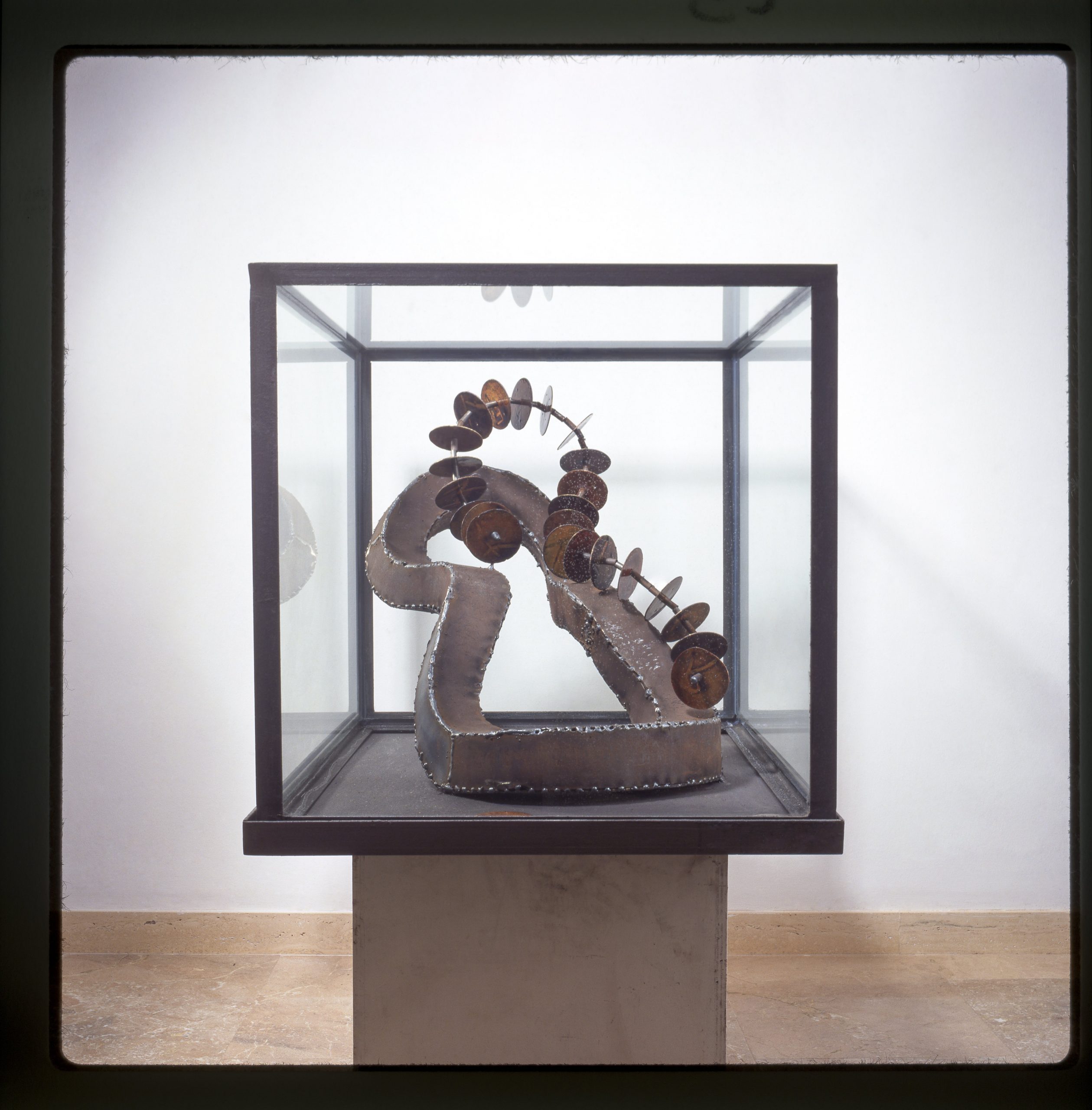
In this piece, Maïs works with one of her trademark subject matters, human feelings and emotions, which in this case are taken to the limit. Her artistic practice is committed, feminist, and powerful. Since her early days working with enamel, she has moved toward other materials, including metals and other non-conventional elements, which allow her to explore symbolism that refers to her personal universe and to her vision of the world we live in.
Maïs (Marisa Jorba Nadal) (1959), Anguished cry, 20th century. Iron, enamel, and glass. Diputació de Tarragona. Museu d’Art Modern. Arxiu Fotogràfic. Alberich fotògrafs.
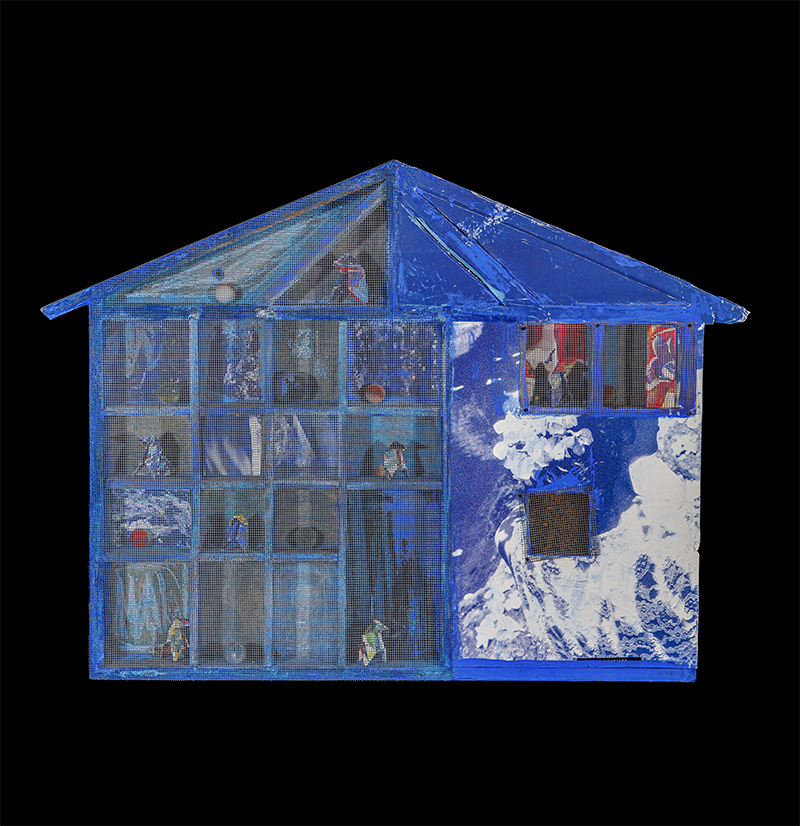
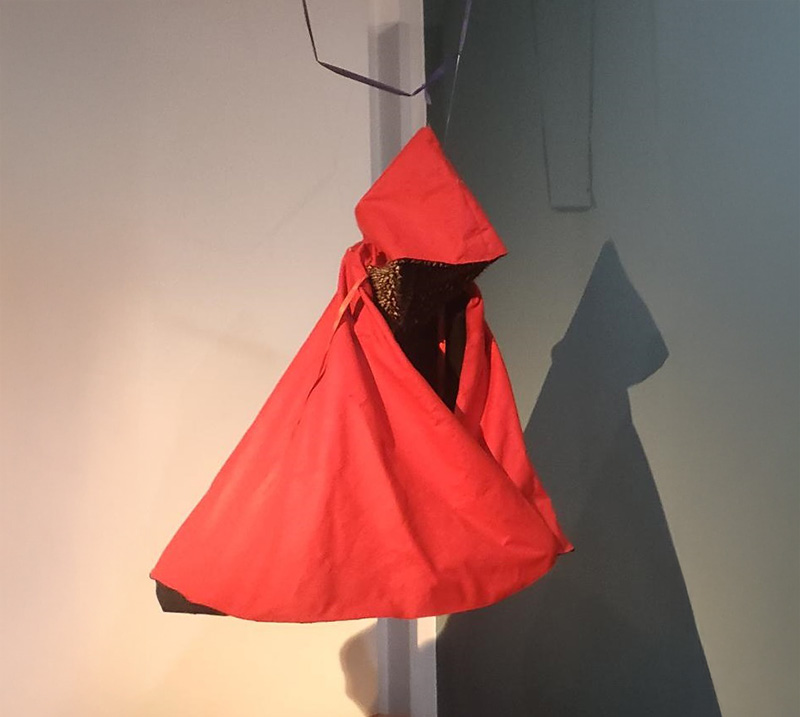
It is common knowledge that certain fairy tales and folk songs have passed down patriarchal values and positions that promote and perpetuate gender stereotypes generation after generation. The works of Rosa Brugat and Marina Ramoneda visualise and denounce the violence inflicted on women through the music and stories that form part of our intangible culture which have traditionally been considered harmless.
Rosa Brugat Batller (1956), The Rooster and Hen were on the balcony (Catalan children’s song), undated. Mixed technique, 36 x 48.5 x 3.5 cm. Museu de l’Empordà.
Marina Ramoneda (1984), Little Red Riding Hood (The Better to Eat You With), 2006. Felt, tape and rose thorns, 75 x 67 x 10 cm. Museu d’Art de Sabadell.