


Beasts
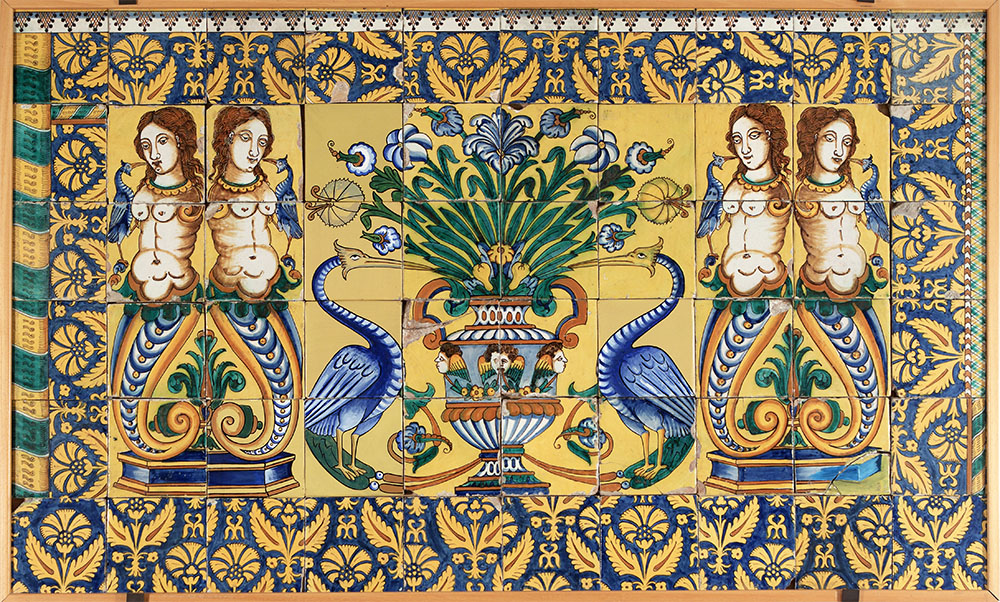
<em>Sirens panel</em>, circa 1748. Terracotta. From the parish church of Sant Martí de Llaneres (Castell d’Empordà). Museu d'Art de Girona
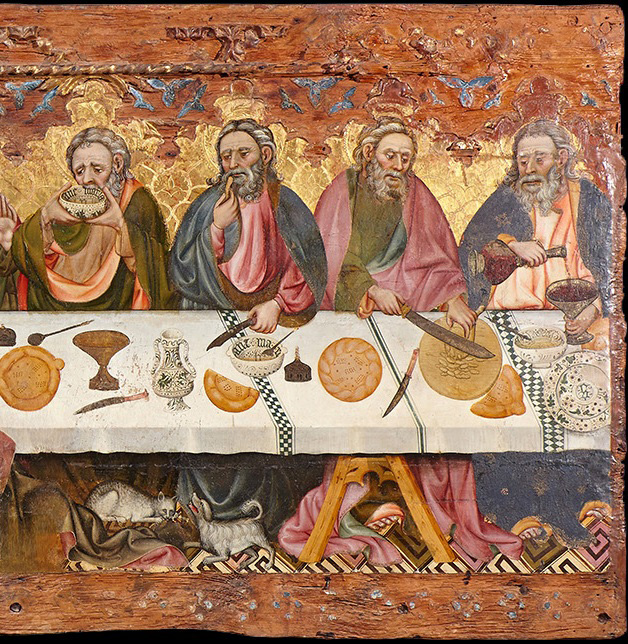
Attributed to Pere Teixidor. <em>Altarpiece of the Holy Supper</em>, 1435-1445. Tempera painting on wood. From the church of Santa Constança de Linya, Navès (el Solsonès) Museu Diocesà de Solsona
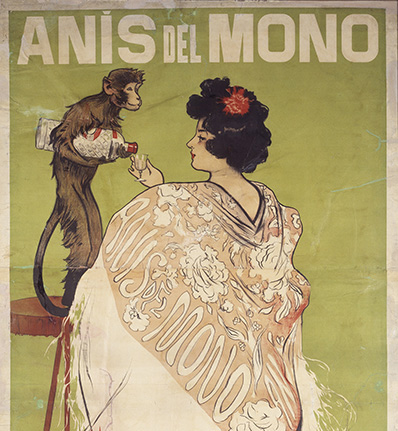
Ramon Casas, <em>Anís del Mono</em> (With an iron-on percale skirt), 1898. Poster, lithograph. Museu Nacional d’Art de Catalunya (CAT: 000385-C)
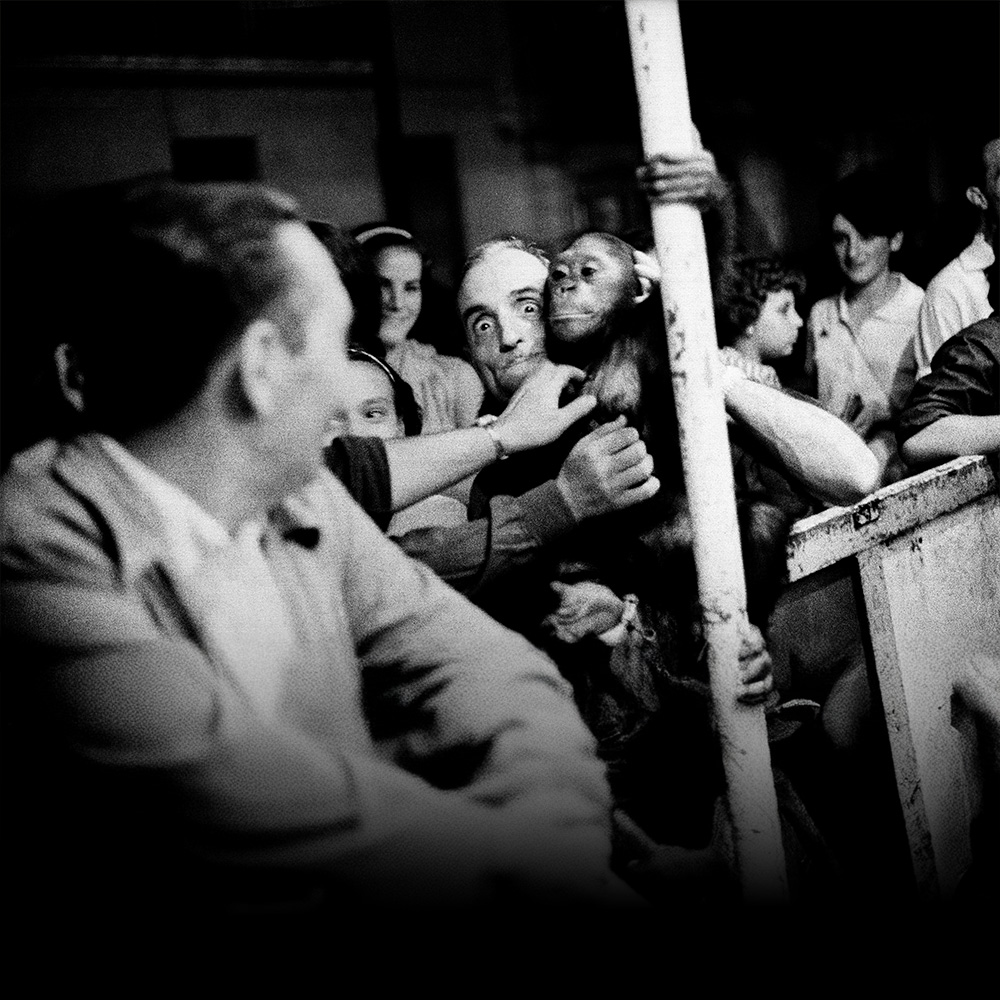
Xavier Miserachs. <em>Barcelona</em>, 1962. Barcelona, 1962. Group of people with a female monkey during the Festa Major de Sants, 1962. Original format: negative, b/w, 35 mm. Fons Xavier Miserachs. Museu d’Art Contemporani de Barcelona
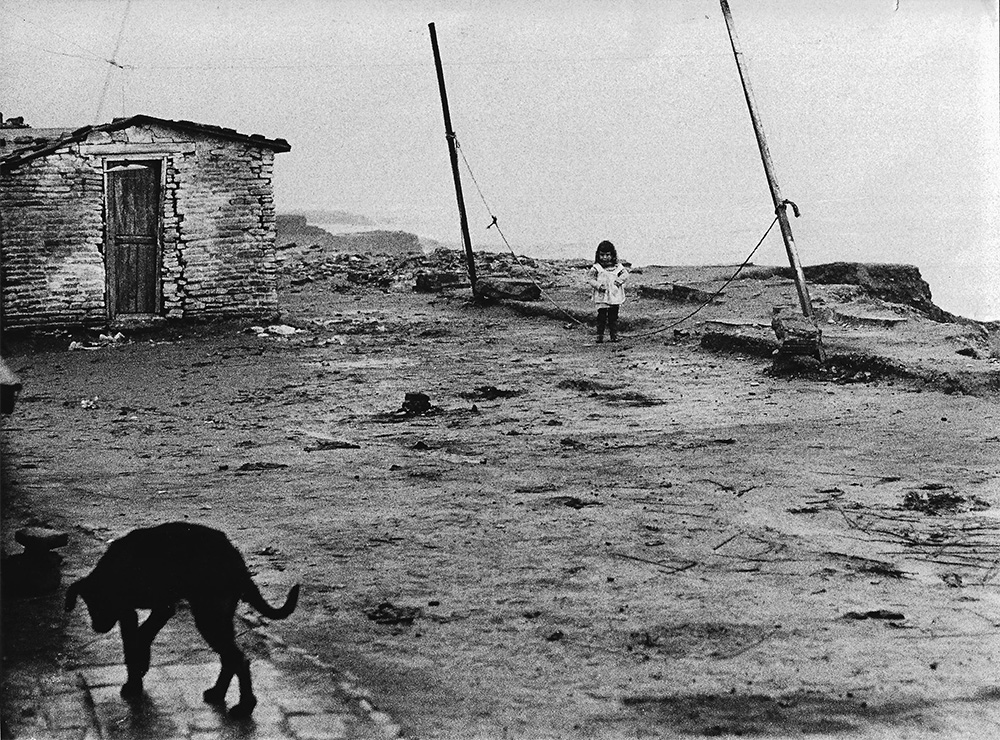
Colita. <em>Somorrostro</em>, 1984. Photograph, original format, negative, b/w, 35 mm. Museu d’Art Contemporani de Barcelona (R.6346, 1963)
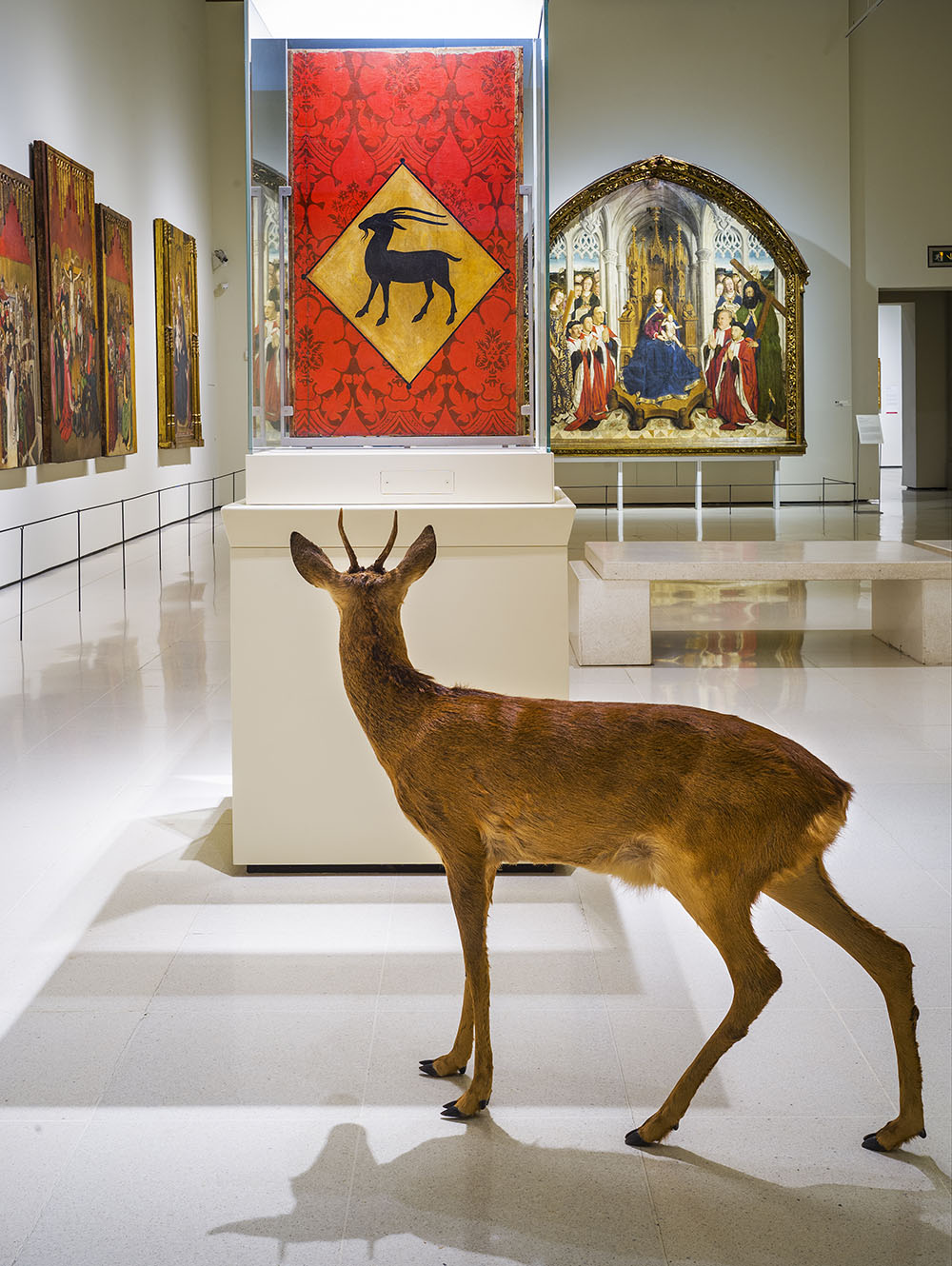
Setxu Xirau. <em>L’ull del cabirol,</em> 2022-23. Cabirol naturalitzat. Intervenció al Museu Nacional d’Art de Catalunya ©
Introduction
Albert Martí Palau
Art historian and antiquary
Throughout history, those in power have used fear, dressed in different forms, to intimidate and control the population. Ever since the Graeco-Roman or medieval world, fantastic animals, some cruel and ruthless and others magical and intangible, have graced the pages of books, murals, altarpieces, objects, and more with their images. More recent art has also created imaginary beasts in order to reflect or give an animal shape to metaphors of good and evil.
We will now embark on a journey guided by all the beasts who seek to terrify viewers or make them reflect. To do so, we will eschew a specific chronology in order to highlight themes and iconography. In the same vein, we have sought to reject any uniformity of techniques and materials as beasts do not follow timelines, formats, or borders.
Heavenly and hellish beasts
How can we give shape to the unknown? How can we visually depict a textual description with overflowing imagination? How can concepts like “brutal”, “beastly”, “hellish”, “monstrous”, “evil”, and more be translated visually? What about the exact opposite: celestial, beautiful, or benevolent? It is precisely in these imaginary contexts where figures like the devil allow artists to be more creative and give free rein to their wildest imagination without worrying about facing reprisals for being too bold. As the old saying goes, a picture is worth a thousand words but managing to achieve that when the thing you want to explain doesn’t exist is truly a feat. Beasts are a creation by humankind to give shape to other realities, to that which we seek to understand and need to represent.
Dragon
Dragons, the symbol of evil par excellence, often appear as a representation of the devil and the embodiment of evil. In this case, a ferocious dragon, sharp in tooth and claw, protected and allowed entry to the Casa de l’Ardiaca in Barcelona at the end of the 15th century. This ring-shaped doorknob with an openwork plate is stored today at the Museu del Cau Ferrat in Sitges, which is home to one of the most singular and richest collections of iron art. Forging has been one of the most notable expressions within objets d’art in our region: for example, the grille of Notre Dame de Paris was made by two Catalan master blacksmiths, Blay and Sunyol, circa 1250.
The ring or handle hangs from the dragon’s body as it looks outward, with defiant mouth and claws, standing guard over the building. This doorknob was likely reproduced and imitated in the late 19th century and onward and served as the model for copies made during Modernism. Santiago Rusiñol himself drew one to publish it in the Álbum de detalles artísticos y plástico-decorativos de la Edad Media Catalana (1882).
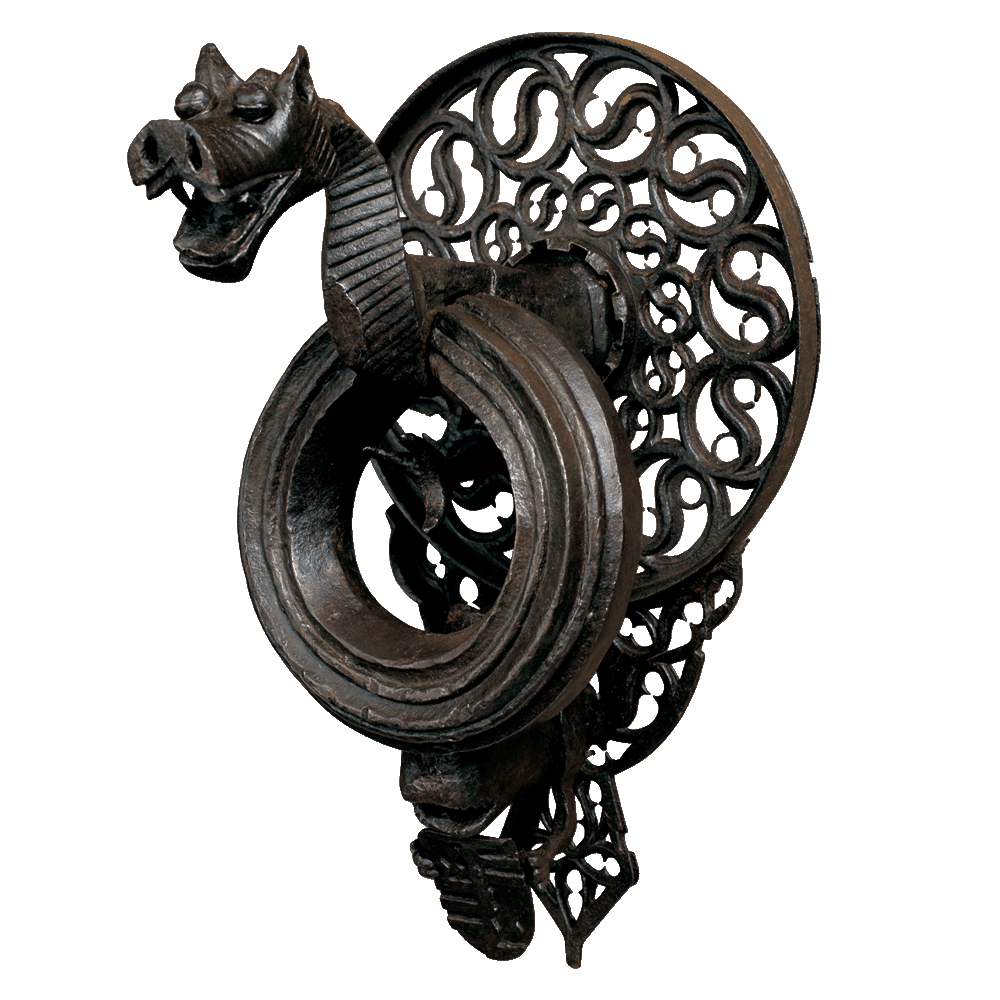
Ring knocker, circa 1500. Wrought iron. Inv. no. 30.987. Museu del Cau Ferrat.
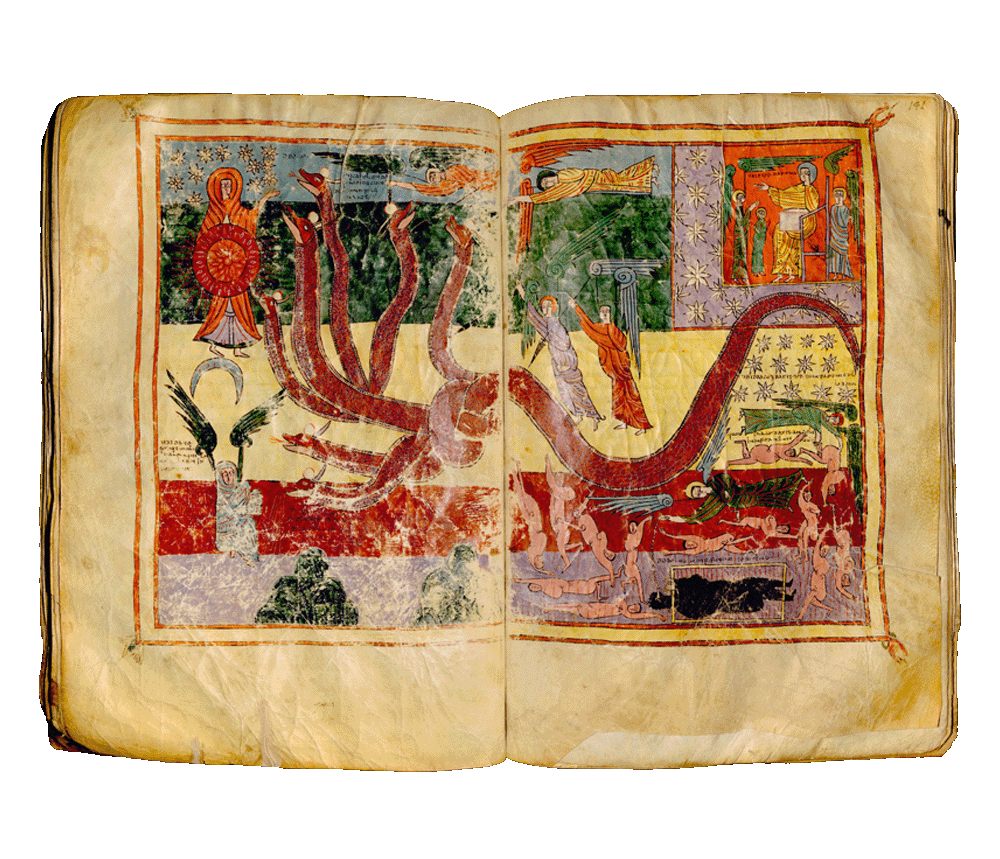
Anonymous. Urgell Beatus, The Lady and the Dragon. Revelation 11, Ms 26 f° 140v 141, 10th century. Illuminated parchment with calligraphy. From the Catedral de la Seu d’Urgell.
Seven-headed serpent
Beatuses, of which there are two extant copies in Catalonia, the Urgell Beatus and the Girona Beatus in the city’s cathedral, are copies of the original 8th century manuscript written by Beatus, the abbot of the monastery of Liébana, commenting on the Apocalypse of Saint John. This manuscript, written in gorgeous calligraphy and featuring miniatures, aimed to prepare the faithful for the arrival of the end of times and the Final Judgement. The first monster to appear in it is the great Dragon, also known as the Devil, Satan, or the serpent, as hell’s equivalent of God in paradise.
This miniature, which spans two pages with the seven-headed dragon, is one of the many illuminated interpretations made based on the following text: “And I saw a beast rising out of the sea, with ten horns and seven heads, with ten diadems on its horns and blasphemous names on its heads” (Revelation 13:1), which was the source of inspiration and countless depictions, first for miniaturists and later for medieval sculptors and painters.
Demons
The images of Saint Bartholomew and Saint Michael both depict beasts or demons at their feet. These were a symbol of evil which were at the same time frequently associated with our venerated saints. Starting in the Middle Ages, the Church sought to bolster the representation of good and evil utilising a Manichean confrontation. Chained to the feet of Saint Bartholomew, the titular saint of the altarpiece, is the devil that he expelled from a pagan statue. Meanwhile, the archangel Saint Michael uses his lance to skewer a mischievous demon that is attempting to tip the scales to his side during the weighing of the souls (psychostasis).
The altarpiece of Saint Bartholomew, a work by Pere Espallargues in the late 15th century, comes from the church of Sant Martí de Capella, in the Catalan speaking territories of la Franja d’Aragó. The piece was removed in the early 20th century, ending up in the United States before finally returning to the collection of the Museu Diocesà de Lleida thanks to private patronage. In 2017, this Museum suffered a beastly attack. In an act that will go down in political infamy, the lance and knife were momentarily overwhelmed by armoured vests and pistols.
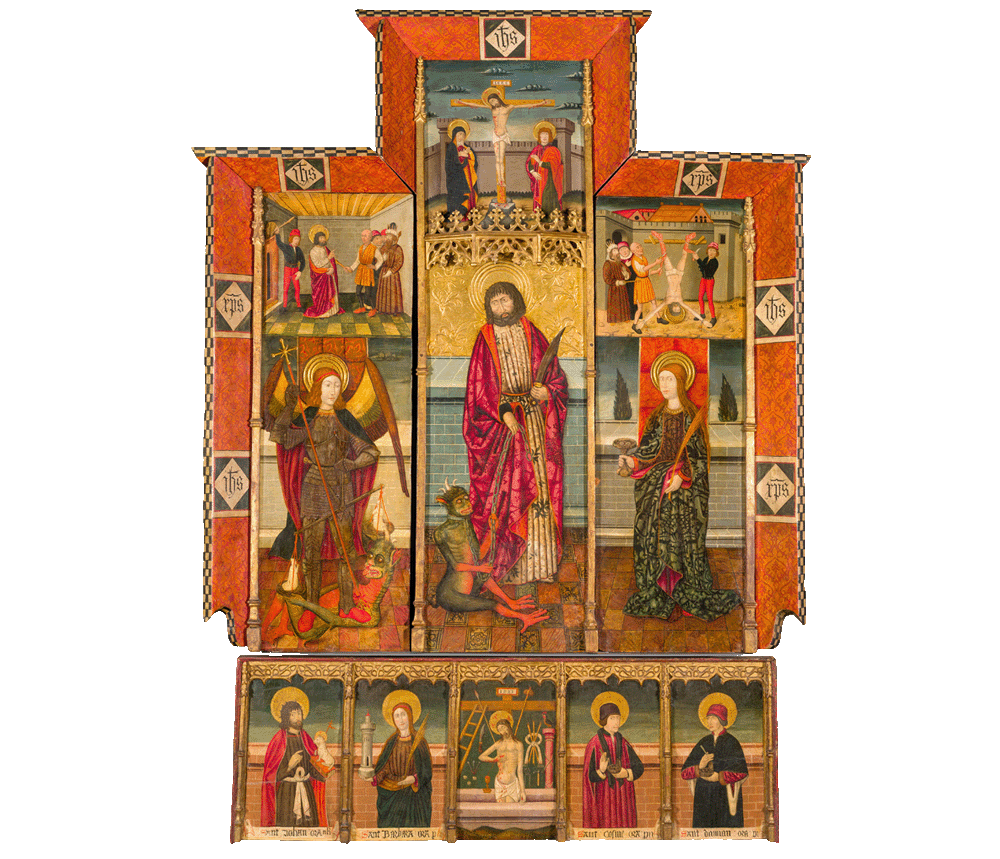
Pere Espallargues. Altarpiece of Saint Bartholomew, last quarter of the 15th century. From Capella (Huesca). Museu de Lleida (Jordi V. Pou)
Griffin
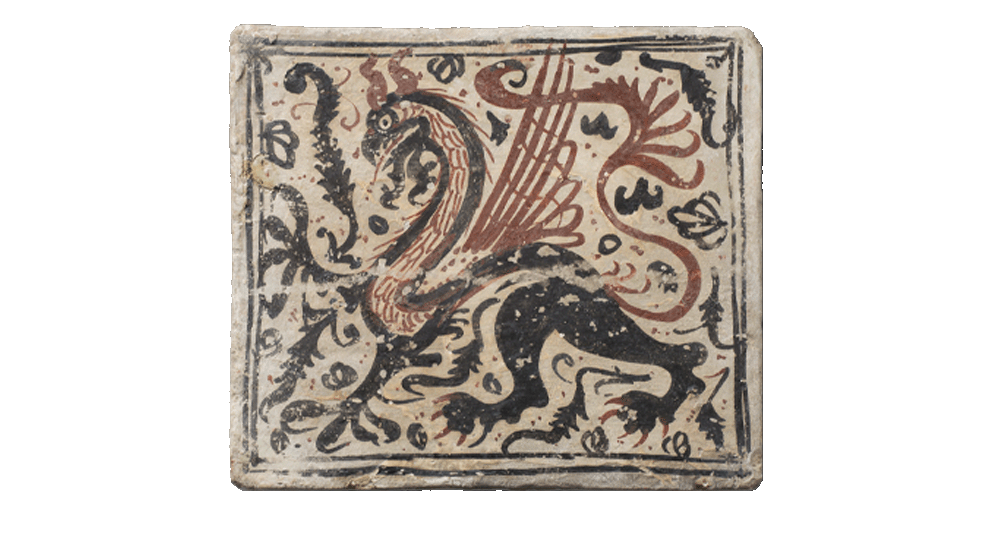
Griffin, 15th century. 32.3 x 37 x 3 cm. Socarrat, terracotta painted with iron oxide and manganese oxide. From Paterna. Disseny Hub Barcelona
Socarrats are rectangular ceramic tiles placed between the wooden beams that decorated ceilings of palaces as well as significant religious and civil buildings. Two colours, red (manganese oxide) and black (iron oxide), are applied on a white base, while the surface is left unglazed. The village of Paterna was the main focal point of the production of socarrats between the 14th and 16th centuries. The decorative motifs were typically geometric, epigraphic, heraldic, anthropomorphic, and zoomorphic, with real or fantastic animals, such as in this case: a solitary griffin. This hybrid beast, half eagle, half lion, sometimes symbolises a protector, though it can also be a representation of evil. We find its origin in the ancient civilisations of the Near East. The iconography of griffins became frequent during classical antiquity and would subsequently reach the bestiaries to become widespread among medieval artistic expressions.
Siren and grylla
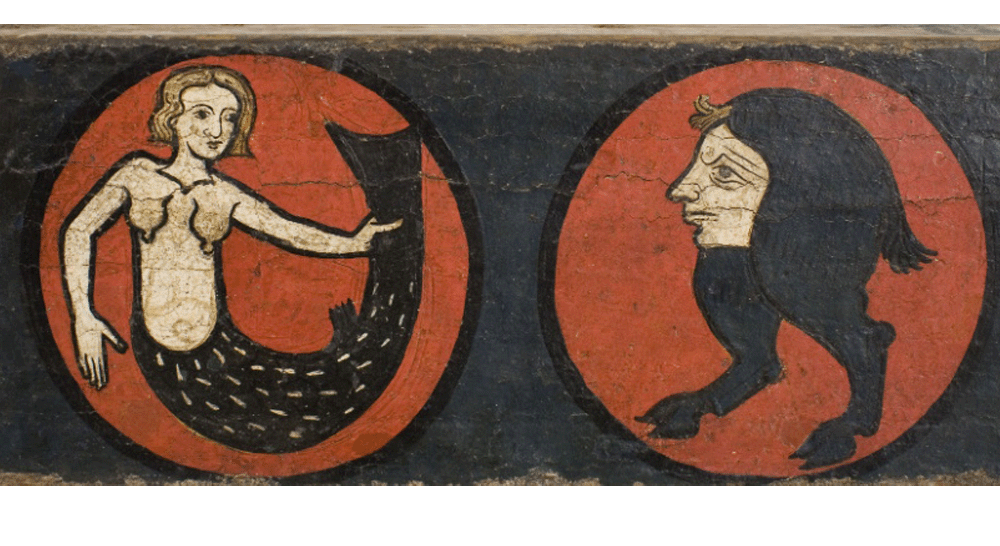
Beam of the baldachin Sant Martí de Tost, Museu Episcopal de Vic. Workshops from La Seu d’Urgell. Beam of the baldachin of Sant Martí de Tost (fragment), circa 1220. Red pine wood, tempera polychrome, stucco and remains of gilding. From the church of Sant Martí de Tost, Ribera d’Urgellet (Alt Urgell). Museu Episcopal de Vic.
The most hidden corners of religious temples, such as the gargoyles that are always out of reach, the misericords upon which the monks take their seats, or the beams of the baldachins, which is the case here, often feature imaginary or infernal beasts, critters drawn from the depths of the forest, or other hybrid creatures. Likely from an ancient origin, Greek at the very least in the case of the sirens, or from northern Europe, like this head with the legs of a hard-to-identify herbivore, this image could have reached the artist through Anglo-Saxon codices. Some viewers see the representation of the deadly sins, the symbolic struggle expressed in terms of psychomachia between animals who embody good and evil. This is likely the case, even though we have largely lost the interpretative keys. Seen from today’s perspective, this image makes us reflect on how artists were attracted to the representation of chaos and the beast that man carries inside him as one of the drivers of human creativity.
Hybrid beasts
The decorative language of the grotesque appeared in the late 15th century in Rome before sweeping over a vast part of Europe that embraced the Renaissance in the first decades of the 16th century. This rapid spread was due mostly to the vast circulation and exchange of prints by artist and artisan workshops. The seduction of a new, capricious, free, fun, and highly varied repertoire creates a new, more modern language, all’Antica, which delves into the land of the fantastic and the extravagant. The hybrid nature of architectural elements, human, animal, and plant figures along with the overflowing imagination of certain artists and artisans created a new world of imaginary beasts that would last until the Counter-Reformation aimed to put an end to it by censoring such iconographic freedom.
Everything begins in Rome
The sea bull of the Museu Episcopal de Vic is an excellent example of the hybrid beasts characteristic of the Graeco-Roman world. With the body of a bull and the tail of a serpent, and a putto or eros on its rump, this piece is a fragment of the cover of a Roman sarcophagus that likely featured the retinue of King Neptune. This iconography featuring hybrid forms of men with all types of animals originates from the civilisations of the Near East and Asian countries. The Mediterranean lands were inundated with mythological animals that have been passed down even to our present day, such as centaurs, sphinxes, minotaurs, harpies, sirens, and other impossible beasts that form part of our visual culture, from comic strips to fantasy cinema.
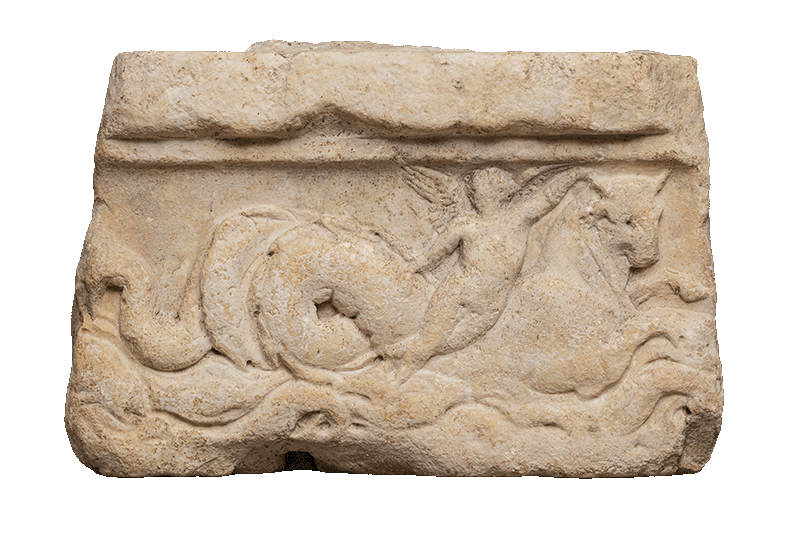
Fragment of sarcophagus cover with a sea bull, Roman Empire, second half of the 2nd century AD. Sculpted Carrara marble. Museu Episcopal de Vic
Man-eagle
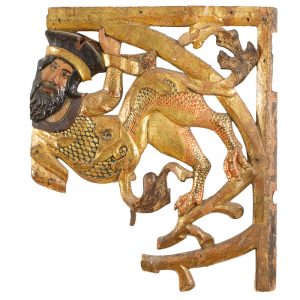
Pere Robredo. Man-eagle, dust guard from the altarpiece of Sant Feliu, 1507-1512. Polychrome wood. Museu d’Art de Girona
Pere Robredo, a sculptor originally from Burgos who settled in Girona between 1507 and 1512, created the upper part of the altarpiece of Saint Feliu, along with the dust guards. On the left side of the dust guard, we find this figure, half human, half eagle, a hybrid which, due to the time and place it was crafted, brings us closer to the iconographic repertoire of the medieval bestiary than the new language of the grotesque that started to spread to Catalonia thanks to the architectural frontispieces found in printed books. It represents the baboon, a symbol of hypocrisy, related to the lower edge of the altarpiece, far from the most important scenes dedicated to Girona’s patron saint. This is precisely where the field is left open to permissiveness and beasts may appear.
Protected by the gods
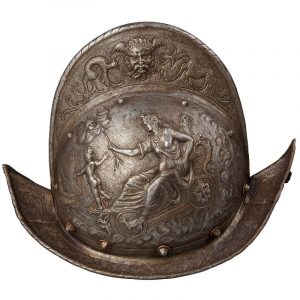
Helmet, Crested Morión, 16th-17th centuries. Iron, copper and leather. Museu Marès (MFM 4659) ©Photo: ArtWorkPhoto.eu
The morión is the iconic helmet of the Castilian Tercios, mainly arquebusiers and pikemen, which was predominant on the Iberian Peninsula in the late 16th century and throughout the 17th. Based on rank, as has occurred throughout military history since the Graeco-Roman world, the helmet was topped or adorned with zoomorphic masks and crowns, reinterpreted here with iconography and an ornamental repertoire that goldsmiths borrowed from engravings. On its crest, this morión features a bearded and winged head in relief, flanked by two monsters with limbs made of plants, elements inherent to the world of the grotesque repeated on the wheels and the figurehead of the chariot of Venus, ironically a goddess who preferred not to wage war.
Cross-border beasts
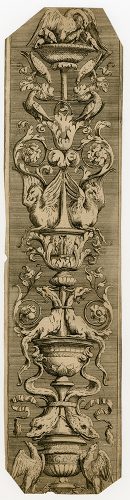
Agostino Mitelli (1609-1660), Grotesque engraving, in Freggi Dell’Architettura, 1645, Bologna. Etching. Museu Marès (MFM 11698). ©Photo: Museu Frederic Marès
Engraving was the principal means of circulating the grotesque throughout Europe and it provided decorative repertoires for all the arts. Engravers occasionally reproduced Roman frescoes, such as those of Nero’s Domus Aurea in Rome, and even contemporary murals. Agostino Mitelli was a prolific baroque painter from Bologna who engraved a small album or book of prints in 1645 entitled Freggi Dell’Architettura featuring 42 pilasters spread across 21 sheets, which is where this image comes from. These engravings reproduce the decoration that the artist himself painted for the Chiesa dei Santi Bartolomeo e Gaetano in Bologna. The print presents an architectural axis a candelieri flanked by rows of plants, garlands, and pairs of real and imaginary birds, combined with other hybrid marine and terrestrial beasts, and depicts the two laws that André Chastel establishes to define this language: “the weightlessness of the shapes and the insolent proliferation of hybrids”.
Sirens panel, circa 1748. Terracotta. From the parish church of Sant Martí de Llaneres (Castell d’Empordà). Museu d’Art de Girona
The last gasp of the Renaissance
Although the repertoire and success of the grotesque language was halted by the Counter-Reformation, which firmly opposed its decorative extravagance, the grotesque would still persist in artistic centres on the periphery and in objets d’art. This is the case of the sirens drawing inspiration from the old repertoire of engravings with stipes and caryatids typical of the 16th century. This set of polychrome tiles, held today at the Museu d’Art de Girona, formed part of the wall covering in the chapel of the Rosary of the church of Sant Martí de Llaneres. Curiously, the motif is wholly profane, with caryatids and fanciful birds appearing as if it were an altarpiece.
Glazed ceramics are one of the most notable expressions of decorative arts in Catalonia. Domestic crockery aside, the decorative panels of the 17th and 18th century, both those of a secular and religious nature, have been a defining original element of our popular culture.
Animals at the table
The desire to represent beasts has always existed. In a positive light, we have sought to depict animals, the species that have been by our side in our daily life, Earth’s other inhabitants with which we interact. We haven’t always invented them, we have observed and represented them with admiration for their shapes, gestures, beauty, or strength. In other words, we have drawn, engraved, or painted them for what they are, beyond the human values or shortcomings with which we have symbolically associated them.
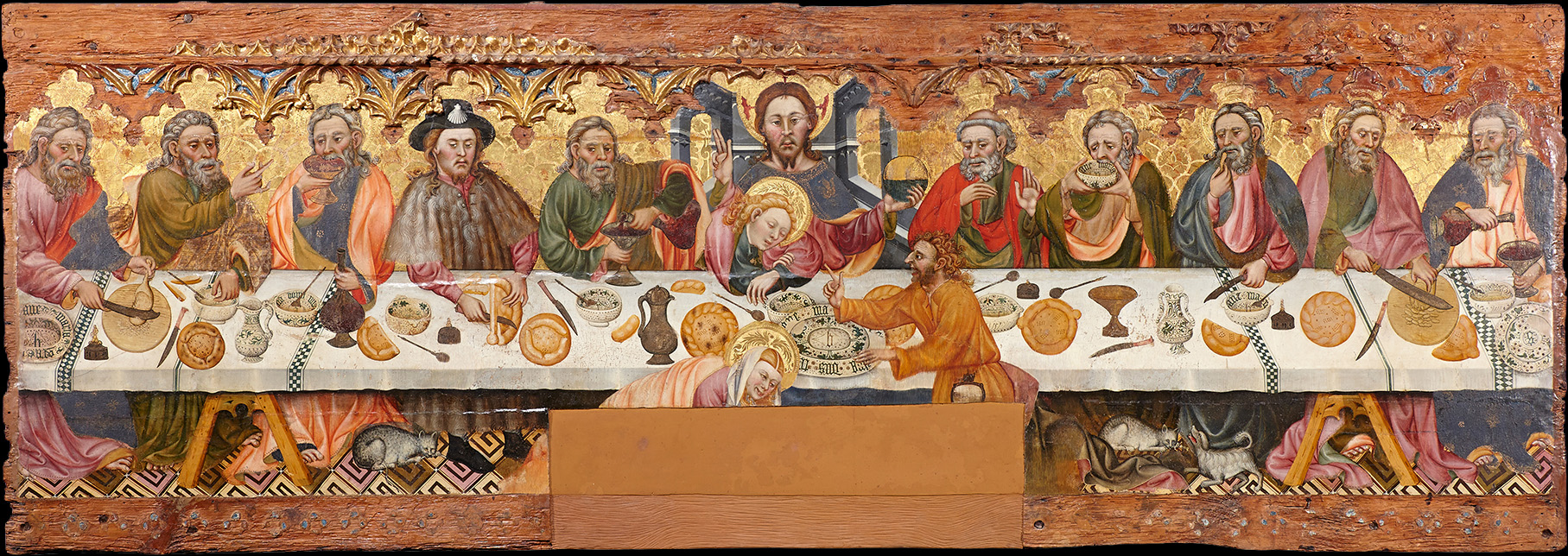
Under the table
This depiction of the Holy Supper aims to make the scene more familiar and recognisable to its contemporaries. We can see this in the utensils and food painted in great detail, typical of the tables of well-off 15th century families, such as the plates from Manises and the braziers. The impossible vantage point that makes the lower part of the table visible, a common technique in this type of work, also shows people’s feet, tunics, two cats and a dog eating the crumbs. These animals are not mentioned in the original sources, nor do they add anything to the narrative of the Holy Supper scene, but the detail and natural behaviours with which they are represented, characteristic of the Flemish style that influenced Catalan painting of the time, provide a vision of everyday life that likely managed to captivate the viewers of that era (and also those today for the very same reasons). We can’t identify their breeds, even though the dog, judging by its size, curly tail, and drooping ears, could be a precursor to spaniels, small dogs originally from the Iberian Peninsula which are highly prized for hunting rabbits and make excellent pets.
Attributed to Pere Teixidor. Altarpiece of the Holy Supper, 1435-1445. Tempera painting on wood. From the church of Santa Constança de Linya, Navès (el Solsonès) Museu Diocesà de Solsona
Wild animal
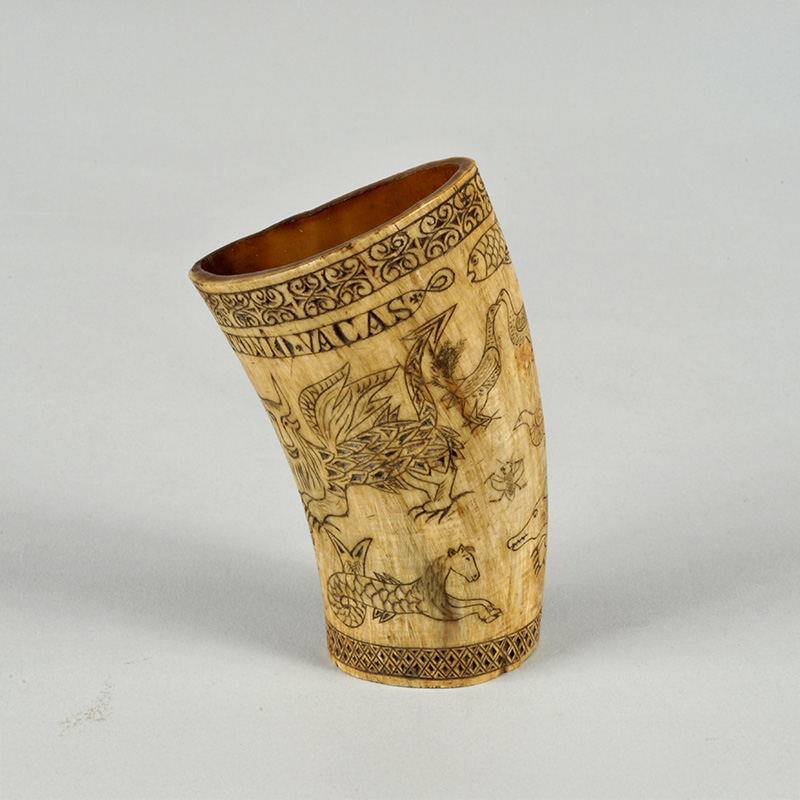
“Antonio Vacas” Cup. Horn. Museu Marès (MFM S-9514) ©Photo: Ramon Muro
Horns and antlers have had numerous uses since prehistory, as an everyday tool and in its artistic format. This cup, traditionally known as a “shepherd’s cup”, features a horror vacui decoration of birds, insects, fish, and mythical animals, such as the hippocampus, a mythological creature with the trunk of a horse and hind legs turned into a fish’s tail, known in 18th and 19th century Catalan romances as a “Wild Animal” and in the rest of the Iberian Peninsula as “Fiera Corrupia”, a fierce mangled beast. This was a variant of the Chimera, present in Ancient Greece in the 7th century BC. According to an example printed in Barcelona in 1726, the beast appeared in the city of Jerusalem and terrorised the population, devastating entire towns and eating their flocks. Throughout the 19th and the early 20th century, other romances were printed with the exact same text and different woodcut variations. This Cordel literature was the iconographic source of the cup owned by “Antonio Vacas”.
Fragile as a bird
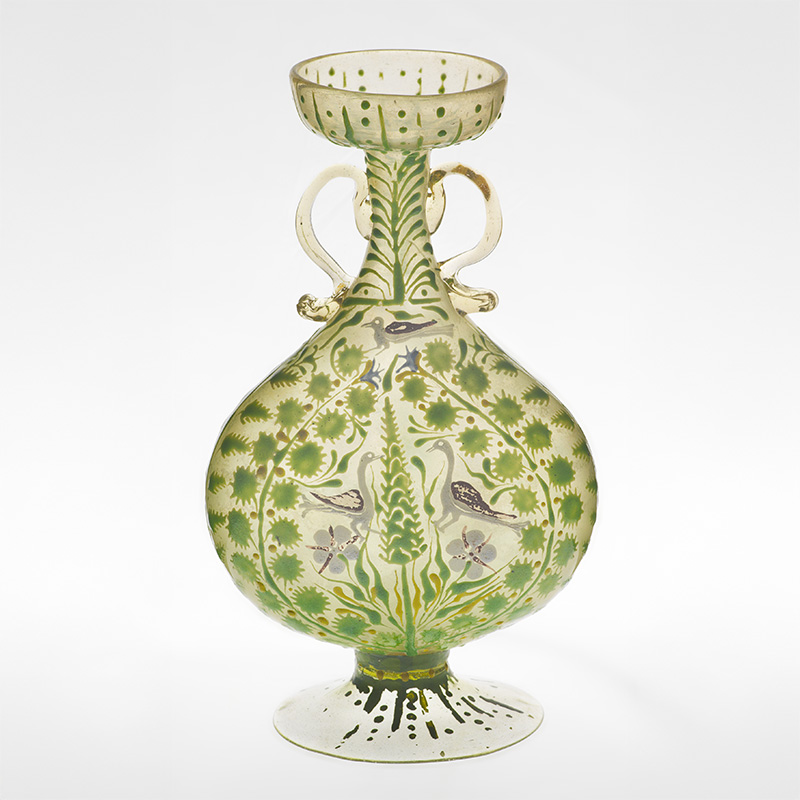
Pitcher, second half of the 16th century. Enamelled glass. Disseny Hub Barcelona (MADB 23288)
This enamelled glass pitcher produced in Catalonia was decorated with plant and animal shapes and features a characteristic green colour. Applying pigments made it possible to go beyond the shape, which is already delicate and complex, to add colour and ornamental flourishes inspired by the Moorish tradition. This pitcher depicts three birds that seem to be from the family of geese, ducks, and swans, animals that were often found on the tables of well-off families to showcase their wealth and sophistication. Already highly prized across the Europe of the time for its excellent quality, the production of enamelled Catalan glass had nothing to envy of the famous Venetian bicchieria, with which it had close contact and mutual influences. Currently, the best collection of Catalan glasswork, aside from the exhibitions in the Louvre, the Victoria & Albert Museum, and the Metropolitan Museum of Art in New York, is hidden in the vaults of the DHUB in Barcelona.
Fresh fish
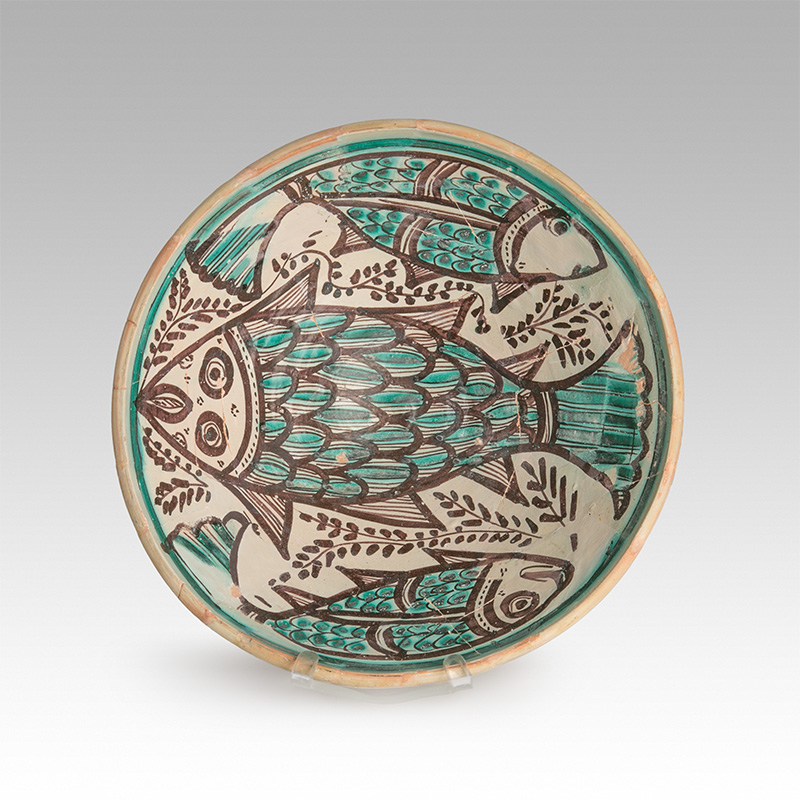
Serving platter, 1250 – 1350. Green and purple series, earthenware. From Paterna. Disseny Hub Barcelona (MCB 18776)
Whether from the east in Byzantine art passing through Italy, or perhaps from the south through Iran and the Caliphate of Cordoba, the Mediterranean ceramics tradition reached Paterna. Fish are a symbol of fertility in Islam while they represent Jesus for Christians, but they are also a typical ingredient in the cuisine of the peoples who live by the sea. In any case, the artisan who painted this piece did not limit himself to making the shape of any old fish, but rather preferred to represent a sole in the centre, clearly identified by the two eyes on the same side of its head, just like a Picassian fish avant la lettre!
Picasso devours it all
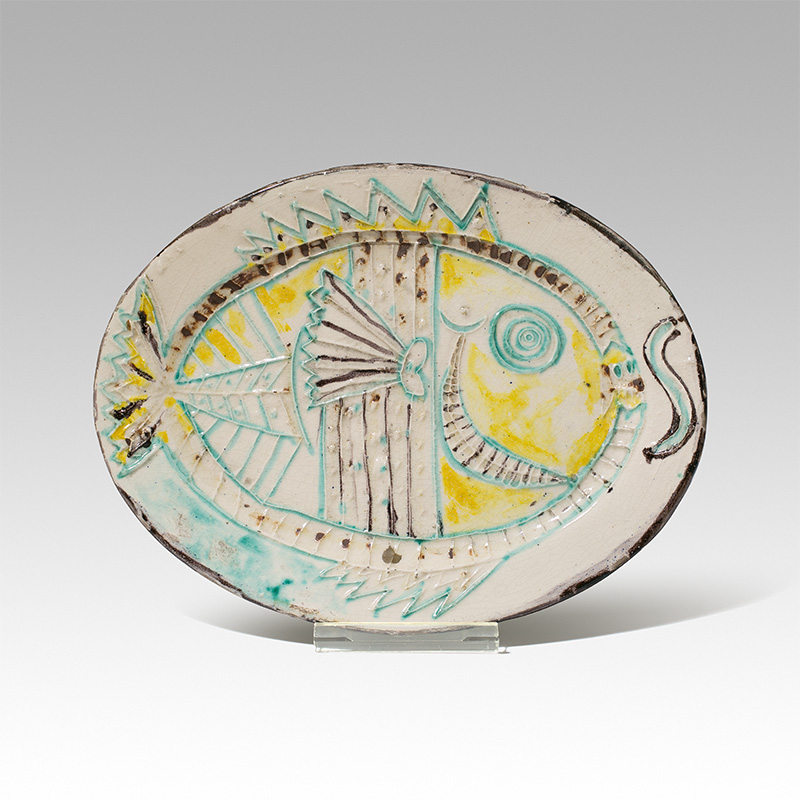
Pablo Picasso. Plate, 1948. Terracotta. Disseny Hub Barcelona (MCB 64671)
“But is it possible that they’ve done something before I did?” Picasso said, bewildered, at an exhibition of Spanish ceramics from the 13th to the 19th century held in Cannes in 1957. Later, the artist donated sixteen of his pieces to Barcelona’s museums under the condition that they be exhibited alongside the old pieces, thus highlighting the fact that the idea of fish on a plate that we have seen countless times in his ceramic pieces was very old indeed. Picasso’s voracious artistic appetite obviously gobbled up a wide variety techniques, styles, and centuries, although his work with ceramics focuses above all on engraving and glazing to decorate traditional typologies. A result of the collaboration with the Madoura Pottery workshop in Vallauris between 1947 and 1971, Picasso created around six hundred ceramic series, focusing more on production than on technical and artistic research of the artistic medium, as opposed to what Joan Miró did with the ceramic artist Josep Llorens i Artigues.
Between beasts and humans
When the beast is man or we doubt who is more of a beast, animal or man… Perhaps it is the beast who embodies the worst values of humankind. Are man and beast two antagonistic and mutually exclusive concepts? By definition, a beast is an irrational animal (those animals who do not think, or who do not think as humans do since we too are obviously animals), but it is also the animal side of man. An irrational, brutal, savage man. Or a sensitive animal, more human than humans?
Asnerías
Goya, And so was his grandfather, 1799. First edition of Los Caprichos. Aquatint. Biblioteca-Museu Víctor Balaguer
It took Goya fourteen days to withdraw the sale of his Caprichos series due to the fear of reprisals, despite his role as the king’s first court painter. They were put on sale on 6 February 1799 at a perfume and liquor store, located at 1 Desengaño Street in Madrid. Goya sought to censure “human defects and mistakes”, opening the door to the enlightened critique and artistic and thematic modernity that place him as a clear precursor of the 19th and 20th century artistic movements. Among the 80 prints of the Caprichos series, we must highlight the Asnerías, in other words, donkeys behaving like humans, and all that this entails given that the donkey is traditionally understood to be a rather unintelligent animal. Although there are different interpretations, this print is linked with Manuel Godoy, as he commissioned a family tree that made him a descendant of the Gothic kings in order to justify his rapid rise within the Spanish Court.
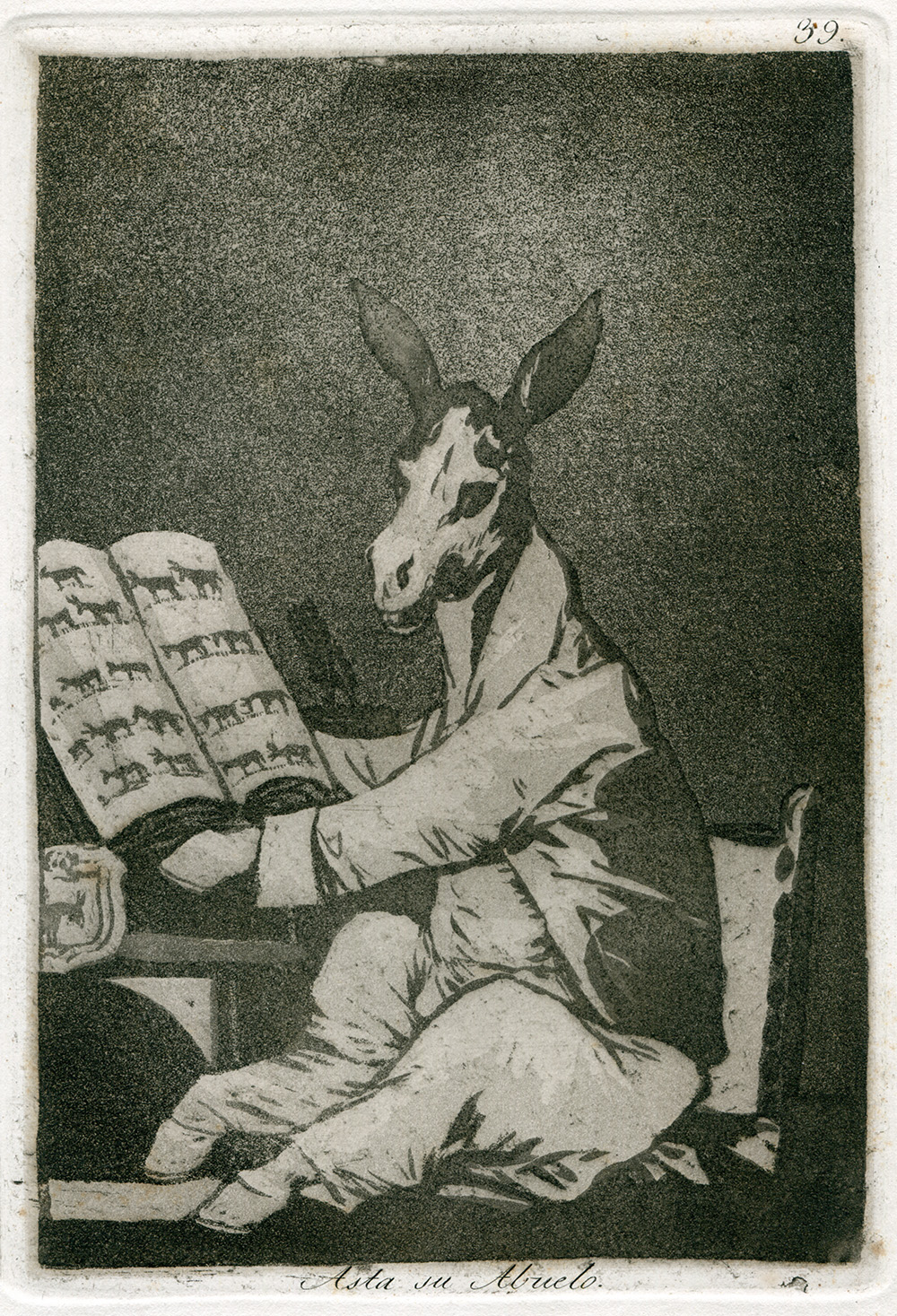
Goya, And so was his grandfather, 1799. First edition of Los Caprichos. Aquatint. Biblioteca-Museu Víctor Balaguer
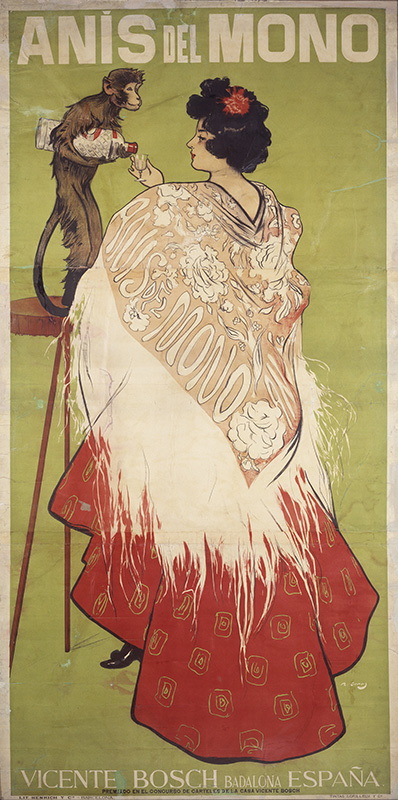
Ramon Casas, Anís del Mono (With an iron-on percale skirt), 1898. Poster, lithograph. Museu Nacional d’Art de Catalunya (CAT: 000385-C)
El Mono and la mona of Badalona (Beauty and the Beast of Badalona)
Ramon Casas is one of the few artists who had no problem at all in applying his art to the modern technique of mass image reproduction, which until then had served less than noble pursuits such as advertising for industrial products. He managed to do all this without losing even an ounce of technical or artistic quality: he is the first modern publicist from a great tradition in Catalonia, reaching the same heights as Jules Cheret, Alphonse Mucha, and Toulouse-Lautrec. In his With an iron-on percale skirt, the poster that won fourth place in the Anis del Mono contest in 1898, we can recognise what defines poster-art when we can already start to call it advertising: it features the name and icons that characterise the brand, like the monkey (the namesake Mono) and the bottle, along with the fashionably dressed attractive woman (or mona in Catalan). Here we need to note the simplicity of the piece: viewers understand the image at first glance, while the complementary colours make it stand out. We have an effective design that even today fulfils its function, ensuring that everyone remembers the brand, and what’s more, making sure that no one can separate it from its artist. And the Mono? Casas’s sense of humour includes the animal, acting almost human-like, as a natural element in the scene. Without it, the composition would lack balance and the image would be bereft of a dignified counterpoint. Brilliant!
Humanised beasts
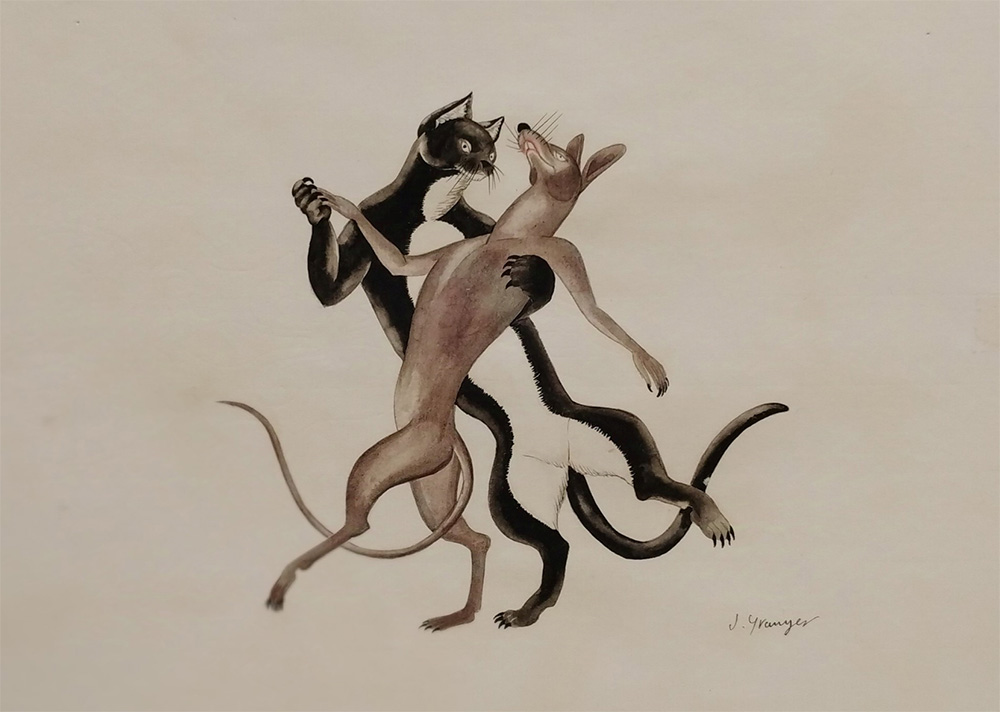
Josep Granyer Giralt. The dance of the cat and the rat, 1962. Watercolour and Chinese ink. Museu d’Art de Sabadell
Josep Granyer is the great animalier of Catalan sculpture, drawing, and engraving. After the end of the Spanish Civil War, he took a turn toward humanised fauna which, beyond surrealism, shows an ironic sense of understanding life. In the words of Daniel Giralt-Miracle, this allowed him to create a metaphorical and symbolic interpretation of mankind and its circumstances. His unmistakable bestiary illustrates editions by Ramon Llull, Cervantes, Josep Carner, and Pere Quart, while they also enliven Barcelona’s Rambla de Catalunya. He was a singular and independent artist, one who has only experienced a critical reappraisal and acclaim in recent decades and who has given us a personal, hybrid, burlesque, one could even say Granyerenca, fauna, one that does not lack in defiance.
Beast-like humans
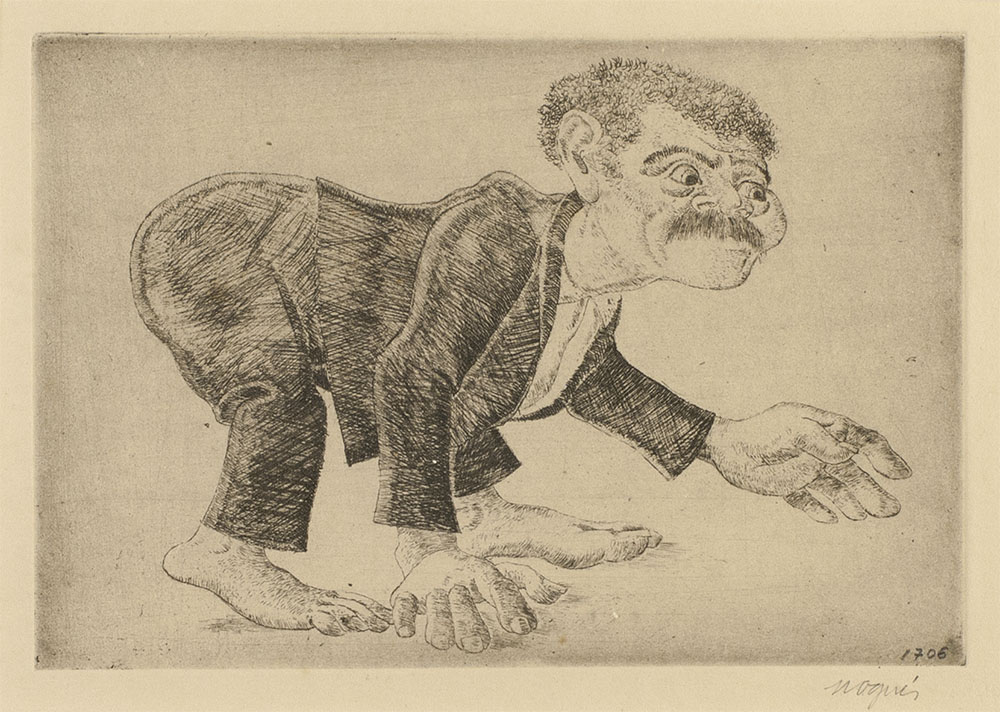
Xavier Nogués. Dog man (quadruped), 1938. Etching. Biblioteca-Museu Víctor Balagué de Vilanova (Ref. No.: G0101)
During the last years of his life, Xavier Nogués, a man who mastered different graphic techniques like none other from Catalonia, immersed himself in a scathing anti-classist critique that brings us closer to the German expressionist artists of the New Objectivity like Otto Dix and George Grosz. Unfortunately, Xavier Nogués has often been defined between a Noucentista and a cartoonist, though he greatly transcends these titles placed around him like corsets. His dog men immerse us in a not-so-subtle social critique, where Nogués, unlike Josep Granyer, turns men into beasts, the result of a profound social conscience and the highly volatile political situation during his lifetime.
Who is more evolved?
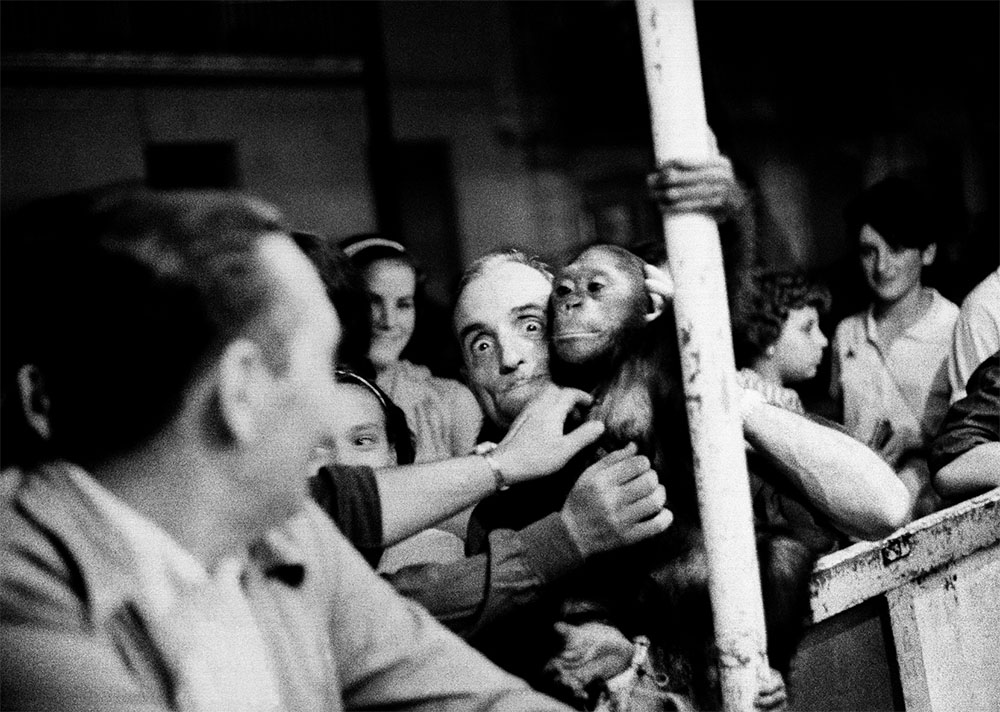
Xavier Miserachs. Barcelona, 1962. Group of people with a female monkey during the Festa Major de Sants, 1962. 1962. Original format: negative, b/w, 35 mm. Fons Xavier Miserachs. Museu d’Art Contemporani de Barcelona
The 1960s were a great time for publishing photobooks, of which Barcelona. Black and white (Aymà, 1964) is an exceptional example, a large format book with 371 photographs by Xavier Miserachs and texts by Josep Maria Espinàs. The photographer’s gaze, situated at the street level, both spontaneous and direct, represented an upheaval of Spanish documentary photographic language, which Miserachs perfected together with other professional colleagues such as Oriol Maspons, Colita, Ricard Terré and Ramon Masats, with William Klein as a reference. The series entitled Barcelona. Black and white is a photographic essay that breaks from the traditional manner of explaining the city and its people. Miserachs captured a Barcelona that was disappearing, the more working-class city, such as the one that allowed animals to be exhibited and exploited in shows and fairs. This image captures the instance in which “the monkey” expresses more humanity than the people surrounding her, who feel the need to ridicule the beast to reaffirm their own human condition.
Beasts haven’t vanished
Beasts are no longer a divine design or an iconographic fantasy, or even a real or humanised animal. Today the beasts live among us: they are the enemy, the tyrant, misery, transformation, and chaos. Art becomes criticism and questions itself through animal eyes.
Monstrous enemies
Ramón Puyol was one of the republican artists who contributed to the political consciousness of the working class with his posters. The Alarmist is the monstrous representation of those who “with their defeated shrieks seek to break the fighting spirit of the front and the rearguard”, as the text that accompanied the drawing on the definitive poster explains. This print forms part of the set of lithographs of allegorical characters: “The Pessimist”, “The Optimist”, “The Hoarder”, “The Defeatist”, “The Strategist”, “The Leftist”, “The Rumour”, and “The Spy”, critical caricatures that drew inspiration from surrealism representing the worst monsters of bourgeois society, identified as the enemy of the people and the republican cause. Renowned for the famous “No pasarán (They shall not pass)” poster, the strength of Puyol’s graphic images led him to be one of the artists selected for the Pavilion of the Republic in 1937, where he exhibited The Alarmist, together with the rest of the series. After the war, in a macabre twist of fate, he was sentenced to forced labour to restore the frescoes in El Escorial. Although he continued to work on graphical illustration and stage design, his work was forgotten over time, like many other artists linked to the republican cause
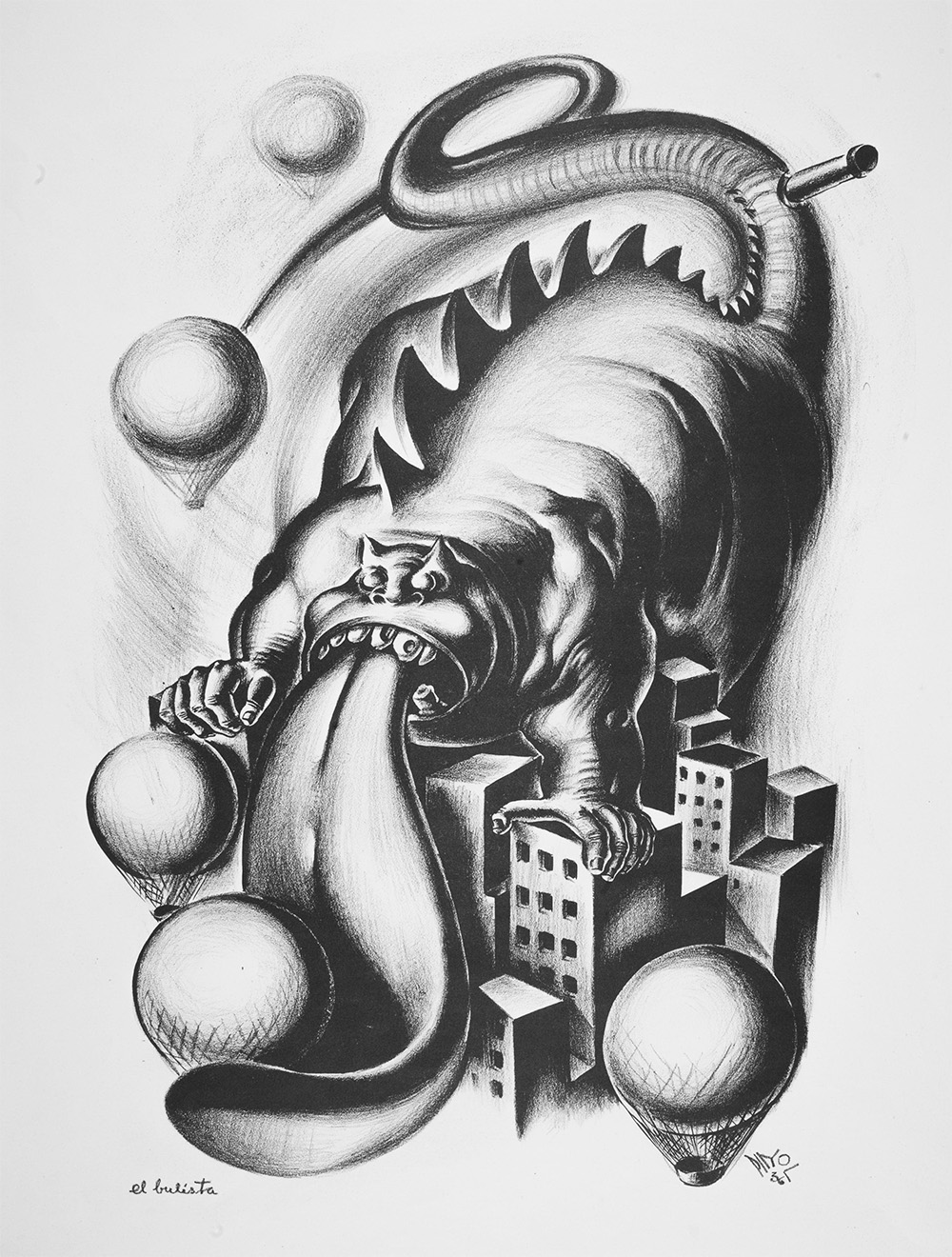
Ramón Puyol. The Alarmist, 1936. Lithograph. Museu Nacional d’Art de Catalunya (Cat. No. 128081-G)
Tyrants and other beasts
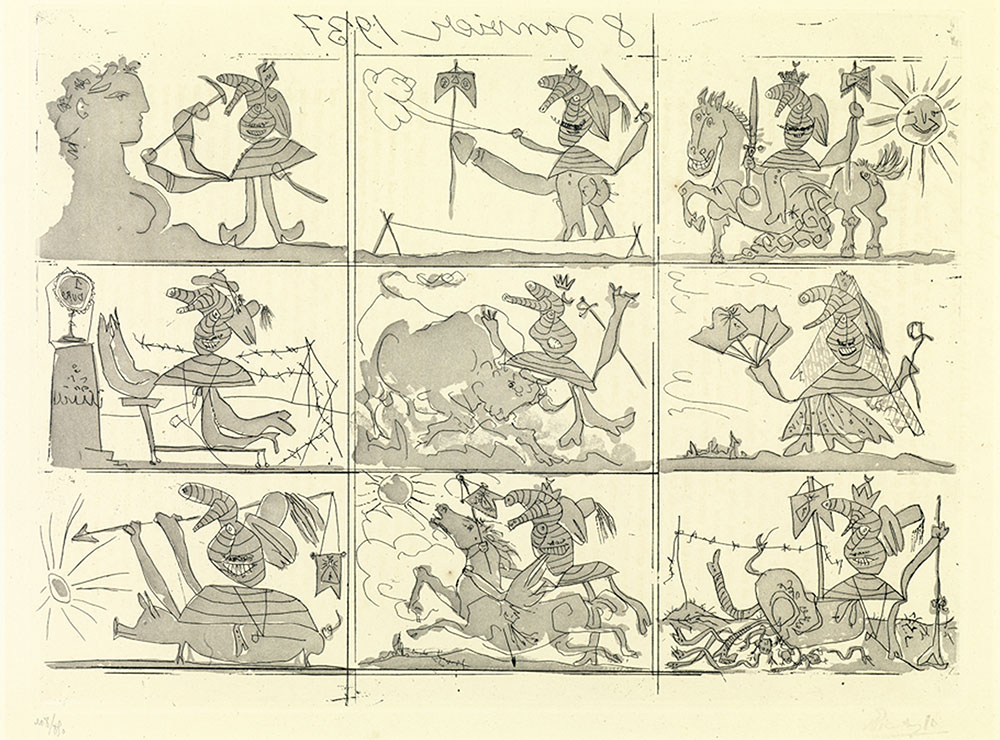
Pablo Picasso. The Dream and Lie of Franco, 1937. Etching and aquatint. Fundació Palau i Fabre, Caldetes
Picasso played every instrument and excelled in nearly all of them. Engraving was no exception, as the series entitled The Dream and Lie of Franco showed, in which he demonstrated his mastery of the etching and aquatint technique with nearly as much expressive force as Goya. For the Spanish Pavilion of the 1937 Paris International Exposition, the government of the Republic commissioned the painter to create a great canvas which would become Guernica along with a series of prints to put on sale in order to raise funds for the republican army: eighteen scenes on two strips of leather that had to be small, individual cut-out print-pamphlets, which is why there is no narrative thread in the vignettes. In them, Picasso did not hesitate to characterise Franco as a tyrannical and burlesque beast, with ridiculous costumes and disproportionate phalluses, accompanied by other symbolic beasts: a bull, which could stand for the Spanish people; a horse, representing freedom curtailed, and the pig, a grotesque riding animal. Picasso would never become as critical again as in this piece.
The hidden beast
Colita. Somorrostro, 1984. Photograph, original format, negative, b/w, 35 mm. Museu d’Art Contemporani de Barcelona (R.6346, 1963)
Dogs, horses, donkeys, and other worse beasts lived in the Barraques or shanties of Somorrostro with working class families employed by nearby factories, in terrible unsanitary conditions and dire poverty, the true hidden beast of the bourgeois city. In the 1960s, Barcelona had around 100,000 people living in slums that the Francoist city council were demolishing, transferring part of their inhabitants to government sponsored housing projects frequently with half-finished buildings. Photographers like Colita (Isabel Steva Hernández) documented this moment of change that also entailed the disappearance of entire communities, other ways of living that no longer had any place in the Barcelona of appearances. This was the case of the Gypsy community of Somorrostro, from which Carmen Amaya hailed, who was also photographed by Colita during the filming of Los Tarantos. This neighbourhood was definitively demolished in 1966, utilising the budget earmarked for a sporting event to provide space for the Passeig Marítim, the new beach, and finally the Port Olímpic. A modus operandi that bears the hallmark of the city.
Contemporary bestiary
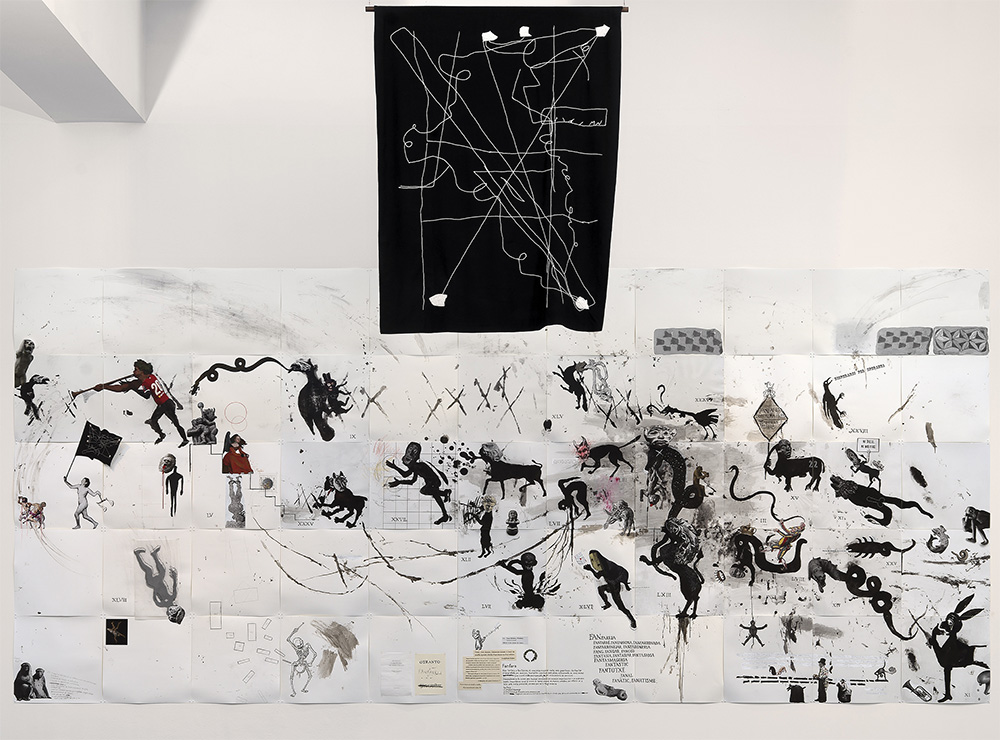
oriol vilapuig. Otranto Fanfarria, 2019-2022. Installation with different materials. MACBA © oriol vilapuig
This multifaceted piece features a collage with techniques that combine music, drawing, photocopies, text as well as a white embroidered fabric. The work depicts a kind of procession of diverse figures, often hybrids of disparate cultures and eras, accompanied by quotations that run the gamut from Shakespeare to Leonard Cohen or Kafka. These cultured references already form part of popular tradition, such as medieval bestiaries or Holbein’s Dance of Death, which are mixed with figures that resemble shadow play or characters drawn from a Miyazaki film, with a touch of Bosch and, naturally, with a hint of the excess and sense of humour of Hogarth or Goya. Certain streaks or strokes of paint are reminiscent of Tàpies, while all together the piece makes us think of the enigmatic walls of Brassaï’s Paris. Such wealth of references allows for this wide variety of approaches; we could dare call the piece a veritable and timeless contemporary bestiary.
Setxu Xirau Roig. L’ull del cabirol (“The eye of the roe deer”), 2022-23. Naturalised deer. Intervention at the Museu Nacional d’Art de Catalunya ©
The animal gaze
This is not the first time that Setxu Xirau Roig has included animals into his work, as he employs the fragile and controversial beauty of naturalised beasts (a modern term applied to dissected animals). The curious and prudent gaze of the roe deer, evidently out of place, makes us think about the meaning of art and about what a museum is, or if it even makes sense for art to be in a museum. But secondly, it forces us to ponder what meaning nature has for us, among culture, possibly the human invention that distances us the most from animals and, conversely, what it means to be an animal, a question that we ought to ask ourselves more often. We should recall John Berger*, who understood the gaze in reverse, from animal toward us, with an enormous amount of empathy:
“Each year more animals depart.
Only pets and carcasses remain,
and the carcasses
living or dead
Are from birth ineluctably and invisibly
turned into meat.
(…)
Now that they have gone
It is their endurance
we miss.
Unlike the tree,
the river or the cloud,
The animals had eyes
And in their glance
Was permanence.”
* Why Look At Animals?, Penguin Great Ideas, 2009